What Does TDS Mean in Drinking Water and Does It Matter?
When people start paying closer attention to their drinking water, one of the first terms they run into is TDS. It shows up on water test reports, filter packaging, and digital meters, often with a number that looks important but is rarely explained clearly. Understanding what TDS means in drinking water, how it affects taste and safety, and when you should actually care can help you make smarter decisions about water for your home and family.
This guide breaks down TDS in plain language. You will learn what it measures, what typical levels look like in the United States, how it connects to water quality and health, and what to do if your TDS is higher or lower than you would like. By the end, you will be able to look at a TDS number and know what it really tells you—and what it does not.
What Is TDS in Drinking Water?
TDS stands for Total Dissolved Solids. It is a measure of all the dissolved substances in water that are small enough to pass through a fine filter. These substances are usually present as ions, which means they carry an electrical charge.
TDS is typically reported in:
- Milligrams per liter (mg/L), which is the same as
- Parts per million (ppm) for most practical purposes
When you see a TDS reading of 250 ppm, it means there are about 250 milligrams of dissolved material in each liter of water.
What Makes Up TDS in Your Water?
TDS is not one single substance. It is a total of many different dissolved materials, some naturally occurring and some from human activity. Common contributors include:
Natural Minerals
- Calcium and magnesium (main minerals that cause hardness)
- Sodium and potassium
- Bicarbonates, sulfates, and chlorides
These minerals often come from rocks and soil that water passes through before it reaches your home.
Other Dissolved Substances
- Iron and manganese
- Trace metals from plumbing or natural deposits
- Low levels of organic matter
- Residual disinfectants such as chlorine byproducts
In most treated municipal water, TDS is dominated by minerals, not by harmful contaminants. However, TDS can also include substances you do not want, which is why it is useful as a general indicator.
How Is TDS Measured?
There are two main ways TDS is measured in drinking water.
Laboratory Testing
Professional labs usually measure TDS by:
- Evaporating a known volume of water
- Weighing the remaining solid residue
This method is very accurate but not practical for everyday home use.
Home TDS Meters
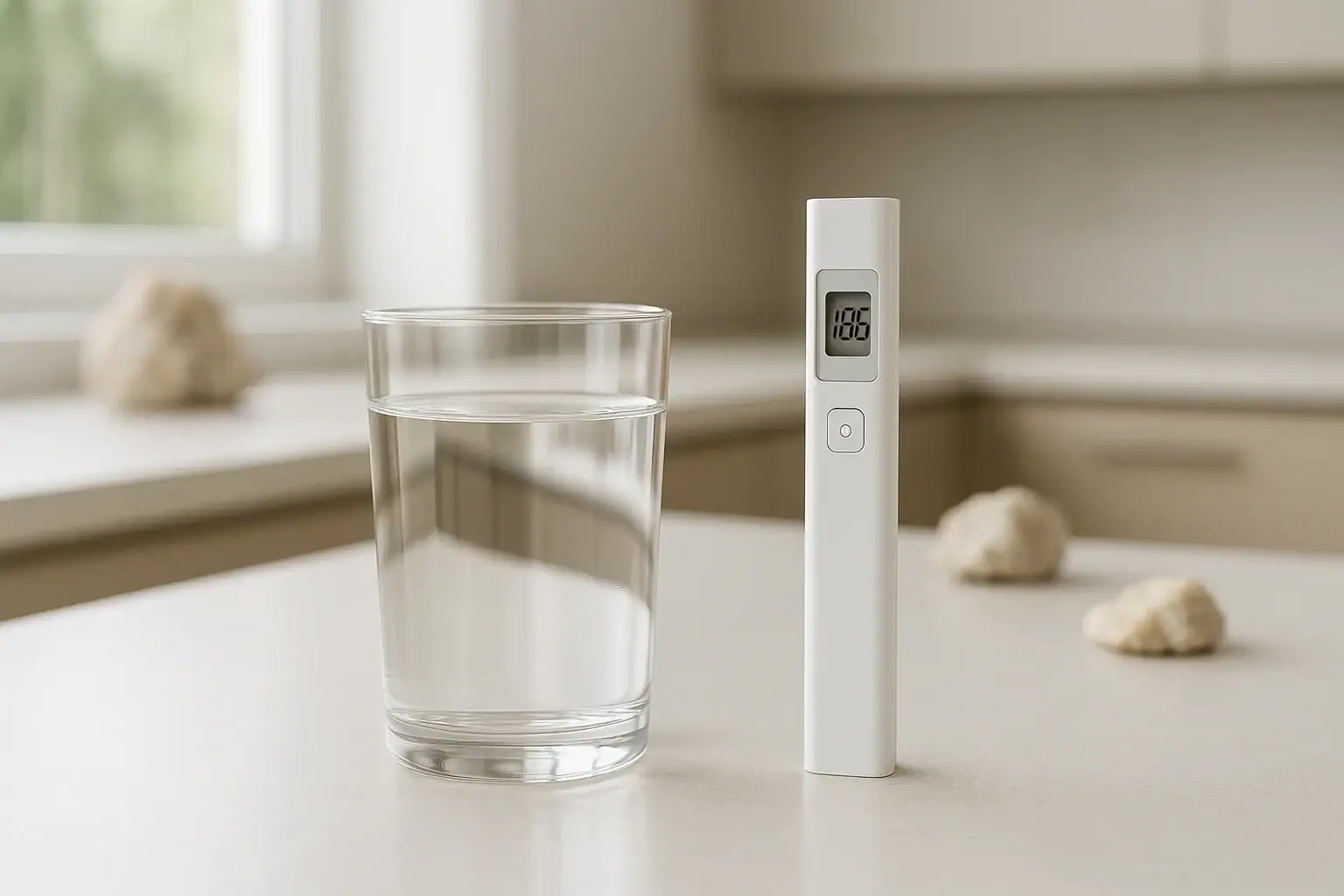
Most homeowners use a handheld TDS meter. These devices do not measure TDS directly. Instead, they measure:
- Electrical conductivity (EC) of the water
- Then convert that conductivity to an estimated TDS value
Because dissolved ions conduct electricity, higher conductivity usually means higher TDS. Home meters are not perfect, but they are useful for tracking changes, such as how well a filter is working or whether your water source has changed.
What Are Typical TDS Levels in US Drinking Water?
TDS levels vary widely across the United States depending on geology, climate, and treatment methods. As a general reference:
- 0–50 ppm: Very low mineral content, often from distilled or highly purified water
- 50–150 ppm: Low TDS, often considered fresh-tasting and light
- 150–300 ppm: Moderate TDS, common in many municipal supplies
- 300–500 ppm: Higher TDS, may taste mineral-rich or slightly salty
- 500+ ppm: Very high TDS, often from wells or hard water regions
Many public water systems in the US fall somewhere between 100 and 400 ppm. Private wells can be lower or significantly higher, depending on local conditions.
Is High TDS in Drinking Water Dangerous?
TDS by itself is not a direct measure of safety. It is a total count of dissolved material, but it does not tell you exactly what those materials are. Some key points:
- High TDS can be mostly harmless minerals, which are not a health concern for most people.
- Low TDS does not guarantee your water is free of harmful contaminants.
- Some dangerous substances (like certain chemicals or microbes) do not significantly change TDS.
In other words, TDS is a general indicator, not a full water quality test. It is most useful for tracking changes over time and for understanding taste and mineral content.
Guidelines for TDS in Drinking Water
In the United States, TDS is usually treated as an aesthetic issue rather than a strict health limit. A common guideline for public supplies is:
- 500 ppm as a recommended upper limit for TDS in drinking water
Water above this level may start to taste noticeably salty, bitter, or metallic. It may also cause more scaling on fixtures and appliances. However, many people drink water above 500 ppm without any immediate health problems, especially in areas with naturally mineral-rich water.
If your water has very high TDS, it is wise to investigate what is contributing to that number, especially if you rely on a private well that is not regularly tested.
How TDS Affects Taste and Everyday Use
While TDS is not a perfect health indicator, it has a big impact on how your water tastes and behaves in your kitchen and home.
Taste and Mouthfeel
Different TDS ranges often taste different:
- Very low TDS (0–50 ppm): Can taste flat or bland because it lacks minerals.
- Low to moderate TDS (50–200 ppm): Often described as clean, crisp, and refreshing.
- Higher TDS (200–500 ppm): Can taste mineral-rich, slightly salty, or bitter depending on which minerals dominate.
Many people prefer some minerals in their water for flavor. This is one reason why some highly purified waters are later remineralized for taste.
Impact on Coffee, Tea, and Cooking
TDS also affects how water interacts with food and beverages:
- Coffee and tea: Very low TDS water can over-extract flavors and taste harsh. Moderate TDS often produces a smoother, more balanced cup.
- Cooking: Mineral content can slightly change the texture of beans, grains, and vegetables, and can affect the way flavors develop.
- Ice: Lower TDS water tends to make clearer ice cubes with less cloudy buildup.
How TDS Relates to Hardness and Scaling
TDS and water hardness are related but not identical. Hardness mainly measures calcium and magnesium, while TDS includes those plus many other dissolved substances.
Still, in many homes:
- Higher TDS often goes hand in hand with harder water.
- Harder water is more likely to leave white scale on faucets, showerheads, kettles, and coffee makers.
- Scale buildup can shorten the life of appliances and reduce efficiency in water heaters and dishwashers.
If you see heavy scaling and also measure high TDS, it is a sign that mineral content is significant. In that case, you may want to consider treatment options for comfort and appliance protection, even if the water is otherwise safe.
Can TDS Tell You If Your Water Is Safe?
TDS can provide clues, but it cannot answer safety questions on its own.
What TDS Can Tell You
- If your water is unusually high or low in minerals compared to typical local values.
- If something has changed in your water source or treatment (sudden jump or drop in TDS).
- If a filtration system that removes minerals is still working (TDS should drop after certain filters).
What TDS Cannot Tell You
- Whether there are bacteria, viruses, or parasites present.
- Whether specific chemicals or heavy metals are within safe limits.
- Exactly which minerals or substances are causing the reading.
For real safety information, you need a more complete water test that checks for specific contaminants, especially if you use a private well or notice changes in taste, color, or odor.
What Is a Good TDS Level for Drinking Water at Home?
There is no single perfect TDS number that fits everyone, but many people find these ranges comfortable for everyday drinking:
- 50–250 ppm: Often considered a good balance of taste and mineral content.
- 250–400 ppm: Acceptable for many households, though taste may be more mineral-heavy.
- Below 50 ppm: Very pure; some people like it, others find it too flat.
Personal preference plays a big role. Some households prefer softer, lighter water, while others like the taste of more minerals. As long as your water meets safety standards, the “best” TDS is the one that tastes good to you and works well in your kitchen.
What If Your TDS Is Very High?
If a test or meter shows that your TDS is high, here are practical steps to consider.
1. Confirm the Reading
- Rinse and recalibrate your TDS meter if possible.
- Test both cold tap water and water after any filters.
- If you rely on a private well, consider a professional lab test.
2. Identify the Source
High TDS can come from:
- Natural mineral-rich groundwater.
- Salt used in water treatment or softening.
- Runoff or contamination near private wells.
- Aging plumbing that releases metals.
A detailed water test can show which minerals or substances dominate your TDS.
3. Consider Treatment Options
Depending on what is in your water, common approaches include:
- Point-of-use filters at the kitchen sink for drinking and cooking water.
- Systems that reduce hardness to limit scaling and improve feel.
- Treatment specifically targeted to any contaminants identified in testing.
It is usually not necessary to remove every mineral from your water. The goal is to reach a level that is safe, tastes good, and works well with your home systems.
What If Your TDS Is Very Low?
Some households use distilled or highly purified water with very low TDS, especially when using certain filtration systems. While this is generally safe for most healthy adults, there are a few points to keep in mind:
- Very low TDS water can taste flat or lifeless.
- Some people prefer a small amount of minerals for flavor.
- For everyday cooking and drinking, moderate mineral content is usually comfortable and familiar.
If you find your water tastes too bland after installing a strong filtration system, you can consider options that add a controlled amount of minerals back into the water to improve taste.
How to Check TDS in Your Home Water
Testing TDS at home is straightforward and inexpensive.
Using a Handheld TDS Meter
- Fill a clean glass with cold tap water.
- Turn on the meter and let it stabilize.
- Dip the probe into the water up to the indicated line.
- Wait for the reading to stabilize and note the ppm value.
- Rinse the probe with clean water and dry it.
For a more complete picture, test:
- Water before any filters.
- Water after under-sink or countertop filters.
- Water from a refrigerator dispenser, if you use it for drinking.
Professional or Lab Testing
If you have concerns about taste, odor, color, or health, consider a professional water test that includes:
- TDS and hardness.
- Metals such as lead and copper.
- Common chemicals and disinfectant byproducts.
- Microbiological testing, especially for private wells.
Choosing Water Treatment with TDS in Mind
When you understand TDS, it becomes easier to choose the right treatment for your kitchen and whole home.
Questions to Ask Yourself
- Is my main concern taste, health, or appliance protection?
- Do I want to treat all the water in my home or just the water I drink and cook with?
- Am I dealing with high TDS, low TDS, or just trying to maintain a comfortable level?
In many households, a practical approach is to:
- Use targeted treatment for drinking and cooking water in the kitchen.
- Address hardness or scaling separately if it is causing problems in bathrooms and appliances.
Key Takeaways: Does TDS in Drinking Water Really Matter?
TDS is a simple number that can tell you quite a bit about your water, as long as you understand its limits.
- TDS stands for Total Dissolved Solids and measures the total amount of dissolved material in your water.
- It is strongly connected to taste, mineral content, and scaling, but it is not a complete safety test.
- Moderate TDS levels are common in US homes and are usually comfortable for everyday drinking and cooking.
- Very high TDS is a signal to look deeper into what is in your water, especially if you use a private well.
- Very low TDS water is highly purified but may taste flat; many people prefer some minerals for flavor.
By treating TDS as one piece of the bigger water quality picture, you can make informed choices about testing, filtration, and the kind of water you want at your kitchen tap.
If you are exploring more ways to improve water and kitchen life at home, you can continue with related guides and resources at Signature Home Guide.
 Black Debris From Faucet Aerator: What It Means and How to Fix It
 Ice Maker Water Tastes Bad: Common Causes and Easy Fixes
 Dishwasher Rinse Aid Basics: What It Does and When It Actually Helps