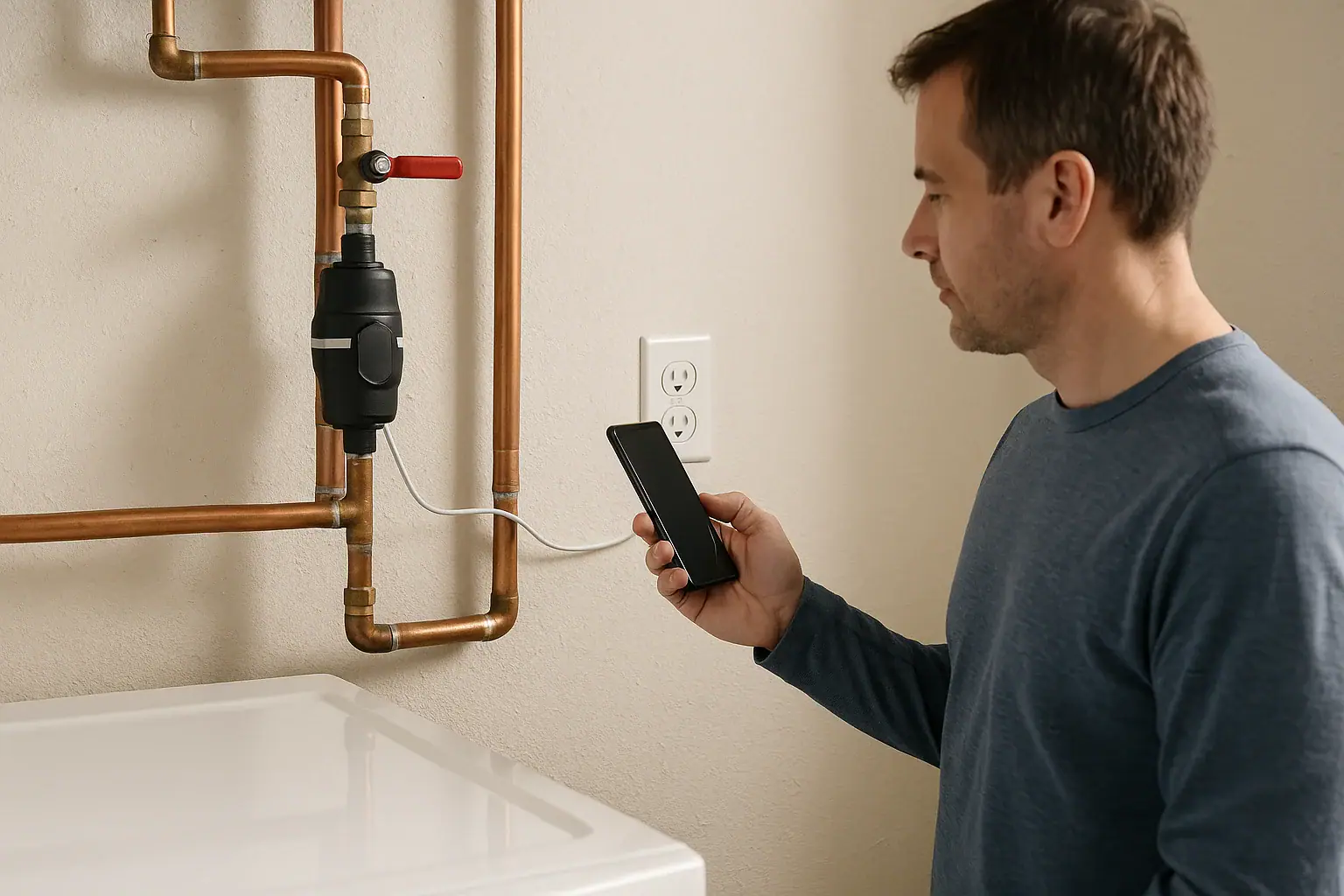
Quick answer: A standalone water alarm detects moisture only where its sensor or cable gets wet. A whole-home water leak detection system monitors water use at the meter or main supply line, or connects multiple sensors to a valve. Some systems can close a compatible valve, but coverage and outage behavior vary by model.
How a whole-home water leak detection system differs from an alarm
A water alarm and a whole-home system can both warn about water, but they work at different boundaries. A point sensor reacts after water reaches its contacts. A sensing cable reacts along its installed route. Neither device observes concealed plumbing beyond the places where it is installed.
A whole-home water leak detection system is installed at, attached to, or associated with the water meter or main supply line. Depending on the design, it may evaluate flow, pressure changes, or signals from paired moisture sensors. Some systems only send an alert. Others can operate a compatible shutoff valve to stop water downstream of that valve.
The U.S. Environmental Protection Agency’s leak detection guide distinguishes point sensors, external monitors, and point-of-entry devices. It advises buyers to check pipe size, power needs, alerts, programming options, and the relationship to fire-sprinkler piping before selecting a system.
How whole-home water leak detection systems detect problems
Point sensors and sensing cable
Point sensors use direct contact with water. Sensing cable provides direct moisture detection along the cable path. These options can identify water at a known installed location, such as beside an appliance, but they do not monitor every pipe in a home. A compatible controller and valve may allow a sensor event to trigger a shutoff.
Flow monitoring
A flow monitor observes water moving through a compatible meter or pipe location and may identify patterns that merit an alert. Its practical boundary begins at the monitoring location. Plumbing branches that split off upstream are not within that downstream monitoring boundary.
Expected water use can be relevant to a system’s settings and alerts. Before choosing a product, review its documentation for irrigation, water-treatment cycles, extended fixture use, guests, and other routine demands in the home.
Pressure monitoring
Pressure-based designs evaluate pressure changes in plumbing, sometimes together with flow information. EPA notes that pressure monitoring may help identify very small leaks. That category-level observation does not establish the sensitivity, response time, or detection capability of a particular product; those details must come from the exact model documentation.
Hybrid arrangements
A hybrid system combines main-line monitoring with point sensors or cable. The main monitor, a paired sensor, or both may participate in a shutoff decision depending on the product. Confirm that the sensors, hub, controller, and valve are listed as compatible components. An alarm and an unrelated smart valve do not automatically create an integrated shutoff system.
Water leak detection system types and dependencies
| System type | Detection and coverage | Power and connectivity | Shutoff action | Installation and testing |
|---|---|---|---|---|
| Point alarm | Direct moisture at one installed location | Battery or plug-in power varies; app use may be optional | None unless it is designed to work with a compatible valve | Follow the manual’s installation and functional-check instructions |
| Sensing cable | Direct moisture detection along the installed cable path | Battery, plug-in, hub, and app dependencies vary | Possible only with a compatible controller and valve | Inspect cable routing and test the complete alert or valve chain as directed |
| External meter or main monitor | Observes compatible downstream water use without necessarily cutting pipe | Sensor, bridge, account, and internet requirements vary | May be alert-only; confirm whether a shutoff option exists | Verify the exact meter and any utility access rules before installation |
| Inline monitor and valve | Flow, pressure, or both at a main-line location; downstream boundary depends on placement | Continuous power and online features are model-specific | May offer automatic, remote, on-device, or manual control | Pipe alteration may be subject to manufacturer instructions and local plumbing requirements; test the approved control methods |
| Sensor-driven main valve | Installed point sensors or cable signal a central controller | Sensor, controller, valve, and network dependencies vary | Closes a paired valve after a qualifying sensor event | Test sensor-to-controller-to-valve communication, not only the local alarm |
What to verify about power, internet, and physical control
Offline behavior is not a category-wide feature. Read the manual and support documents for each candidate system, separating these questions:
- Does local sensing continue during a Wi-Fi interruption?
- Can the device still make a local shutoff decision?
- Which alerts and remote controls require internet access?
- Can occupants operate the valve at the device?
- What happens after power or connectivity returns?
For example, Moen states that certain Flo Shutoff models continue monitoring and local data storage during a Wi-Fi interruption, while real-time alerts and remote control require internet access. Its support guidance also specifies 2.4 GHz Wi-Fi for setup and updates. These statements apply to the listed product support information, not to every whole-home system.
Phyn states that Phyn Plus requires always-on broadband to operate properly and does not support mobile hotspots. Its internet requirements and shutoff-control instructions describe model-specific connectivity and physical-control considerations. Compare the documentation for the exact generation under consideration.
Power requirements also differ. The cited Moen Flo installation instructions specify continuous 100–240 VAC power within the stated installation range for the covered device. Treat those installation requirements as model-specific rather than as a rule for every product.
Deciding whether automatic shutoff fits the household
Automatic shutoff may limit continued downstream flow after a system identifies a qualifying event. It does not guarantee that water damage will be prevented: water may have escaped before detection, and piping upstream of the shutoff location is outside the valve’s control.
Before selecting automatic operation, establish how the household will manage these practical questions:
- Expected demand: Review how the candidate product addresses irrigation, treatment equipment, softener cycles, and other long-running normal uses.
- Water-dependent equipment: Check relevant appliance or equipment instructions before planning for an automatic interruption while that equipment is operating.
- Shared access: Confirm who receives alerts, who can adjust settings, and who can restore water service.
- Physical access: Identify the approved on-device or manual control and make sure trusted occupants can reach it without relying on one person’s account or phone.
- Service boundary: Map any branch that occurs before the proposed monitoring or valve location.
Pre-purchase compatibility checklist
Document the actual plumbing before ordering. Photographs and model information are more useful to a manufacturer or installer than assumptions about what is behind a wall.
- Photograph the water-meter label, the existing main shutoff, exposed main pipe, nearby branches, and proposed device location.
- Record visible pipe material and marked nominal size without estimating size from outside appearance.
- Identify whether irrigation, water treatment, a softener, an outbuilding, well equipment, or other branches connect upstream or downstream of the proposed location.
- For an external meter monitor, check the exact meter against the manufacturer’s current compatibility process. Flume’s compatibility guidance, for example, directs customers to verify meter compatibility and notes that some utilities restrict access to meter boxes.
- Check the actual device location for the power source, network requirements, and physical access specified by the candidate product.
- Identify domestic-water and fire-sprinkler piping before proposing a location. Do not assume they can share an arrangement without confirmation from the relevant authority and qualified installer.
- Ask whether a proposed bypass is allowed and what monitoring or shutoff protection is lost while it is open.
- Review current privacy terms for the product’s account, device, settings, and water-use data handling. Moen’s published privacy policy is one example of why this review should be product-specific and current.
- Check the exact brand and model in current recall information before purchase and installation.
- Ask the local authority having jurisdiction about plumbing, electrical, permit, licensing, inspection, and testing requirements before altering piping.
Requirements are local. New York City’s plumbing permit information describes permits, licensed supervision, testing, and inspection for covered plumbing work there; it is an example of local oversight, not a national rule. Any utility or insurer incentive should also be checked against its current terms. For example, LADWP’s rebate program terms contain program-specific eligibility and installation conditions.
Hypothetical comparison: choosing a system boundary
Example only: Consider a city-water home with an accessible indoor main line, a separate fire-sprinkler service, irrigation and a softener downstream of the proposed device location, nearby power, and two adults who need access to controls.
An external meter monitor could offer information about compatible downstream water use without altering the indoor pipe, but the household would need to confirm meter compatibility, utility access rules, and whether the product includes any shutoff capability. An inline monitor-and-valve arrangement could add shutoff capability if the pipe, installation location, power, and local requirements are suitable. A sensor-driven valve could respond to moisture at selected locations, but it would only have direct sensor coverage where sensors or cable are installed.
In this hypothetical home, the useful decision is not which label sounds most comprehensive. It is whether automatic shutoff is needed, whether normal irrigation and softener activity can be handled according to the product documentation, and whether both adults can use the approved physical and account controls. If an irrigation branch were actually upstream of the device, that branch would sit outside the proposed downstream monitoring boundary.
Maintenance and records after installation
Use the product manual for functional checks, valve exercise instructions, firmware updates, sensor care, account recovery, and outage recovery. When the system design includes a valve, an end-to-end check should follow the manufacturer’s directions and cover the intended monitor or sensor, communication path, notification, and valve response.
Keep the model number, manual, installation details, installer contact information, permit records where applicable, and account-transfer information where other household members can find them. Update alert recipients and access arrangements when occupants, network equipment, plumbing branches, or service providers change.
For more planning on connected household devices and controls, visit the Smart Home & Safety guide.
Frequently asked questions
Does whole-home monitoring show the exact leak location?
Not necessarily. A main-line system may identify unusual flow or pressure information without identifying a particular fixture or pipe. Point sensors and sensing cable provide direct location-specific information only where they are installed.
Will automatic shutoff work without Wi-Fi?
It depends on the exact model and function. Local monitoring, valve decisions, data storage, alerts, remote controls, and physical operation can have separate dependencies. Verify each function in the current manual and support documentation.
Can an inline system monitor pipes before the valve?
Its effective boundary is determined by the installation location and plumbing layout. A pipe or branch upstream of that location is not controlled by the downstream valve, so map the main line and branches before selecting a location.
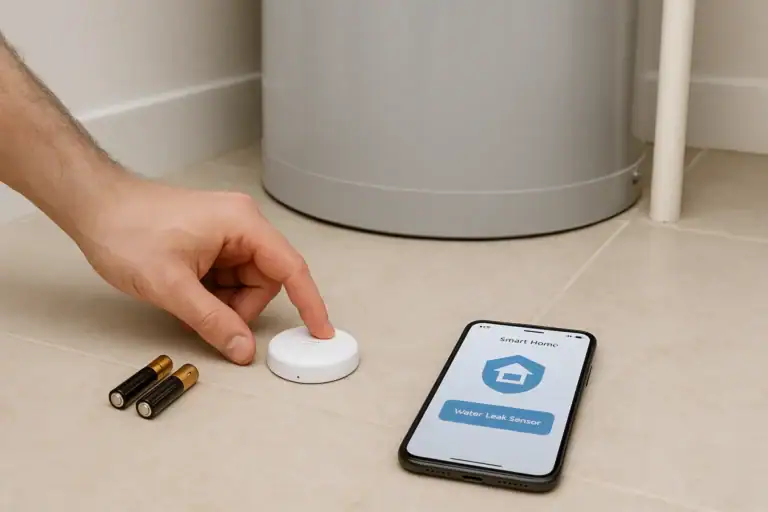 Water Leak Sensor Battery Test Schedule Checklist