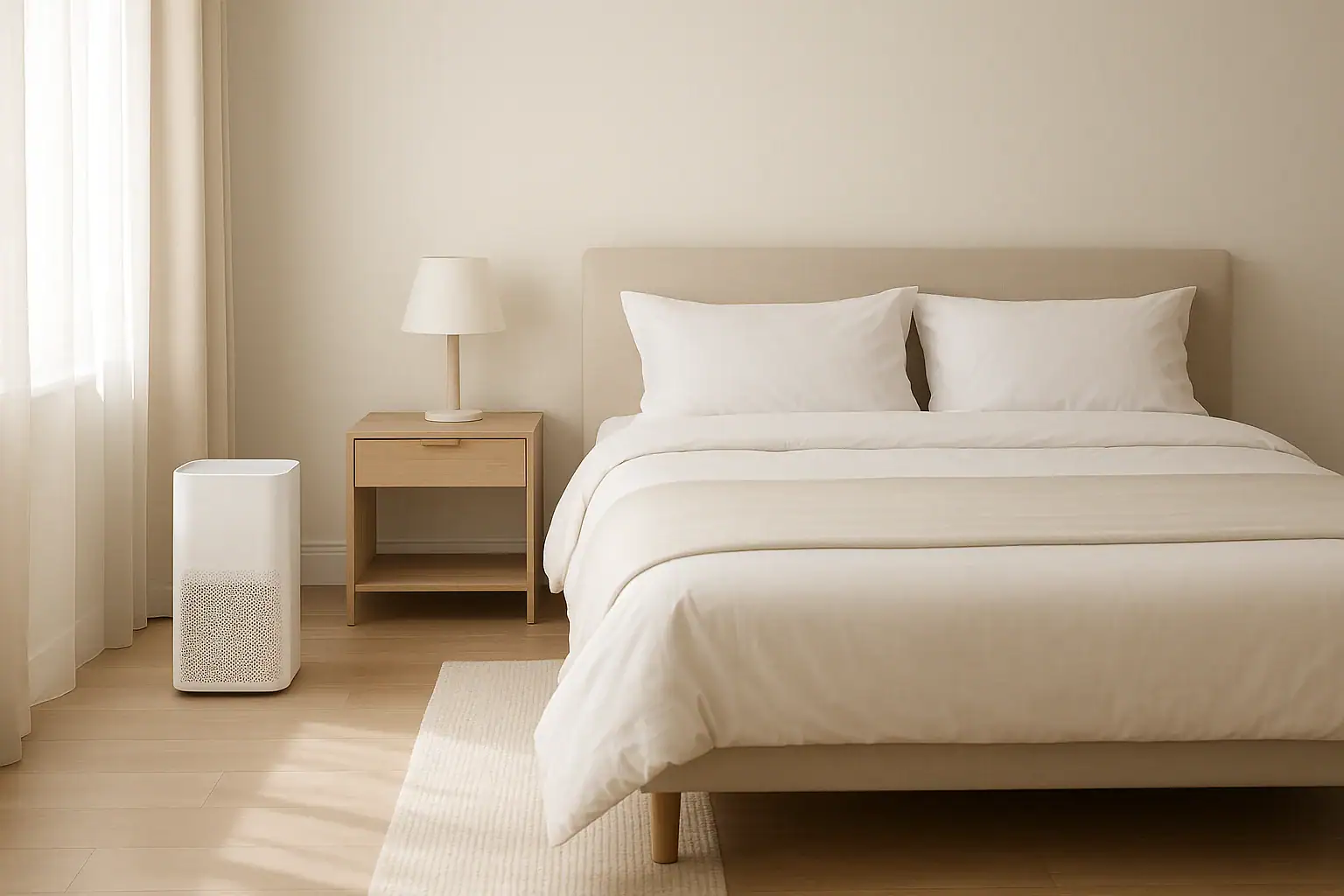
Placing an air purifier in your bedroom sounds simple: set it down, plug it in, and you are done. But where you put it can make a big difference in how quietly and effectively it cleans your air. The right placement can help reduce dust, pollen, and other airborne particles while still keeping your room calm and restful for sleep. The wrong spot can leave you with noisy airflow, annoying drafts, or a purifier that barely improves your air at all.
On this page(click to collapse)
- Why Bedroom Air Purifier Placement Matters
- The Best General Spot for a Bedroom Air Purifier
- How Far From the Bed Should Your Air Purifier Be?
- Best Height for Quiet, Effective Airflow
- Where to Avoid Putting an Air Purifier in a Bedroom
- Balancing Quiet Operation and Clean Air
- Considering Room Layout, Vents, and Windows
- Small vs. Large Bedrooms: Placement Adjustments
- Special Situations: Allergies, Pets, and Snoring
- Step-by-Step: Finding the Best Spot in Your Own Bedroom
- Safety and Maintenance Considerations
- Putting It All Together
- Related guides
This guide walks you through the best spots for an air purifier in a bedroom, how far it should be from your bed, how to avoid noisy or uncomfortable airflow, and common placement mistakes to skip. You will also learn how room size, vents, windows, and furniture layout affect performance. By the end, you will know exactly where to place your air purifier for quiet, steady airflow and cleaner air all night long.
Why Bedroom Air Purifier Placement Matters
Air purifiers work by pulling in air, filtering it, and pushing cleaner air back into the room. Placement affects how efficiently the purifier can circulate air and how comfortable that airflow feels while you sleep.
Key reasons placement is important
- Air circulation: A purifier tucked into a corner or blocked by furniture cannot pull in and push out air effectively.
- Noise and comfort: If the clean air stream blows directly on you, you may feel chilled, dried out, or notice fan noise more.
- Coverage: The farther the purifier is from the center of the room, the more likely you will have spots with less filtration.
- Safety: Poor placement can create tripping hazards with cords or block vents and outlets.
Thoughtful placement balances all three: good circulation, quiet comfort, and safe, practical positioning in your bedroom.
The Best General Spot for a Bedroom Air Purifier
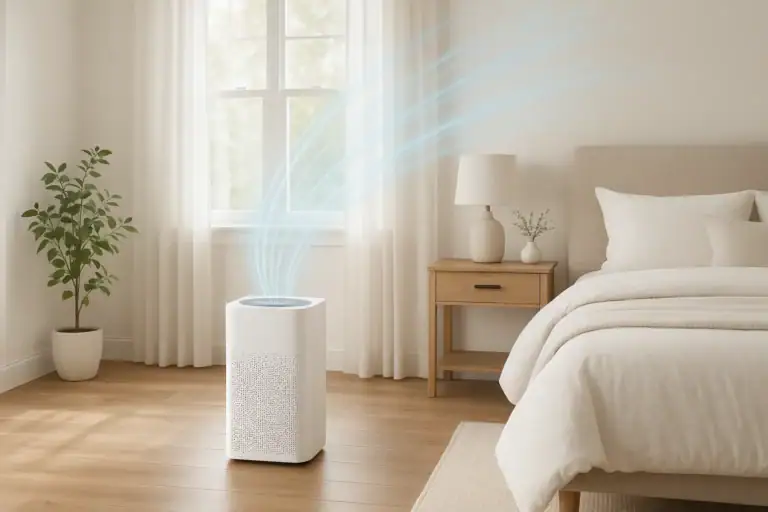
For most bedrooms, the best spot is along a side wall, a few feet from the bed, with several inches of space around the unit so air can move freely.
Ideal placement checklist
- Distance from the bed: About 3 to 8 feet from your head while sleeping.
- Wall clearance: At least 6 to 12 inches from the wall or large furniture.
- Open surroundings: Not squeezed between the bed and a dresser or inside a tight nook.
- Near the breathing zone: Roughly at mattress height or slightly higher if possible.
This layout lets the purifier pull in room air, clean it, and gently move it around without blasting you with a strong stream or creating extra noise near your ears.
How Far From the Bed Should Your Air Purifier Be?
Distance from your bed is one of the biggest factors in both comfort and perceived noise. You want clean air near your breathing zone without a fan blowing directly on your face.
Recommended distance ranges
- Minimum: 3 feet from your head or pillow
- Comfort range: 4 to 8 feet from your head
- Maximum: Up to the opposite wall, as long as the purifier is not blocked
Closer than 3 feet may feel drafty and louder, especially at higher fan speeds. Farther than 8 to 10 feet is usually fine in a small bedroom, but in a larger room you may need to increase the fan speed or adjust placement to ensure the purifier can circulate air across the entire space.
Best Height for Quiet, Effective Airflow
Height matters because many particles you care about in a bedroom, such as dust, pet dander, and skin flakes, tend to collect around bed and floor level.
Good height options
- On the floor: Works well if the intake and outlet are not blocked and the purifier is designed for floor use.
- On a low table or nightstand: Ideal when the outlet is at or slightly above mattress height.
- On a dresser: Acceptable as long as the outlet is not blowing directly at your head.
For quiet comfort, avoid placing the purifier so its outlet is exactly level with your face at close range. If you use a nightstand placement, angle the outlet away from your pillow or move the unit slightly toward the foot of the bed.
Where to Avoid Putting an Air Purifier in a Bedroom
Certain spots reduce performance or increase noise and discomfort. Avoid these common mistakes when choosing a location.
Bad placement spots
- Directly behind furniture: Do not push the purifier behind a dresser, under a desk, or into a tight corner where air cannot circulate.
- Right next to your head: A unit on the nightstand inches from your pillow can feel noisy and drafty.
- Blocked by curtains: Do not put it under long curtains or directly behind them; fabric can block intake and outlet vents.
- In a closet or under the bed: These confined spaces trap air and prevent the purifier from cleaning the whole room.
- Directly under a vent: Strong airflow from a heating or cooling vent can disrupt the purifier’s circulation pattern.
Whenever you choose a spot, imagine the purifier needs to “breathe” freely. If the intake or outlet is blocked or crowded, it will not perform at its best.
Balancing Quiet Operation and Clean Air
In a bedroom, noise level can be just as important as air quality. The closer the purifier is to you, the louder it will seem, even at the same fan speed. Smart placement can give you both quiet and effective filtration.
Tips for quieter nighttime use
- Place it across the room, angled toward the bed: This keeps the sound farther away while still circulating air toward your sleeping area.
- Use a lower fan speed at night: Run a higher speed during the day with the bedroom door closed, then switch to a lower, quieter setting before bed.
- Avoid reflective hard surfaces nearby: Position the purifier away from bare walls or corners that can bounce sound back toward you.
- Check for vibration: Place the unit on a stable, level surface so it does not rattle or hum.
Many people find a gentle fan sound soothing, almost like white noise. If you prefer near silence, prioritize distance from your head and use the lowest effective speed overnight.
Considering Room Layout, Vents, and Windows
Your bedroom’s layout, doors, vents, and windows all influence the best placement. A good rule is to think about how air naturally moves through the room and position the purifier to support that flow.
Doors and traffic paths
- Do not place the purifier where you will constantly bump into it, such as directly in front of the door or in a narrow walkway.
- If you keep the bedroom door closed at night, place the purifier inside the room, not in the hallway.
Windows and outdoor air
- If you open windows regularly, place the purifier a few feet away from the window, not directly in front of it.
- When windows are closed, move the purifier closer to the center of the room or to the side of the bed.
Heating and cooling vents
- Avoid placing the purifier directly under a ceiling vent or right in front of a floor vent where strong air currents can interfere with its airflow.
- Position it off to the side so it can work with, not against, your heating or cooling system.
Small vs. Large Bedrooms: Placement Adjustments
Room size changes how far air needs to travel and how strong your purifier’s airflow must be. Adjust placement based on whether your bedroom is compact or more spacious.
In a small bedroom
- Place the purifier along a side wall, roughly midway between the door and the bed if possible.
- Keep at least 6 to 12 inches of clearance behind and beside the unit.
- Use a low to medium fan speed at night; even at lower speeds, a small room will circulate fairly quickly.
In a large bedroom
- Place the purifier closer to where you spend the most time, usually near the bed but not directly next to your head.
- Consider a more central location along a wall or near the foot of the bed so air can circulate across the room.
- You may need a higher fan speed or a second purifier if the room is very large or has high ceilings.
Special Situations: Allergies, Pets, and Snoring
Your specific concerns can also guide where you place your air purifier. Adjust placement to match what you are trying to improve most.
If you have allergies or asthma
- Place the purifier closer to your side of the bed, about 3 to 6 feet away.
- Make sure the intake is not blocked by bedding, rugs, or piles of clothes.
- Run the purifier on a higher speed for at least an hour before bedtime with the bedroom door closed.
If you share the bed
- Place the purifier near the center of the shared sleeping area, such as near the foot of the bed or on the wall opposite the headboard.
- This helps distribute cleaner air more evenly between both sleepers.
If you have pets in the bedroom
- Place the purifier between the area where your pet sleeps and your bed, if possible.
- Keep it off the floor if your pet tends to shed heavily right next to the unit; this can help reduce fur buildup on the intake.
If you are concerned about snoring or stuffiness
- Position the purifier so the outlet gently moves air toward your upper body without blowing directly on your face.
- Experiment with a slightly higher fan speed before bed, then drop to a quieter setting once you fall asleep.
Step-by-Step: Finding the Best Spot in Your Own Bedroom
If you are unsure where to start, use this simple process to test and refine placement.
Step 1: Map your room
- Note the bed, windows, door, vents, and main walking paths.
- Look for a wall space with at least a foot of clearance around where the purifier could sit.
Step 2: Choose a starting location
- Pick a spot 4 to 8 feet from your pillow, along a side wall or near the foot of the bed.
- Ensure the intake and outlet are not blocked by furniture or curtains.
Step 3: Test daytime performance
- Run the purifier on a medium or high setting for a few hours with the bedroom door closed.
- Check for noticeable drafts, noise reflections, or hotspots of airflow.
Step 4: Test nighttime comfort
- At bedtime, switch to a low or sleep mode if available.
- Lie in bed and notice whether you feel a direct stream of air or distracting noise.
- If needed, shift the purifier a foot or two in either direction and test again.
Step 5: Recheck after a week
- Pay attention to how you feel in the morning: less congestion, fewer sneezes, or less dust on surfaces.
- If results are weak, try moving the purifier closer to the bed or to a more central location and repeat the process.
Safety and Maintenance Considerations
Once you have found a good spot, keep safety and maintenance in mind so your purifier continues to work quietly and efficiently.
Safety tips
- Keep cords away from walkways to prevent tripping.
- Do not cover the unit with clothes, blankets, or other items.
- Ensure children and pets cannot easily tip it over.
Maintenance and airflow
- Check filters regularly according to the manual and replace them on schedule.
- Wipe dust from vents and grilles so air can move freely.
- Reevaluate placement if you rearrange furniture or add large items to the room.
Putting It All Together
The best spot for an air purifier in a bedroom is usually along a side wall, a few feet from your bed, with clear space around the unit. Aim for 3 to 8 feet from your head, avoid blocking the intake and outlet, and keep the purifier away from tight corners, heavy curtains, and strong vents. Adjust distance and height to balance quiet operation with effective airflow.
By taking a few minutes to experiment with placement, you can turn your bedroom into a calmer, cleaner space with steady, quiet airflow that supports better rest. If you want to explore more ways to improve comfort and air quality throughout your home, consider reading additional guides on air and comfort topics for a complete, whole-home approach.
Related posts
Browse this topic →
Smoke and Wildfire Season: Sealing, Filtration, and Safe Ventilation at Home
Why VOC Readings Spike After Cleaning (And What To Do About It)
Air Quality Monitor Basics: PM2.5, VOC, CO2—What Numbers To Trust
CO2 Levels at Home: What’s Normal and How to Improve Ventilation
How to Use Exhaust Fans Correctly for Better Bathroom and Kitchen Airflow
Mold in the Bathroom: A Practical Humidity Control Checklist
Keep reading
About this site
Signature Home Guide publishes practical, independent home guides. We aim to be clear, helpful, and transparent.
Affiliate disclosure
As an Amazon Associate, we earn from qualifying purchases. Some links on this site may be affiliate links. If you buy through these links, we may earn a small commission at no extra cost to you. This helps support our content. Learn more.