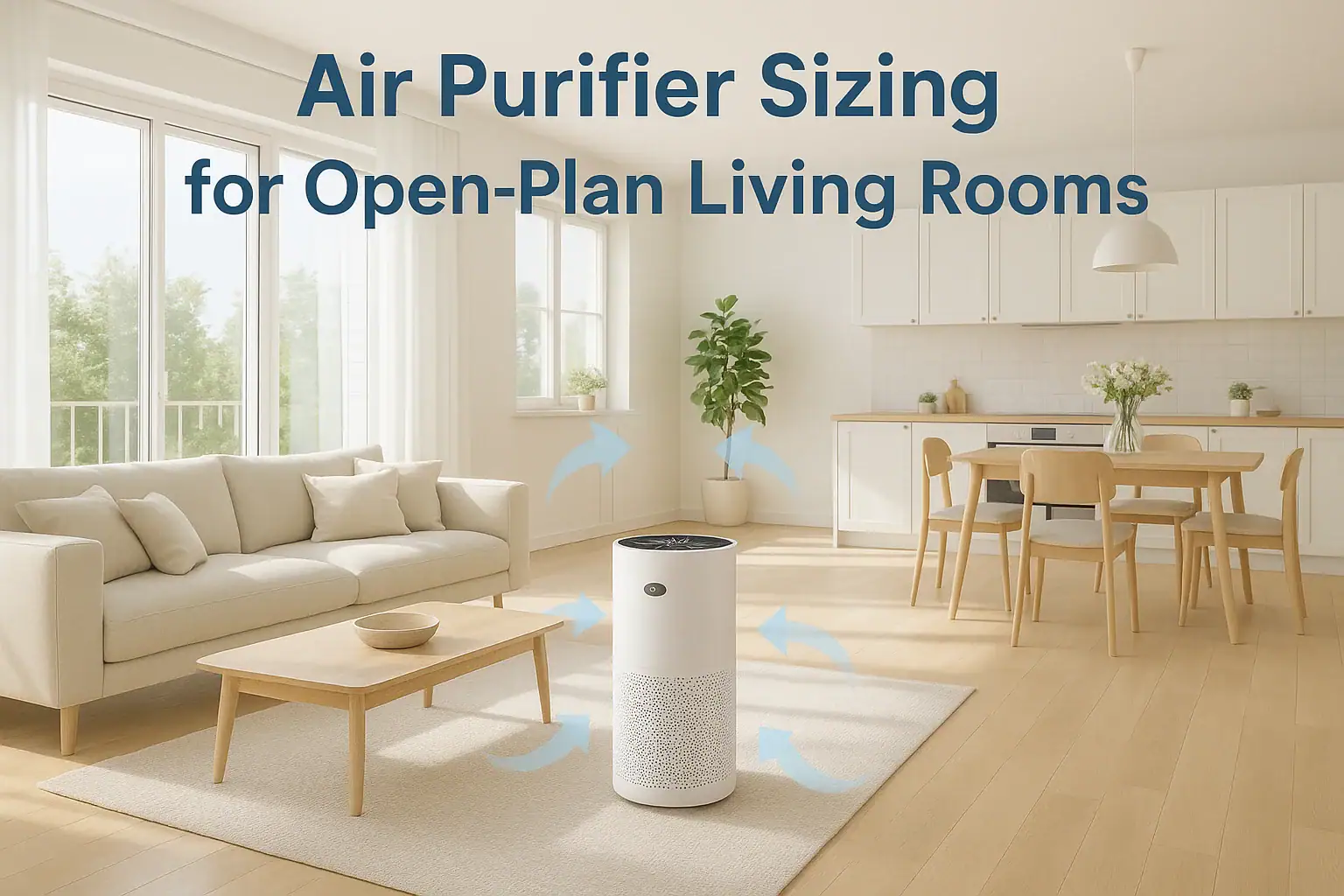
Open-plan living rooms are great for light, space, and family time, but they are challenging when it comes to cleaning the air. One small air purifier in the corner rarely keeps up with cooking fumes, pet dander, and dust drifting across a large, connected space. To get real results, you need to size your air purifier properly using two key numbers: CADR and airflow (CFM). This checklist-style guide walks you through each step so you can match the right purifier to your open-plan living room and avoid wasting money on units that are too weak for the job.
On this page(click to collapse)
- Why Open-Plan Living Rooms Need Special Sizing
- Key Terms: CADR, CFM, and ACH Explained
- Step-by-Step Checklist for Sizing an Air Purifier
- Special Considerations for Open-Plan Layouts
- Practical Placement Tips for Better Airflow
- Noise, Fan Speeds, and Real-World Performance
- Filter Types and Maintenance for Open-Plan Use
- Quick Reference: Open-Plan Living Room Sizing Examples
- Final Checklist: Choosing the Right Air Purifier for Your Space
- Related guides
Why Open-Plan Living Rooms Need Special Sizing
Most air purifier packaging assumes a simple, closed room with four walls and a door. Open-plan layouts are different. They usually combine living, dining, and kitchen zones, and sometimes connect to hallways or staircases. Air moves freely, and so do pollutants.
Common sources of indoor pollution in open spaces include:
- Cooking smoke and grease aerosols from the kitchen
- Pet dander and hair that spread across the entire level
- Dust from high-traffic areas, rugs, and soft furnishings
- Pollen and outdoor particles entering through doors and windows
- Odors from food, trash, and household activities
Because these spaces are larger and more connected, they usually need higher CADR and airflow than a typical bedroom. The goal is to clean the full volume of air several times per hour, not just the air in one corner of the room.
Key Terms: CADR, CFM, and ACH Explained
Before you start measuring and calculating, it helps to understand three basic terms used in air purifier sizing.
What Is CADR?
CADR stands for Clean Air Delivery Rate. It measures how quickly an air purifier reduces specific particles from the air. CADR is usually reported in cubic feet per minute (CFM) for three categories:
- Smoke CADR – very fine particles, similar in size to many airborne pollutants
- Dust CADR – typical household dust particles
- Pollen CADR – larger particles, often easier to filter
For general use in an open-plan living room, smoke CADR is often the most useful indicator because it reflects the purifier’s ability to handle fine particles that stay suspended in the air.
What Is CFM (Airflow)?
CFM stands for cubic feet per minute and describes how much air the purifier’s fan can move. Higher CFM means more air passes through the filters each minute. CADR is usually lower than raw CFM because it accounts for filter efficiency, but both numbers matter:
- CFM tells you how much air the unit circulates.
- CADR tells you how much clean air it delivers.
What Is ACH (Air Changes per Hour)?
ACH describes how many times per hour the purifier can clean the entire volume of air in a room. Higher ACH means faster and more thorough cleaning.
For an open-plan living room, a common target is:
- 4 ACH for general air quality improvement
- 5–6 ACH if you have allergies, asthma, or multiple pollution sources
Step-by-Step Checklist for Sizing an Air Purifier
Use this checklist to size an air purifier for your open-plan living room. Keep a tape measure, a calculator, and a notepad handy.
Step 1: Define the Actual Air Space
In an open-plan layout, you need to decide how much of the space you want the purifier to cover. Ask yourself:
- Does the living area open directly into the kitchen?
- Is there a dining area without walls between it and the living room?
- Are there open staircases or long hallways connected to the space?
Checklist:
- Identify the main zones: living, dining, kitchen, or others.
- Decide whether you want to cover all zones or just the living area.
- If the layout is very open, consider treating the entire level as one space.
Step 2: Measure Floor Area
Next, measure the length and width of the space you want to treat.
- Measure the length (in feet).
- Measure the width (in feet).
- Multiply length × width to get the floor area in square feet.
Example:
- Length: 30 feet
- Width: 20 feet
- Area: 30 × 20 = 600 square feet
Step 3: Measure Ceiling Height
Ceiling height has a big impact on the total volume of air. Higher ceilings mean more air to clean.
Checklist:
- Measure the height from floor to ceiling in feet.
- For sloped or vaulted ceilings, use the average height.
Example:
- Ceiling height: 9 feet
Step 4: Calculate Room Volume
Room volume tells you how much air is in the space.
Formula: Room volume (cubic feet) = floor area (sq ft) × ceiling height (ft)
Example using the numbers above:
- Area: 600 sq ft
- Ceiling height: 9 ft
- Volume: 600 × 9 = 5,400 cubic feet
Step 5: Choose Your Target ACH
Next, decide how aggressively you want to clean the air.
Use this quick guide:
- 3–4 ACH: light use, no major allergies, minimal pollution sources
- 4–5 ACH: typical family use, pets, moderate cooking
- 5–6 ACH: allergies, asthma, frequent cooking, or multiple pets
Checklist:
- If you have allergies or respiratory issues, aim for at least 5 ACH.
- If you cook often in the same open space, lean toward the higher end.
Step 6: Calculate Required Airflow (CFM)
Now you can calculate the airflow you need from your air purifier.
Formula:
Required CFM = (Room volume × Target ACH) ÷ 60
Using the example room (5,400 cubic feet) and a target of 5 ACH:
- Required CFM = (5,400 × 5) ÷ 60
- Required CFM = 27,000 ÷ 60
- Required CFM = 450 CFM
That means you need an air purifier, or combination of units, that can move at least 450 cubic feet of air per minute through its filters at the setting you will actually use.
Step 7: Match CADR to Your Room Size
Once you know the airflow you need, compare it to the CADR ratings listed for each purifier. For general particle control in an open-plan living room:
- Use the smoke CADR as your main reference.
- Aim for a smoke CADR that is at least two-thirds of your required CFM.
In the example above with 450 CFM required:
- Target smoke CADR: about 300 CFM or higher
Higher CADR is generally better, especially if you want faster cleanup after cooking or if you often have windows open.
Special Considerations for Open-Plan Layouts
When One Purifier Is Not Enough
In very large or irregularly shaped open spaces, a single purifier may not circulate air effectively across the entire area. Signs that you may need more than one unit include:
- Strong cooking odors lingering on one side of the room
- Visible dust buildup far from the purifier
- Air quality readings (if you use a monitor) that vary by location
Checklist for multiple units:
- Divide the open space into two or three zones by function (living, dining, kitchen).
- Size each purifier for its zone using the same volume and ACH method.
- Place units so air can circulate freely around them.
High Ceilings and Loft Spaces
High or vaulted ceilings increase room volume quickly. In these spaces:
- Use the actual average ceiling height in your volume calculation.
- Consider using ceiling fans on low settings to mix the air gently.
- Do not rely on tiny tabletop purifiers; they are rarely sized for loft-like volumes.
Connected Hallways and Stairs
Open stairways and hallways allow air to move between levels and rooms. For sizing:
- If the hallway is short and part of the same visual space, include it in your measurements.
- If stairs lead to a separate level, treat that level as a separate zone with its own purifier.
- Be realistic: it is difficult for one purifier to handle multiple floors effectively.
Practical Placement Tips for Better Airflow
Even the best-sized purifier will underperform if it is placed poorly. Use this quick placement checklist to get the most from your CADR and airflow.
- Keep clearance: Leave at least 12–18 inches of space around the intake and outlet.
- Avoid corners: Do not push the unit tightly into a corner where air cannot circulate.
- Stay away from heavy furniture: Large sofas and cabinets can block airflow.
- Near pollution sources: In open-plan layouts, placing a unit between the kitchen and living area often works well.
- Use central positions: For large rooms, a central location can help distribute clean air more evenly.
- Consider outlets and noise: Place the unit where you can plug it in safely and tolerate the sound level on the effective setting.
Noise, Fan Speeds, and Real-World Performance
Many air purifiers list impressive CADR numbers, but those ratings are often measured at the highest fan speed, which can be noisy. In real life, you might run the purifier on medium most of the time.
Checklist for realistic performance:
- Check whether CADR values are tied to specific fan speeds.
- Plan to use a speed that you can tolerate for hours at a time.
- If you know you will rarely use the highest setting, size up to compensate.
- Consider running the purifier on higher speed when you are away or during cooking, then lowering it when you are relaxing.
Filter Types and Maintenance for Open-Plan Use
Open-plan living rooms often collect more particles and odors than closed bedrooms, so filters may load up faster.
Common Filter Stages
- Pre-filter: Catches hair, lint, and larger dust; helps protect the main filter.
- Particle filter: Captures fine particles such as dust, dander, and smoke.
- Gas and odor filter: Often uses adsorbent media to reduce cooking odors and some gases.
Maintenance Checklist
- Vacuum or wash the pre-filter as recommended to keep airflow high.
- Replace the main filter on schedule, or sooner if you notice reduced airflow or persistent odors.
- Keep the intake grilles free of dust buildup.
- Track filter replacement dates on a calendar or reminder app.
Quick Reference: Open-Plan Living Room Sizing Examples
Use these simplified examples as a starting point. Always adjust for your actual measurements and needs.
Example 1: Medium Open-Plan Living Area
- Area: 500 sq ft
- Ceiling height: 8 ft
- Volume: 500 × 8 = 4,000 cubic feet
- Target ACH: 5 (allergies and a dog)
- Required CFM: (4,000 × 5) ÷ 60 ≈ 333 CFM
- Suggested smoke CADR: around 225 CFM or higher
Example 2: Large Open-Plan with High Ceilings
- Area: 800 sq ft (living, dining, and kitchen combined)
- Average ceiling height: 10 ft
- Volume: 800 × 10 = 8,000 cubic feet
- Target ACH: 4 (no major allergies, frequent cooking)
- Required CFM: (8,000 × 4) ÷ 60 ≈ 533 CFM
- Suggested approach: one large unit plus a smaller unit near the kitchen, or two mid-sized units placed in opposite zones.
Example 3: Long, Narrow Open Space
- Area: 650 sq ft (long living-dining combo)
- Ceiling height: 9 ft
- Volume: 650 × 9 = 5,850 cubic feet
- Target ACH: 4.5 (moderate allergies)
- Required CFM: (5,850 × 4.5) ÷ 60 ≈ 439 CFM
- Suggested approach: two units spaced along the length of the room to avoid dead zones.
Final Checklist: Choosing the Right Air Purifier for Your Space
Before you decide on an air purifier for your open-plan living room, run through this final checklist:
- Have you measured the length, width, and ceiling height of the area you want to treat?
- Have you calculated the total room volume in cubic feet?
- Have you chosen a target ACH based on your health needs and pollution sources?
- Have you calculated the required CFM using volume and ACH?
- Have you checked that the purifier’s smoke CADR is strong enough for your room size?
- Have you considered whether one unit or multiple units will work better for your layout?
- Have you thought about noise levels at the fan speed you will actually use?
- Do you understand the filter replacement schedule and cost?
- Have you identified a placement spot with good airflow and convenient power access?
By following this CADR and airflow checklist, you can match your air purifier to the real demands of an open-plan living room. That means cleaner air, fewer lingering odors, and a more comfortable home environment for everyone who shares the space.
For more tips on managing air quality, comfort, and ventilation throughout your home, you can explore additional resources in the air and comfort section of your favorite home guide sites.
Related posts
Browse this topic →
Smoke and Wildfire Season: Sealing, Filtration, and Safe Ventilation at Home
Why VOC Readings Spike After Cleaning (And What To Do About It)
Air Quality Monitor Basics: PM2.5, VOC, CO2—What Numbers To Trust
CO2 Levels at Home: What’s Normal and How to Improve Ventilation
How to Use Exhaust Fans Correctly for Better Bathroom and Kitchen Airflow
Mold in the Bathroom: A Practical Humidity Control Checklist
Keep reading
About this site
Signature Home Guide publishes practical, independent home guides. We aim to be clear, helpful, and transparent.
Affiliate disclosure
As an Amazon Associate, we earn from qualifying purchases. Some links on this site may be affiliate links. If you buy through these links, we may earn a small commission at no extra cost to you. This helps support our content. Learn more.