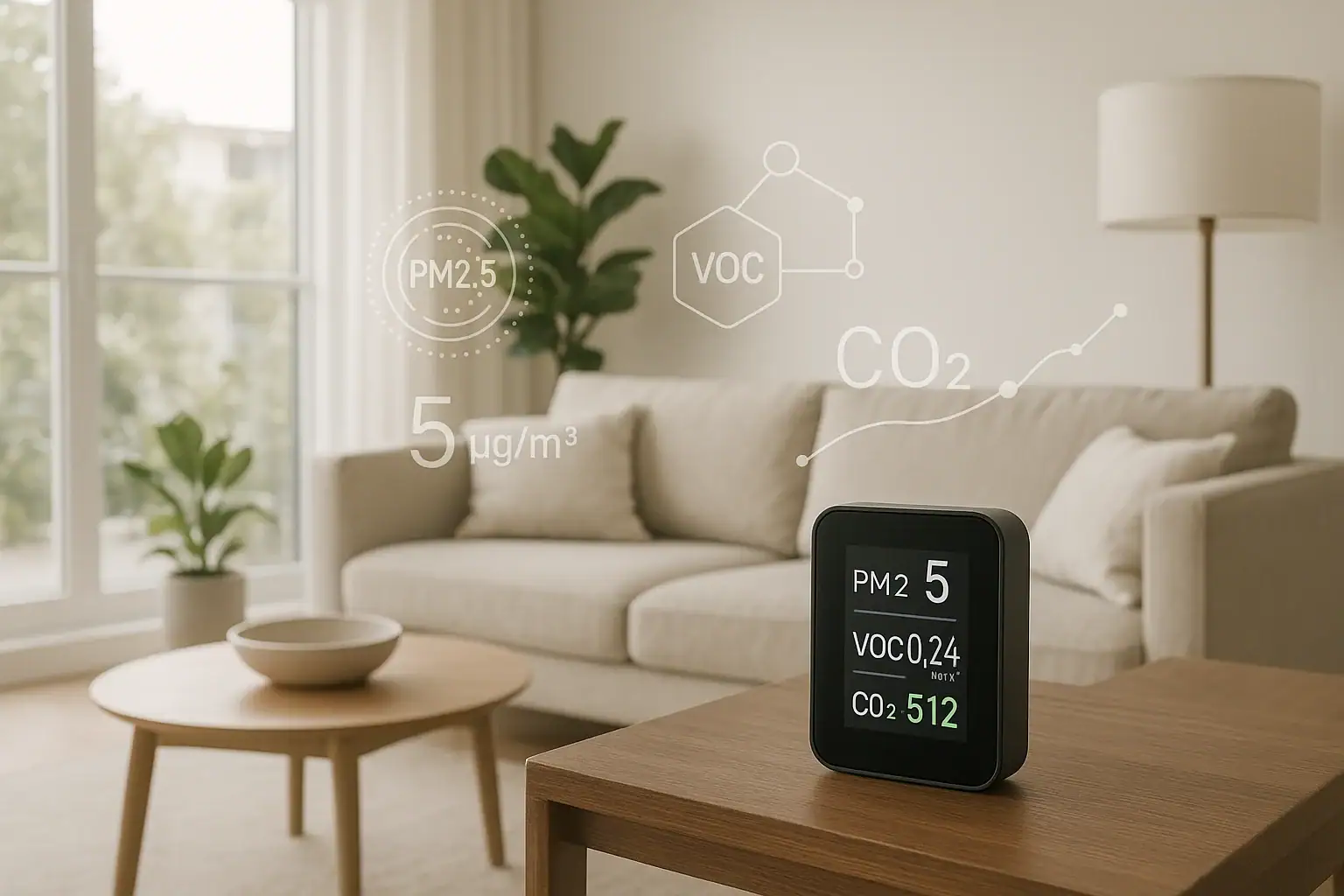
Indoor air can be several times more polluted than outdoor air, yet most of the time we cannot see, taste, or smell what is in it. That is why air quality monitors have become popular in homes and apartments across the United States. They promise to turn invisible pollution into easy-to-read numbers. But once you set one up, you might be left wondering: What do PM2.5, VOC, and CO2 actually mean, and which numbers should you really trust when you make decisions about your home?
On this page(click to collapse)
- Why Indoor Air Quality Matters
- Key Air Quality Terms You Will See on a Monitor
- PM2.5: Fine Particles You Cannot See
- VOC and TVOC: Gases and Vapors in the Air
- CO2: A Marker of Fresh Air and Ventilation
- What Numbers Should You Trust the Most?
- How to Respond to High Readings
- Tips for Getting Better Results from Your Monitor
- When to Seek Professional Help
- Bringing It All Together
- Related guides
This guide breaks down the basics in plain language. You will learn what each common air quality number represents, what typical ranges look like in a home, and how to respond when readings go up. You will also see where consumer-grade monitors are helpful, where they have limits, and how to use them as a practical tool instead of a source of anxiety. By the end, you will be able to glance at your monitor and confidently decide whether to open a window, run a filter, or simply relax and breathe easy.
Why Indoor Air Quality Matters
Indoor air quality affects comfort, focus, sleep, and long-term health. In modern, tightly sealed homes, pollutants can build up faster than they are removed, especially when windows stay closed for heating or cooling. Everyday activities add to the mix: cooking, cleaning, burning candles, using sprays, and even just breathing.
Common indoor air concerns include:
- Fine particles from cooking, smoke, and outdoor pollution that leak indoors
- Gases and vapors from building materials, furniture, cleaners, and hobbies
- Carbon dioxide from people and pets breathing in closed spaces
Air quality monitors help you see these issues in real time so you can adjust ventilation, filtration, and habits. To use them well, you need to understand the main readings they provide.
Key Air Quality Terms You Will See on a Monitor
Most home air quality monitors display at least three main types of readings:
- PM2.5: tiny particles floating in the air
- VOC or TVOC: a group of gases and vapors
- CO2: carbon dioxide from breathing and combustion
Some devices also show temperature, humidity, and sometimes other gases such as carbon monoxide or ozone. For basic home use, PM2.5, VOC, and CO2 are the core numbers to understand.
PM2.5: Fine Particles You Cannot See
PM2.5 stands for particulate matter that is 2.5 micrometers or smaller in diameter. These particles are so small that dozens could fit across the width of a human hair. Because they are tiny, they can travel deep into the lungs and even enter the bloodstream.
Common Sources of PM2.5 Indoors
In a typical US home, PM2.5 comes from:
- Cooking, especially frying, grilling, and toasting
- Smoke from fireplaces, candles, incense, and tobacco
- Outdoor pollution that leaks in through doors, windows, and cracks
- Dust that becomes airborne when you vacuum or move around
Units and Typical Ranges
PM2.5 is usually shown in micrograms per cubic meter, written as µg/m³. For everyday home monitoring, you can think of the ranges roughly like this:
- 0–12 µg/m³: Low level, generally considered good
- 13–35 µg/m³: Moderate; common while cooking or cleaning
- 36–55 µg/m³: Elevated; sensitive people may feel irritation
- Above 55 µg/m³: High; smoke or heavy cooking often involved
Short spikes during cooking are common and usually not a reason to panic, especially if they drop back down within 30 to 60 minutes after you ventilate or run a filter.
How Reliable Are PM2.5 Readings?
Most consumer monitors use optical sensors that count particles using light. They are not laboratory-grade, but they are usually good at showing trends:
- When PM2.5 goes up after frying food, the increase is real.
- If a filter or range hood is working, you should see levels fall faster.
- During wildfire smoke events, indoor PM2.5 often rises unless you seal leaks and filter the air.
The exact number may be off by some amount, but for home decisions, the direction and size of changes are what matter most.
What PM2.5 Numbers to Aim For
For everyday comfort and health, many experts suggest trying to keep long-term indoor PM2.5 levels in the low or moderate range. Practical targets include:
- Most of the day: Below about 12–15 µg/m³ when possible
- Short events: Spikes from cooking that return to low or moderate levels within an hour
If your monitor shows PM2.5 staying high for many hours, it is a sign to improve ventilation, filtration, or both.
VOC and TVOC: Gases and Vapors in the Air
VOC stands for volatile organic compounds. These are gases and vapors that easily evaporate from liquids and solids at room temperature. When a monitor shows TVOC, it means total volatile organic compounds, or a combined measurement of many different VOCs.
Where VOCs Come From in a Home
Common indoor sources include:
- Paints, finishes, and new building materials
- Furniture, carpets, and mattresses
- Cleaning sprays, disinfectants, and air fresheners
- Personal care products such as hair spray, perfume, and nail products
- Hobby supplies like glues, solvents, and markers
- Cooking, especially at high heat
Units and Typical Ranges
Home monitors usually show VOC or TVOC in parts per billion (ppb) or in milligrams per cubic meter (mg/m³). Because each monitor may use a different scale, it is best to focus on relative levels and changes rather than exact numbers.
As a rough guide for a typical home:
- Very low: Fresh outdoor air or well-ventilated spaces
- Low to moderate: Normal lived-in home without strong chemical odors
- High: After painting, using strong cleaners, or heavy use of sprays and fragrances
Limits of Consumer VOC Readings
VOC readings on home monitors have important limits:
- They usually cannot tell you which specific chemicals are present.
- They may respond to harmless alcohol vapors from hand sanitizer or cooking.
- They may drift over time and need periodic recalibration according to the manufacturer.
Because of this, treat VOC numbers as a general indicator of chemical activity in the air, not as a precise health measurement.
How to Use VOC Numbers in Daily Life
Use VOC or TVOC readings to guide simple decisions:
- If levels jump while you are cleaning, open windows or run exhaust fans.
- If readings stay higher than usual for days after painting or new furniture, add ventilation and consider using an air purifier with an appropriate filter.
- If you notice headaches or irritation when VOC readings are high, reduce use of sprays, fragrances, and strong chemicals.
Instead of chasing a perfect VOC number, aim for consistent, lower readings over time and avoid long periods of strong chemical odors indoors.
CO2: A Marker of Fresh Air and Ventilation
Carbon dioxide (CO2) is a gas we exhale every time we breathe. Outdoors, CO2 levels are typically around a few hundred parts per million. Indoors, CO2 builds up when people and pets share a space with limited fresh air coming in.
Why CO2 Matters in Homes
CO2 itself, at levels normally found in homes, is not considered a major direct health threat. However, it is a useful indicator of ventilation. Higher CO2 often means:
- Stale air and buildup of odors
- More concentrated indoor pollutants from people and activities
- Possible effects on comfort, alertness, and focus
Units and Typical Ranges
CO2 is measured in parts per million (ppm). In everyday home settings, you might see:
- Outdoor air: Often in the 400–500 ppm range
- Well-ventilated room: Commonly 600–800 ppm with people present
- Moderately stuffy room: 800–1200 ppm
- Stale, crowded room: Above 1200 ppm
These numbers are approximate, but they give a sense of when a room might need more fresh air.
How Reliable Are Home CO2 Sensors?
Many home monitors use sensors that estimate CO2 based on other gases rather than measuring it directly. These are sometimes labeled as equivalent CO2. They can be influenced by VOCs and other factors. Monitors with dedicated CO2 sensors tend to be more accurate, but all consumer devices have limits.
Again, trends are more important than exact numbers. If CO2 consistently climbs when several people are in a small room with closed windows, that is a clear sign ventilation is limited, even if the exact reading is not perfect.
CO2 Targets for Comfort
For many homes, practical goals include:
- Keeping occupied rooms roughly under 1000 ppm when possible
- Opening windows or increasing ventilation if CO2 rises well above that level for long periods
- Paying attention to how you feel: if a room feels stuffy and your monitor shows higher CO2, that is a cue to bring in fresh air
What Numbers Should You Trust the Most?
Home air quality monitors are not laboratory instruments, but they are very useful for everyday decisions when you know how to interpret them. Here is how to prioritize the main readings:
1. Trust PM2.5 for Smoke and Dust Trends
PM2.5 is generally the most actionable number for home comfort and health. Use it to:
- See how much cooking affects your air
- Track indoor levels during wildfire smoke or high outdoor pollution
- Check whether your air filter or range hood is making a difference
2. Use CO2 as a Ventilation Gauge
CO2 is a reliable way to see whether a room is getting enough fresh air for the number of people inside. If CO2 climbs and stays high, it is time to increase ventilation with open windows, exhaust fans, or a mechanical system if you have one.
3. Treat VOC as a General Warning Light
VOC or TVOC readings are less precise but still useful. When they rise sharply after using sprays, solvents, or new materials, take it as a sign to ventilate more and limit exposure. Focus on reducing strong, persistent sources rather than chasing a perfect number.
4. Focus on Patterns, Not Single Spikes
Instead of worrying about every brief spike, look for patterns:
- Do PM2.5 and VOC levels drop back to baseline after you ventilate?
- Does CO2 stay elevated in certain rooms or at certain times of day?
- Do you feel better when readings are lower and air is fresher?
Patterns over days and weeks are more meaningful than one-time peaks.
How to Respond to High Readings
When your air quality monitor shows higher numbers, you have several practical options. You do not need to use all of them every time. Choose what fits the situation.
Improve Ventilation
Ventilation brings in outdoor air to dilute indoor pollutants.
- Open windows on opposite sides of the home to create a cross-breeze when outdoor air is reasonably clean.
- Use kitchen and bathroom exhaust fans during and after cooking or showering.
- In mild weather, use window or whole-house fans to move stale air out and fresh air in.
During wildfire smoke or heavy outdoor pollution, you may need to limit outdoor air and rely more on filtration instead.
Filter the Air
Air filtration removes particles and, with the right filters, some gases.
- Run a portable air cleaner with a high-efficiency particle filter in rooms where PM2.5 is highest.
- Check and replace central heating and cooling filters on schedule.
- Consider filters designed to reduce certain gases if VOCs are a frequent issue.
Reduce Pollution at the Source
Source control often has the biggest long-term impact.
- Use the back burners and range hood when cooking, especially at high heat.
- Limit indoor burning from candles, incense, and fireplaces.
- Choose low-odor, low-emission paints and finishes when possible.
- Store strong chemicals, solvents, and fuels in a garage or shed, not in living spaces.
- Use fragrance-free or lower-emission cleaning and personal care products if VOCs are a concern.
Tips for Getting Better Results from Your Monitor
To make your air quality readings more meaningful, keep these practical tips in mind:
- Placement matters: Avoid placing the monitor directly over a stove, right next to a window, or in direct sunlight. A central location at breathing height is usually best.
- Give it time: Some monitors need a day or two to settle after first being plugged in.
- Watch the baseline: Note what your typical “good day” readings look like so you can recognize when things are off.
- Compare rooms: If you can move the monitor, check bedrooms, living areas, and the kitchen to see where air quality tends to be worse.
- Use logs or screenshots: If your monitor has an app or logging feature, review patterns over days and weeks instead of focusing on single moments.
When to Seek Professional Help
Home monitors are great for everyday awareness, but they are not a substitute for professional testing in certain situations. Consider reaching out to a qualified professional if:
- You experience ongoing respiratory symptoms, headaches, or irritation that seem linked to time spent at home.
- Your monitor shows consistently high readings for particles or VOCs even after improving ventilation and filtration.
- You suspect specific issues such as mold, combustion problems, or unusual chemical exposures.
Professionals can perform detailed testing, inspect ventilation systems, and recommend targeted fixes that go beyond what a consumer monitor can show.
Bringing It All Together
Air quality monitors turn invisible indoor pollution into visible numbers, but those numbers only help if you know how to use them. PM2.5 tells you about fine particles from smoke, cooking, and dust. VOC or TVOC readings give a general sense of chemical vapors from products and materials. CO2 offers a window into how well your space is ventilated.
You do not need to chase perfect readings or worry about every brief spike. Instead, watch for patterns, use the monitor as a guide for ventilation and filtration, and reduce pollution at the source where you can. With a basic understanding of PM2.5, VOC, and CO2, you can make simple, effective changes that help your home feel fresher and more comfortable day and night.
For more ways to improve the comfort and air in your home, you can explore additional resources on indoor air and comfort here: air and comfort hub.
Related posts
Browse this topic →
Smoke and Wildfire Season: Sealing, Filtration, and Safe Ventilation at Home
Why VOC Readings Spike After Cleaning (And What To Do About It)

CO2 Levels at Home: What’s Normal and How to Improve Ventilation
How to Use Exhaust Fans Correctly for Better Bathroom and Kitchen Airflow

Mold in the Bathroom: A Practical Humidity Control Checklist

How to Stop Condensation on Windows: Humidity and Airflow Fixes That Work
Keep reading
About this site
Signature Home Guide publishes practical, independent home guides. We aim to be clear, helpful, and transparent.
Affiliate disclosure
As an Amazon Associate, we earn from qualifying purchases. Some links on this site may be affiliate links. If you buy through these links, we may earn a small commission at no extra cost to you. This helps support our content. Learn more.