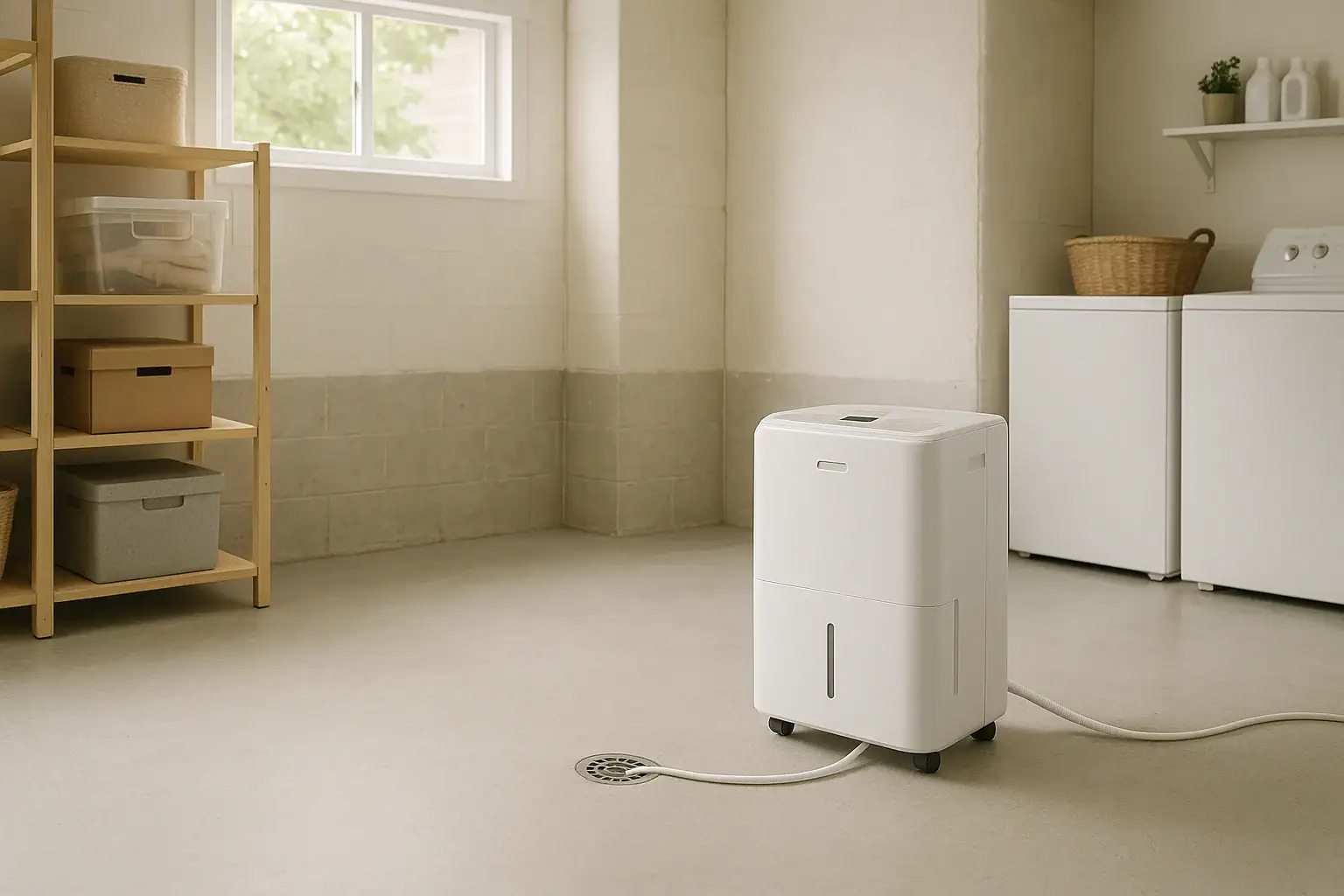
A damp basement can lead to musty odors, peeling paint, mold growth, and even damage to stored items or building materials. A well-chosen dehumidifier with a drain hose can quietly manage moisture in the background so you do not have to empty a bucket every day. This guide explains how to choose the best dehumidifier for a basement with a drain hose, how to size it correctly, and which features actually matter. You will also find best-for recommendations based on basement size, layout, and how you use the space, so you can match the right unit to your specific needs instead of guessing.
On this page(click to collapse)
- Why a Drain Hose Is Essential in a Basement
- How to Size a Dehumidifier for Your Basement
- Key Features to Look For in a Basement Dehumidifier With Drain Hose
- Best Dehumidifier With Drain Hose by Basement Type
- Setting Up a Basement Dehumidifier With a Drain Hose
- Maintenance Tips for Long-Lasting Performance
- When a Dehumidifier Is Not Enough
- Related guides
Why a Drain Hose Is Essential in a Basement
Basements tend to collect moisture from the ground, plumbing, and everyday activities such as laundry. A standard dehumidifier with only a collection bucket can fill up quickly, especially in humid climates or older homes. Once the bucket is full, the unit shuts off and humidity creeps back up.
Choosing a dehumidifier that supports continuous drainage with a hose solves this problem. Instead of emptying the bucket, you route water to a floor drain, utility sink, condensate pump, or sump pit. This keeps humidity under control with far less effort and reduces the risk of forgetting to empty the tank.
Benefits of Using a Drain Hose in the Basement
- Hands-off operation: Run the unit for weeks without emptying a bucket.
- More consistent humidity: The dehumidifier does not shut off just because the tank is full.
- Better for high-humidity areas: Ideal for coastal regions, older homes, or homes with known moisture issues.
- Safer for storage: Helps protect tools, electronics, photos, and seasonal items from moisture damage.
- Improved comfort: Lower humidity makes the space feel less clammy and can help reduce musty odors.
How to Size a Dehumidifier for Your Basement
Choosing the best dehumidifier for a basement with a drain hose starts with correct sizing. Units are typically rated by how many pints of moisture they can remove from the air per day. A unit that is too small will run constantly and still leave the space damp, while an oversized unit may short-cycle and be less efficient.
Step 1: Measure Your Basement
Measure the length and width of the basement and multiply them to get square footage. If your basement has multiple rooms or odd shapes, break it into sections and add the totals.
- Small basement: Up to about 600 square feet
- Medium basement: 600 to 1,200 square feet
- Large basement: Over 1,200 square feet
Step 2: Assess Moisture Level
Next, think about how damp the basement feels and what you see:
- Slightly damp: Occasional musty smell, minor condensation on windows
- Moderately damp: Frequent musty odor, some visible moisture on walls or floors
- Very damp or wet: Standing water after rain, visible mold patches, peeling paint or efflorescence
Step 3: Match Basement Size and Dampness to Capacity
Here is a general guide to picking capacity for a basement dehumidifier with a drain hose:
- Small, slightly damp basement: Look for a smaller-capacity unit.
- Small to medium, moderately damp basement: A mid-capacity unit is usually best.
- Medium to large, very damp basement: Choose a higher-capacity unit, possibly more than one for separate rooms.
- Very large or multi-room basement: Consider two units placed in different zones or a ducted, whole-area solution.
If you are on the fence between sizes, it is usually better to choose the larger capacity for a basement, especially if you live in a humid region or plan to finish the space.
Key Features to Look For in a Basement Dehumidifier With Drain Hose
Once you know the size you need, focus on features that matter most in a basement. The best dehumidifier for a basement with a drain hose is not just about capacity; it is about long-term reliability, convenience, and energy use.
1. Drainage Options
Not all basements have the same drainage setup, so pay attention to how the unit handles water removal.
- Gravity drain: The most common option. You connect a standard hose to the outlet and route it to a floor drain or sump. The drain point must be lower than the dehumidifier.
- Built-in pump: Some units include an internal pump that can push water up to a sink or out a window, helpful if you do not have a floor drain.
- External condensate pump: You can pair a gravity-drain unit with a separate pump if needed.
For most basements with a floor drain, a gravity drain is enough. If your drain or sink is higher than the floor, a pump becomes more important.
2. Humidistat and Adjustable Settings
A built-in humidistat lets you set a target humidity level, often between 30 and 80 percent. For most basements, a range of 45 to 55 percent is ideal. Look for:
- Clear digital display of current humidity
- Easy-to-adjust target humidity
- Automatic start and stop based on your setting
This prevents over-drying the air and helps the unit run more efficiently.
3. Auto-Restart After Power Outages
Basements can be prone to power interruptions during storms. An auto-restart feature ensures the dehumidifier turns back on with your previous settings after power is restored, so you do not have to remember to reset it.
4. Defrost and Low-Temperature Operation
Basements often stay cooler than the rest of the home. If the temperature drops too low, coils can freeze and reduce performance. Look for:
- Automatic defrost function
- Operating temperature range that includes cooler spaces, often down to the low 40s Fahrenheit
This is especially important in unheated or partially heated basements.
5. Noise Level
If your basement is used as a family room, office, or guest space, noise matters. While dehumidifiers are not silent, some are quieter than others. Check:
- Noise ratings in decibels, when available
- Low-fan or quiet modes
- User reviews that mention sound levels
For storage-only basements, noise is usually less of a concern, but you may still want to avoid very loud models if sound carries into living areas.
6. Energy Efficiency
Because basement dehumidifiers often run for long periods, efficiency affects your energy bills. Look for:
- Energy-efficient ratings or certifications
- Multiple fan speeds
- Auto mode, which adjusts operation based on humidity levels
While more efficient units can cost more upfront, they can pay off over time in lower utility costs.
7. Filter Access and Maintenance
Dehumidifiers use air filters to keep dust out of the coils. Easy filter access makes maintenance simpler.
- Washable or reusable filters reduce ongoing costs
- Front or top access is more convenient in tight spaces
- Filter reminders or indicator lights help you remember to clean them
Best Dehumidifier With Drain Hose by Basement Type
Instead of focusing on specific brands, this section breaks down the best types of dehumidifiers with drain hoses for different basement situations. Match your space to the scenario that fits you best.
Best For Small, Slightly Damp Basements
If your basement is under about 600 square feet and only occasionally feels damp, you may not need a large, heavy-duty unit. A compact dehumidifier with a gravity drain option is often enough.
Look for:
- Smaller capacity suited to your square footage
- Built-in gravity drain port for a standard garden hose
- Simple controls and a basic humidistat
- Quiet operation for multipurpose rooms
Best for: Light moisture control, finished playrooms, small home offices, or storage rooms that are not excessively damp.
Best For Medium Basements With Noticeable Dampness
For basements between about 600 and 1,200 square feet with regular musty smells, visible condensation, or damp walls, a mid-capacity dehumidifier with continuous drain is usually the best choice.
Look for:
- Mid-range capacity to handle moderate moisture
- Gravity drain with the option to add a small external pump
- Digital humidistat with clear display
- Auto-restart and auto-defrost features
- Multiple fan speeds to balance noise and performance
Best for: Partially finished basements, laundry areas, or spaces where you store sensitive items such as photos, books, or clothing.
Best For Large or Very Damp Basements
Large basements over 1,200 square feet or spaces with serious moisture issues need more robust equipment. In these cases, the best dehumidifier for a basement with a drain hose is a high-capacity or even commercial-grade unit.
Look for:
- High-capacity moisture removal rating
- Continuous drain with a reliable hose connection
- Built-in pump if your drain or sink is above floor level
- Heavy-duty construction and long-duty cycle capability
- Wide operating temperature range and strong defrost system
Best for: Very humid regions, basements with a history of water intrusion, or large storage spaces with valuable items.
Best For Finished Basements Used as Living Space
Finished basements used as family rooms, guest suites, or home theaters need moisture control and comfort. In this case, noise, appearance, and control options matter almost as much as capacity.
Look for:
- Mid to high capacity, depending on size and moisture level
- Quiet or low-noise modes
- Digital controls with precise humidity settings
- Timer functions to run more during off-peak hours
- Discreet design that blends with the room
Best for: Basements that function as everyday living areas where comfort and sound levels are important.
Best For Basements Without a Floor Drain
If your basement does not have a floor drain or nearby utility sink, a standard gravity-drain setup may not work. You will need a way to move water up and away from the unit.
Look for:
- Built-in pump capable of lifting water several feet
- Included hose or compatibility with standard tubing
- Clear instructions on maximum pumping height
- Backup bucket in case the pump fails temporarily
Best for: Basements where the only drainage options are higher than the floor, such as a sink or window drain.
Setting Up a Basement Dehumidifier With a Drain Hose
Proper setup is just as important as choosing the right unit. A poorly routed hose or bad placement can lead to leaks, noise, or poor performance.
1. Choose the Right Location
- Place the dehumidifier near the center of the area you want to treat, if possible.
- Keep at least several inches of clearance around the intake and exhaust vents.
- Avoid placing the unit directly against walls, furniture, or stored boxes.
- Position it on a level, stable surface to prevent vibration and noise.
2. Connect the Drain Hose
- Attach a standard hose to the drain outlet according to the manufacturer instructions.
- Ensure the hose slopes downward with no upward loops if you are using gravity drain.
- Route the hose to a floor drain, sump pit, or utility sink.
- Secure the hose so it cannot be kicked loose or tripped over.
3. Test the Drainage
- Turn the dehumidifier on and set it to a low target humidity to force it to run.
- Check the hose connection for leaks.
- Confirm that water flows freely to the drain after some time.
- If using a pump, test that it cycles properly and reaches the drain point.
4. Set the Target Humidity
For most basements, a target of 45 to 55 percent relative humidity balances comfort, mold prevention, and energy use. If you see signs of mold or heavy condensation, start at the lower end of that range.
Maintenance Tips for Long-Lasting Performance
The best dehumidifier for a basement with a drain hose is only as good as its maintenance. A few simple habits can extend the life of your unit and keep it working efficiently.
Clean or Replace Filters Regularly
- Check filters every one to three months, depending on dust levels.
- Wash or replace them according to the manual.
- Dirty filters reduce airflow, increase noise, and strain the compressor.
Inspect the Drain Hose
- Look for kinks, clogs, or buildup that could block water flow.
- Flush the hose occasionally with clean water.
- Ensure the hose connection remains tight and leak-free.
Check for Ice or Frost in Cool Weather
- If you notice frost on the coils, confirm that the temperature is within the operating range.
- Make sure the auto-defrost feature is working properly.
- Consider raising the basement temperature slightly in very cool seasons.
Monitor Humidity Levels
Use a separate humidity meter in addition to the built-in display. This helps you verify that the unit is performing as expected and alerts you to changes in moisture conditions.
When a Dehumidifier Is Not Enough
Even the best dehumidifier for a basement with a drain hose cannot solve every moisture problem. If you notice persistent standing water, strong mold odors, or structural damage, you may need additional solutions.
- Check gutters and downspouts to ensure water is directed away from the foundation.
- Inspect for plumbing leaks or seepage through walls and floors.
- Consider sealing cracks or adding interior or exterior drainage systems.
- Use fans or improved ventilation along with dehumidification.
Addressing the source of water, combined with the right dehumidifier and drain hose setup, offers the best long-term protection for your basement and everything stored in it.
Related posts
Browse this topic →
Smoke and Wildfire Season: Sealing, Filtration, and Safe Ventilation at Home
Why VOC Readings Spike After Cleaning (And What To Do About It)
Air Quality Monitor Basics: PM2.5, VOC, CO2—What Numbers To Trust
CO2 Levels at Home: What’s Normal and How to Improve Ventilation
How to Use Exhaust Fans Correctly for Better Bathroom and Kitchen Airflow
Mold in the Bathroom: A Practical Humidity Control Checklist
Keep reading

About this site
Signature Home Guide publishes practical, independent home guides. We aim to be clear, helpful, and transparent.
Affiliate disclosure
As an Amazon Associate, we earn from qualifying purchases. Some links on this site may be affiliate links. If you buy through these links, we may earn a small commission at no extra cost to you. This helps support our content. Learn more.