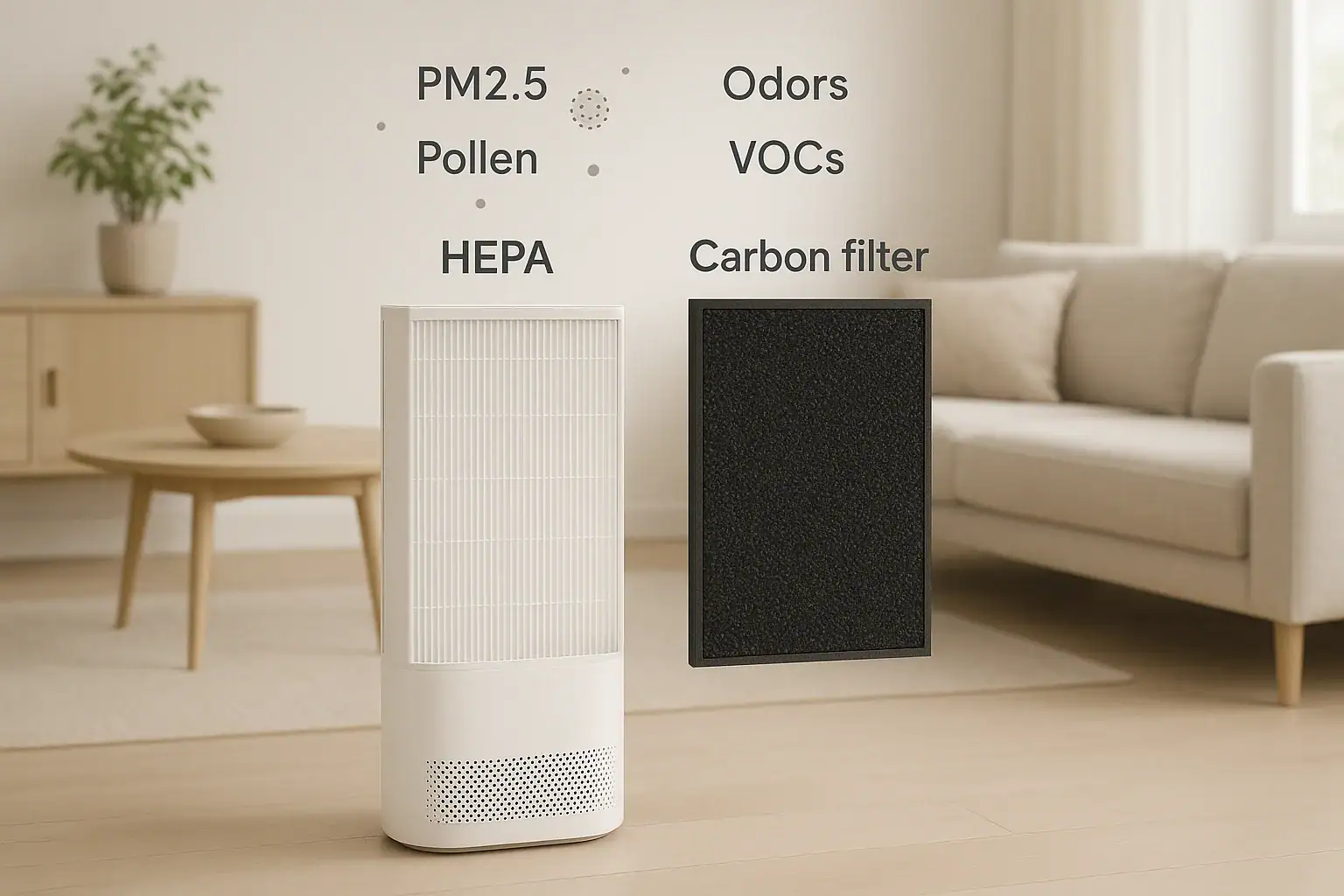
HEPA vs Carbon Filters: What Each Removes (PM2.5, Odors, VOCs)
Indoor air can hold a surprising mix of particles and gases: fine dust, wildfire smoke, pet dander, cooking fumes, and chemical vapors from cleaners and building materials. When you start shopping for air purifiers or HVAC upgrades, you quickly see two terms everywhere: HEPA filters and carbon filters. They are often bundled together, but they do very different jobs. Understanding what each filter type removes (and what it does not) helps you choose the right setup for your home instead of relying on confusing marketing claims.
On this page(click to collapse)
- HEPA vs Carbon Filters in One Glance
- What a True HEPA Filter Actually Does
- What an Activated Carbon Filter Actually Does
- HEPA vs Carbon for PM2.5, Odors, and VOCs
- When You Need HEPA, Carbon, or Both
- How to Read Filter Labels and Specs
- Using and Maintaining HEPA and Carbon Filters
- Key Takeaways: Matching Filters to Your Needs
- Related guides
This explainer walks through how HEPA and carbon filters work, what they capture (PM2.5, allergens, odors, VOCs, and more), and when you might want one, the other, or both. The goal is to help you match filtration to your real indoor air problems, whether that is seasonal smoke, pet odors, or sensitivity to chemical fumes.
HEPA vs Carbon Filters in One Glance
HEPA and carbon filters target different types of pollutants:
- HEPA filters: Capture solid and liquid particles floating in the air.
- Carbon filters: Capture gases and vapors that you usually notice as odors or chemical smells.
Think of HEPA as a super-fine net for tiny dust and smoke particles, and carbon as a sponge for unwanted smells and chemical vapors. Most homes benefit from both, but not everyone needs the same level of each type.
What a True HEPA Filter Actually Does
HEPA stands for High Efficiency Particulate Air. A true HEPA filter is designed to capture at least 99.97% of particles that are 0.3 microns in diameter under standard test conditions. That size is used because it is considered among the most difficult to capture; many particles smaller and larger than 0.3 microns are actually trapped even more efficiently.
How HEPA Filters Work
HEPA filters are made of dense mats of fibers arranged in layers. As air is pushed through the filter, particles are removed by several mechanisms:
- Interception: Particles following the air stream come close enough to a fiber and stick to it.
- Impaction: Larger or heavier particles cannot follow the air stream around fibers and collide with them.
- Diffusion: Very tiny particles move randomly and bump into fibers, where they get trapped.
The result is a filter that can dramatically reduce particle levels in a room when sized and used correctly.
Pollutants HEPA Filters Remove
HEPA filters are focused on particulate matter, including PM10, PM2.5, and even smaller particles in many cases. Common examples include:
- PM2.5 from traffic, wildfire smoke, and other combustion sources
- Dust and dust mite debris
- Pollen from trees, grasses, and weeds
- Pet dander and hair fragments
- Mold spores (airborne, not mold growing on surfaces)
- Some bacteria and other biological particles
- Smoke particles from cooking or candles
If your main concern is allergies, asthma triggers, or fine particulate pollution such as wildfire smoke haze, HEPA filtration is usually the priority.
What HEPA Filters Do Not Remove
HEPA filters are not designed to capture gases or vapors. They do not effectively remove:
- Odors from cooking, pets, trash, or bathrooms
- Volatile organic compounds (VOCs) from paints, cleaners, new furniture, or building materials
- Carbon monoxide or other combustion gases
- Ozone or other reactive gases
If the main thing you notice in your home is smell rather than visible dust or allergy symptoms, HEPA alone will probably not solve the problem.
What an Activated Carbon Filter Actually Does
Activated carbon (sometimes called activated charcoal) is a porous material with a huge internal surface area. When air passes through, many gas molecules stick to the carbon surface in a process called adsorption. This makes it useful for reducing odors and certain chemical vapors.
How Carbon Filters Work
Carbon filters are usually made of granules or a porous block of activated carbon. The effectiveness depends on:
- Amount of carbon: More carbon generally means more capacity to hold gases.
- Contact time: Slower airflow and thicker filters allow more time for gases to be adsorbed.
- Type of gas: Some gases are captured more readily than others.
Once the carbon surface becomes saturated, it can no longer hold additional gases and needs to be replaced.
Pollutants Carbon Filters Remove
Carbon filters focus on gaseous pollutants, including many VOCs and odor-causing compounds. Examples include:
- Cooking odors from frying, spices, and lingering food smells
- Pet odors and litter box smells
- Smoke odors from tobacco or wildfire smoke (the smell component, not the particles)
- VOCs from paints, solvents, adhesives, and some cleaning products
- New home or renovation smells from flooring, cabinetry, and other materials
- Garbage and bathroom odors
For people sensitive to chemical smells or those trying to reduce indoor VOC levels, a substantial carbon filter can be an important part of an air cleaning strategy.
What Carbon Filters Do Not Remove
Carbon filters are not particle filters. They do not effectively capture:
- PM2.5 and other fine particles
- Pollen, dust, and pet dander
- Mold spores or other biological particles
- Visible smoke particles and soot
Some products combine a thin dust prefilter with carbon, but that is not the same as a true HEPA filter for fine particles.
HEPA vs Carbon for PM2.5, Odors, and VOCs
To match filtration to your needs, it helps to look at common indoor air concerns one by one.
PM2.5 and Fine Particles
PM2.5 refers to particles with a diameter of 2.5 microns or smaller. They can travel deep into the lungs and are linked with respiratory and cardiovascular issues. Sources include:
- Wildfire smoke and outdoor pollution that leaks indoors
- Cooking, especially frying and high-heat methods
- Candles, incense, and fireplaces
Best choice: A true HEPA filter is the primary tool for reducing PM2.5. A carbon filter alone will not meaningfully lower particle counts.
Odors You Can Smell
Odors usually come from gas molecules, not from the larger particles that HEPA filters capture. Common odor sources include:
- Cooking and kitchen smells
- Pet and litter box odors
- Garbage and bathroom smells
- Musty or stale air
Best choice: An activated carbon filter is the main tool for odor reduction. HEPA filters might remove some odor-carrying particles, but the core smell usually remains without carbon.
VOCs and Chemical Fumes
Volatile organic compounds (VOCs) are gases released from many everyday products and materials, such as:
- Paints, varnishes, and solvents
- Adhesives and sealants
- Cleaning sprays and disinfectants
- New furniture, flooring, and cabinetry
- Fragranced products and air fresheners
Best choice: A substantial activated carbon filter is needed to meaningfully reduce VOCs. HEPA filters do not capture these gases.
Smoke: Particles vs Smell
Smoke is a mix of fine particles and gases. For wildfire smoke or tobacco smoke, you may care about both the health impact and the lingering odor.
- Particles and haze: Best handled by HEPA filtration.
- Smell and chemical gases: Best handled by activated carbon.
Best choice: For smoke, a combination of HEPA + carbon is usually recommended if you want to address both health and odor concerns.
When You Need HEPA, Carbon, or Both
Your ideal setup depends on your home, health concerns, and local environment. Here are common scenarios and what typically helps most.
If You Have Allergies or Asthma
Allergies and asthma are often triggered by airborne particles such as pollen, pet dander, dust mites, and mold spores.
- Priority: True HEPA filtration to reduce particle exposure.
- Nice to have: Carbon filtration if you are sensitive to fragrances or cleaning product smells.
If You Live in an Area with Wildfire Smoke
Wildfire smoke can raise indoor PM2.5 levels and leave a strong smell even after the visible haze is gone.
- Priority: True HEPA filtration sized for the room to reduce PM2.5.
- Also helpful: Carbon filtration to reduce smoke odors and some smoke-related gases.
If Odors Are Your Main Complaint
For homes where the main issue is smell rather than dust or allergies:
- Priority: A filter with a meaningful amount of activated carbon.
- Optional: HEPA filtration if you also want general dust and particle reduction.
If You Are Sensitive to Chemicals and VOCs
Some people experience headaches, irritation, or other symptoms from low levels of VOCs.
- Priority: A robust activated carbon filter, ideally with enough carbon mass and contact time.
- Also consider: Source control (choosing low-VOC products) and ventilation in addition to filtration.
If You Just Want Cleaner Everyday Air
For general indoor air quality in a typical home:
- Good baseline: True HEPA filtration to handle dust, dander, and everyday particles.
- Bonus: Carbon filtration to keep common household odors and some VOCs lower.
How to Read Filter Labels and Specs
Product labels can be confusing. Here are key terms and what they usually mean.
True HEPA vs HEPA-Type
Look for language that clearly states the filter meets a high efficiency standard for small particles.
- True HEPA or HEPA: Typically means 99.97% efficiency at 0.3 microns under standard test conditions.
- HEPA-type, HEPA-like, or similar terms: Often lower efficiency and not tested to the same standard.
If you are buying primarily for allergy or smoke protection, a true HEPA filter is usually worth seeking out.
Carbon Filter Thickness and Weight
Carbon filters vary a lot. Some are thin sheets lightly coated with carbon; others are deep beds of granules.
- Thin, lightweight filters may help with mild odors but often saturate quickly.
- Thicker, heavier filters with more carbon usually have better capacity for VOCs and persistent smells.
When possible, look for details about the amount of carbon or the filter weight rather than relying only on marketing terms.
Combined HEPA + Carbon Units
Many air cleaners combine HEPA and carbon in one device. The combination can be effective, but details matter:
- Check that the particle filter is true HEPA or another high-efficiency rating.
- Check that the carbon filter is more than a very thin prefilter if VOCs and odors are a priority.
- Confirm the unit is sized for your room based on its clean air delivery rate (CADR) or recommended coverage.
Using and Maintaining HEPA and Carbon Filters
Even the best filter will not help much if it is undersized, rarely used, or never replaced. A few practical habits go a long way.
Right-Sizing for Your Space
Match the air cleaner to the size of the room or area you want to treat.
- Check the manufacturer’s recommended square footage.
- Look for particle and smoke ratings if available.
- Consider running the unit on higher settings during events like cooking or nearby wildfires.
Placement Tips
Where you place the unit affects how well it cleans the air.
- Keep it in the room where you spend the most time, such as a bedroom or living room.
- Avoid blocking the intake or outlet with furniture or curtains.
- Elevate slightly off the floor if recommended, but keep it stable and safe.
Filter Replacement Schedules
Both HEPA and carbon filters have a limited life.
- HEPA filters: Gradually fill with particles and become harder for air to pass through. Replace on the schedule recommended, or sooner if airflow drops or the filter looks heavily loaded.
- Carbon filters: Saturate with gases and odors. Once full, they stop being effective even if they still look clean. Replace according to the suggested interval or sooner if odors return quickly.
Running a clogged filter can reduce air cleaning performance and strain the fan motor.
Pairing Filtration with Other Air Quality Steps
Filters work best as part of a broader indoor air strategy:
- Source control: Choose low-VOC products, store chemicals safely, and avoid unnecessary fragrances.
- Ventilation: Use kitchen and bathroom exhaust fans and open windows when outdoor air quality is good.
- Cleaning: Vacuum with a high-efficiency filter and dust regularly to reduce settled particles that can become airborne.
Key Takeaways: Matching Filters to Your Needs
Choosing between HEPA and carbon filters becomes much easier once you separate particles from gases:
- Use HEPA when your main concern is PM2.5, dust, pollen, pet dander, mold spores, or smoke particles.
- Use activated carbon when your main concern is odors and VOCs from cooking, pets, cleaners, paints, or new materials.
- Use both together when you want broad coverage, especially for smoke, allergies plus odors, or chemical sensitivity.
By matching filter type to your specific indoor air challenges and maintaining the filters on schedule, you can make a noticeable difference in comfort and air quality throughout your home.
For more ways to improve the air and comfort in your living spaces, explore additional guides and resources on home air quality, ventilation, and humidity control.
Related posts
Browse this topic →
Smoke and Wildfire Season: Sealing, Filtration, and Safe Ventilation at Home
Why VOC Readings Spike After Cleaning (And What To Do About It)
Air Quality Monitor Basics: PM2.5, VOC, CO2—What Numbers To Trust
CO2 Levels at Home: What’s Normal and How to Improve Ventilation
How to Use Exhaust Fans Correctly for Better Bathroom and Kitchen Airflow
Mold in the Bathroom: A Practical Humidity Control Checklist
Keep reading
About this site
Signature Home Guide publishes practical, independent home guides. We aim to be clear, helpful, and transparent.
Affiliate disclosure
As an Amazon Associate, we earn from qualifying purchases. Some links on this site may be affiliate links. If you buy through these links, we may earn a small commission at no extra cost to you. This helps support our content. Learn more.