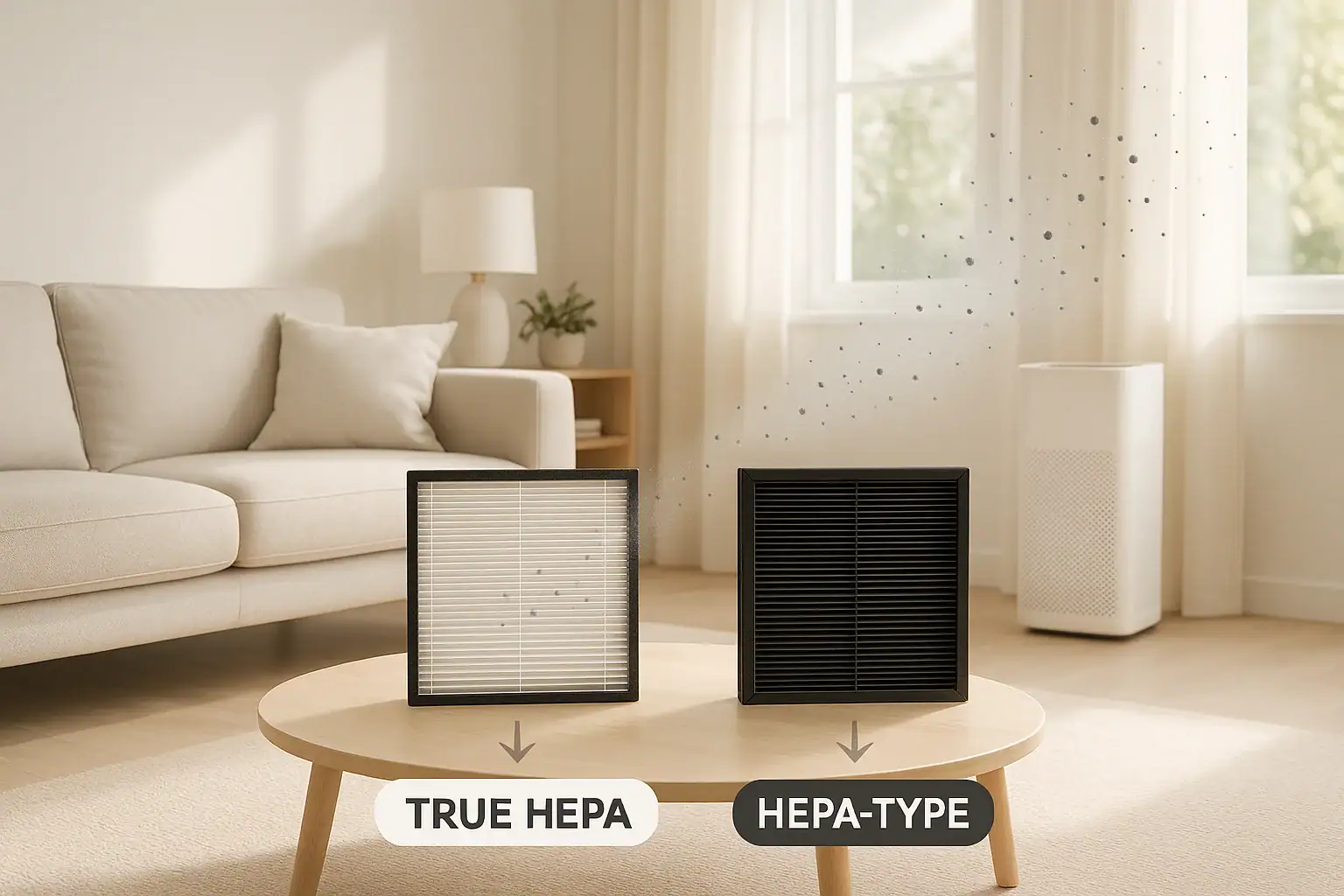
If you have ever shopped for an air purifier, vacuum, or furnace filter, you have probably seen labels like “HEPA,” “HEPA-type,” or “HEPA-like.” At a glance, they sound almost identical, and the packaging often suggests similar benefits. But these terms do not all mean the same thing, and the differences can have a real impact on how clean your indoor air actually becomes. Understanding what these labels truly represent helps you avoid overpaying for weak filtration and ensures you pick the right product for allergies, asthma, smoke, or dust control.
On this page(click to collapse)
- What Does HEPA Actually Mean?
- What Is HEPA-Type (and Similar) Filtration?
- Side-by-Side: HEPA vs HEPA-Type Filters
- How to Read Filtration Labels Without Being Misled
- Which One Do You Need: HEPA or HEPA-Type?
- Where HEPA and HEPA-Type Filters Are Commonly Used
- Maintenance Tips for Getting the Most from Any Filter
- Key Takeaways: Making a Confident Choice
- Related guides
This guide breaks down HEPA vs HEPA-type filters in clear, practical terms. You will learn how each one is defined, how they are tested, what they realistically capture, and how to read between the lines of marketing language. We will also cover how to choose the right filter for your home, how to maintain it, and when HEPA-level filtration is worth the extra cost. By the end, you will be able to walk down the air and comfort aisle with confidence instead of confusion.
What Does HEPA Actually Mean?
HEPA is not just a buzzword. It is a specific performance standard for air filters. The term stands for “high-efficiency particulate air,” and it refers to filters that meet a defined level of efficiency when tested under controlled conditions.
The basic HEPA performance standard
In general, a true HEPA filter must meet these criteria:
- Capture at least 99.97% of particles
- Tested at a particle size of 0.3 microns (often called the most penetrating particle size)
- Verified by standardized laboratory testing, not just internal claims
Particles around 0.3 microns are small enough to slip through many filters but large enough to behave differently than gases. If a filter can trap 99.97% of particles at that size, it usually does even better with larger particles like dust and pollen and can still capture a meaningful portion of smaller particles.
What HEPA filters are designed to capture
True HEPA filters are very effective at capturing:
- Dust and dust mite debris
- Pollen and plant spores
- Pet dander and hair fragments
- Smoke particles from cooking or wildfires
- Fine particulate pollution (often called PM2.5)
- Some bacteria and other biological particles
HEPA filters are not designed to remove gases or odors by themselves. For that, you usually need an additional stage, such as an activated carbon filter. However, for solid and liquid particles suspended in the air, HEPA is one of the most efficient consumer-level options available.
What Is HEPA-Type (and Similar) Filtration?
HEPA-type, HEPA-like, and similar terms are marketing labels rather than strict technical standards. They generally describe filters that resemble HEPA in appearance or construction but do not meet the full HEPA performance requirement.
Common HEPA-type marketing terms
You may see phrases such as:
- “HEPA-type” or “HEPA-style”
- “99% efficient” or “up to 99%”
- “Captures particles as small as 2 microns”
- “HEPA-like performance”
These labels can sound impressive, but they often leave out critical details such as the exact particle size tested, the airflow rate, and whether independent testing was performed.
Typical performance of HEPA-type filters
Because there is no single standard for HEPA-type filters, performance can vary widely. In general, many HEPA-type filters:
- Capture a lower percentage of fine particles than true HEPA
- May be tested at larger particle sizes (for example, 2 or 5 microns instead of 0.3 microns)
- May not have any third-party certification or standardized test results
That does not mean HEPA-type filters are useless. For larger particles like visible dust, lint, and some pollen, a HEPA-type filter can still improve air cleanliness. The key is understanding that it is not the same as a certified HEPA filter, especially for very fine particles such as smoke or tiny allergens.
Side-by-Side: HEPA vs HEPA-Type Filters
To see the real difference between HEPA and HEPA-type filters, it helps to compare them across a few important categories.
1. Filtration efficiency
- True HEPA: At least 99.97% efficiency at 0.3 microns. This is a very strict standard and is verified through testing.
- HEPA-type: Often in the range of 90% to 99% efficiency, but usually at larger particle sizes and without a consistent standard. Claims may be based on internal tests.
In practical terms, this means a true HEPA filter can remove a much higher portion of the tiniest, most stubborn particles that tend to trigger allergy and asthma symptoms.
2. Particle size range
- True HEPA: Specifically tested at 0.3 microns and generally effective for particles both smaller and larger than that size.
- HEPA-type: Often tested at 2 microns or larger, which covers many dust and pollen particles but may miss a significant portion of smoke and fine pollution.
3. Testing and certification
- True HEPA: Must meet defined efficiency levels under standardized test conditions. Many products will reference recognized test methods or independent labs.
- HEPA-type: No single required standard. Some may be tested, others may not. The details are often vague or missing from packaging.
4. Cost and availability
- True HEPA: Usually more expensive up front and for replacement filters. Often found in higher-end air purifiers, vacuums, and some HVAC accessories.
- HEPA-type: Typically more affordable and common in budget air purifiers and basic appliances.
5. Best uses
- True HEPA: Best for households with allergies, asthma, sensitivity to smoke, or concerns about fine particulate pollution.
- HEPA-type: Reasonable for general dust reduction, light odor control when combined with other media, or as a step up from basic filters when budget is tight.
How to Read Filtration Labels Without Being Misled
Packaging can make almost any filter sound powerful. To cut through the marketing, focus on a few key details when comparing HEPA and HEPA-type products.
Look for specific numbers, not vague claims
Helpful packaging details include:
- The exact efficiency percentage (for example, 99.97%)
- The particle size used for testing (for example, 0.3 microns)
- Any reference to standardized test methods or independent labs
Be cautious with phrases like “up to 99%” without a particle size or test method. “Up to” can mean the filter only performs that well under ideal conditions, not in everyday use.
Check for airflow and room size ratings
Even the best filter will not help much if the device does not move enough air. For air purifiers, look for:
- Recommended room size in square feet
- Clean air delivery rate (CADR), if available
- Fan speed options and noise levels
A true HEPA filter in a small, weak purifier may clean a small bedroom well but struggle with a large, open living area. Matching the purifier to your room size is just as important as the filter type.
Be aware of multi-stage systems
Many devices use more than one filter type. A typical setup might include:
- A pre-filter to catch hair, lint, and large dust
- A HEPA or HEPA-type filter for fine particles
- An activated carbon filter for some gases and odors
When reading labels, make sure you know which layer is being described. A product may highlight a HEPA-type main filter while using the term “HEPA” loosely in the description of the entire system.
Which One Do You Need: HEPA or HEPA-Type?
The right choice depends on your health needs, your home environment, and your budget. Use the questions below to guide your decision.
Do you or your family members have allergies or asthma?
If allergies or asthma are a concern, a true HEPA filter is usually worth the extra cost. The higher efficiency at small particle sizes can reduce exposure to:
- Pet dander
- Pollen
- Dust mite debris
- Fine particles that can irritate airways
While a HEPA-type filter may help somewhat, it is less likely to provide consistent relief for sensitive individuals.
Are you dealing with smoke or fine pollution?
For wildfire smoke, traffic pollution, or frequent cooking smoke, fine particles are the main issue. In these cases:
- Choose true HEPA whenever possible, ideally with a carbon stage for gases and odors.
- Use HEPA-type only as a temporary or budget-friendly option, understanding it may not capture as much of the finest particles.
Is your main goal simple dust and pet hair control?
If your primary concern is visible dust, pet hair, and general freshness rather than medical issues, a HEPA-type filter can still be helpful. Paired with regular cleaning and vacuuming, it can reduce the amount of dust settling on surfaces and furniture.
What is your budget for filters over time?
When comparing costs, look beyond the initial purchase price. Consider:
- How often replacement filters are needed
- The cost of each replacement filter
- Whether pre-filters are washable or disposable
A true HEPA system may cost more up front but can be cost-effective if filters last longer or if it prevents doctor visits triggered by poor air quality.
Where HEPA and HEPA-Type Filters Are Commonly Used
Understanding where these filters show up can help you make better choices across your home, not just in standalone air purifiers.
Air purifiers
Most consumer air purifiers advertise either HEPA or HEPA-type filtration. For bedrooms, nurseries, and living rooms, a purifier with a true HEPA filter is often the best choice, especially if anyone in the home has respiratory issues. For occasional use in a home office or guest room, a HEPA-type purifier may be sufficient.
Vacuum cleaners
Vacuum exhaust can release fine dust back into the air if the filtration is weak. Vacuums with true HEPA filtration help trap more of that dust and dander inside the machine instead of blowing it out the back. HEPA-type filters in vacuums can still help, but they may not capture the smallest particles stirred up during cleaning.
HVAC and furnace filters
Whole-house systems usually use filters rated by a different standard, often described by a minimum efficiency reporting value (MERV). Some specialty products for furnaces and central air systems incorporate HEPA-level filtration, but they may require professional installation to avoid restricting airflow. If you see HEPA-type language on a furnace filter, read the fine print and check the MERV rating to understand its true performance.
Maintenance Tips for Getting the Most from Any Filter
Whether you choose HEPA or HEPA-type, proper maintenance is essential. A clogged, neglected filter will not perform well, no matter how advanced it is on paper.
Follow the recommended replacement schedule
Manufacturers typically suggest replacing filters every few months to a year, depending on usage and air quality. Heavy smoke, pets, or construction dust can shorten this timeline. Mark your calendar or set reminders so you do not forget.
Do not wash non-washable HEPA filters
Some filters are designed to be rinsed or gently vacuumed, but many true HEPA filters are not washable. Exposing them to water can damage the fibers and reduce efficiency. Always check the product instructions before attempting to clean a filter.
Keep pre-filters clean
Pre-filters capture larger debris and protect the main filter. If your device has a washable pre-filter, clean it on schedule. This can extend the life of the main HEPA or HEPA-type filter and maintain good airflow.
Place devices for best airflow
For air purifiers, placement matters. To maximize performance:
- Keep the unit away from walls and corners when possible
- Avoid blocking intake or exhaust vents with furniture or curtains
- Run the purifier on an appropriate fan speed for the room size
Key Takeaways: Making a Confident Choice
When you understand the difference between HEPA and HEPA-type filters, it becomes much easier to choose the right option for your home and budget.
- True HEPA filters meet a strict standard: at least 99.97% efficiency at 0.3 microns.
- HEPA-type filters look similar but do not have a consistent performance standard and usually capture fewer fine particles.
- For allergies, asthma, and smoke, a true HEPA filter is usually the better investment.
- For general dust reduction in less critical spaces, a HEPA-type filter can still provide noticeable improvement.
- Always read labels carefully, looking for specific efficiency percentages, particle sizes, and room size ratings.
- Regular maintenance and proper placement are essential for any filter to work effectively.
By focusing on the actual performance details instead of just the label on the box, you can create a cleaner, more comfortable indoor environment that truly supports your health and well-being.
For more guidance on managing indoor air and comfort throughout your home, explore related resources and tips on improving ventilation, controlling humidity, and choosing the right equipment for each room.
Related posts
Browse this topic →
Smoke and Wildfire Season: Sealing, Filtration, and Safe Ventilation at Home
Why VOC Readings Spike After Cleaning (And What To Do About It)
Air Quality Monitor Basics: PM2.5, VOC, CO2—What Numbers To Trust
CO2 Levels at Home: What’s Normal and How to Improve Ventilation
How to Use Exhaust Fans Correctly for Better Bathroom and Kitchen Airflow
Mold in the Bathroom: A Practical Humidity Control Checklist
Keep reading
About this site
Signature Home Guide publishes practical, independent home guides. We aim to be clear, helpful, and transparent.
Affiliate disclosure
As an Amazon Associate, we earn from qualifying purchases. Some links on this site may be affiliate links. If you buy through these links, we may earn a small commission at no extra cost to you. This helps support our content. Learn more.