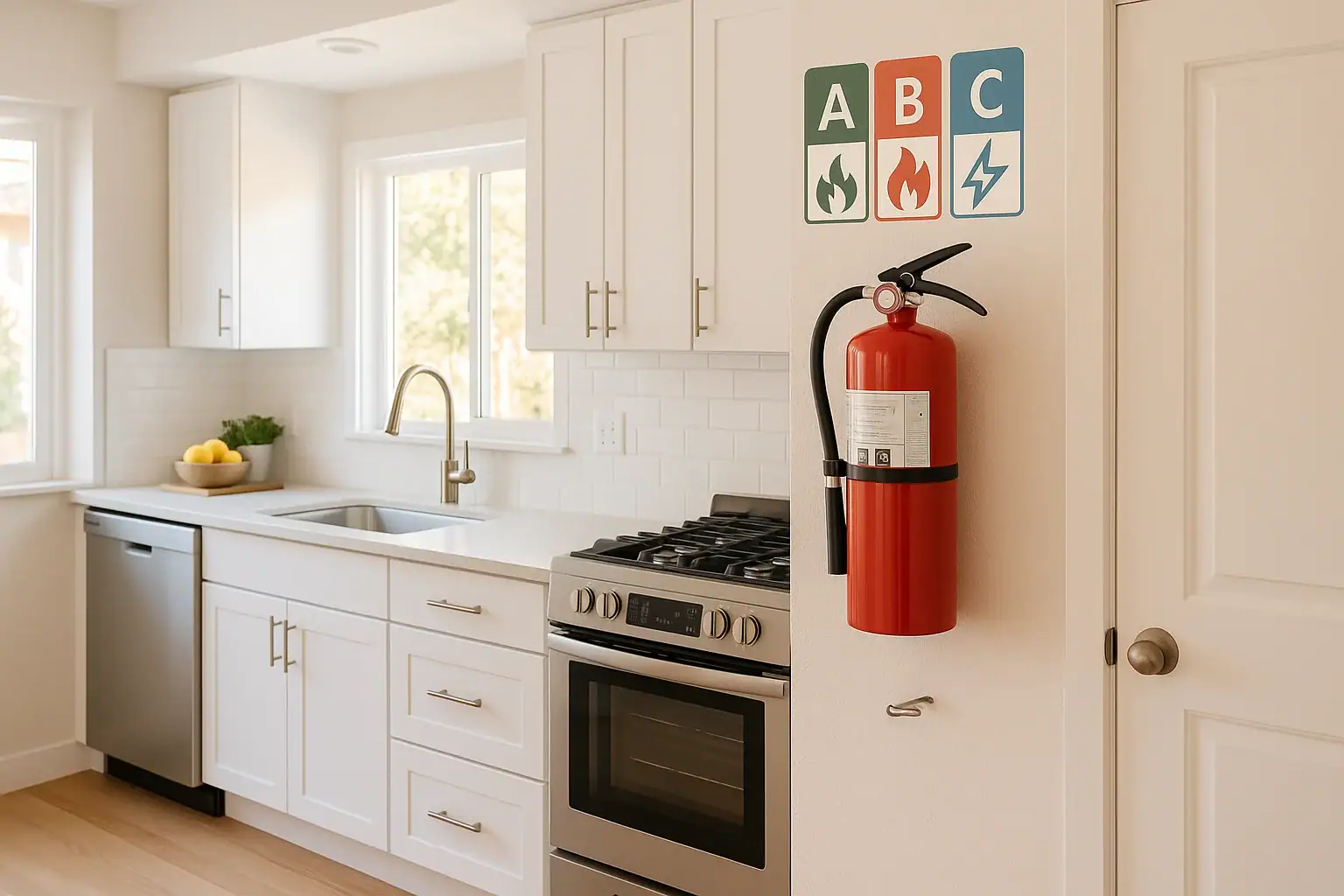
Kitchen fires are one of the most common home emergencies, and they can spread faster than many people realize. Having the right fire extinguisher within arm’s reach can turn a dangerous situation into a minor incident. But not every extinguisher is safe or effective for every type of kitchen fire. Understanding the different fire classes, ratings, and features will help you choose the best option for your home and use it with confidence.
On this page(click to collapse)
- Why Your Kitchen Needs a Specific Fire Extinguisher
- Fire Classes Explained: What the Letters Mean
- The Best Fire Extinguisher Types for Home Kitchens
- How to Read Fire Extinguisher Ratings
- Choosing the Right Size for Your Kitchen
- Where to Place a Kitchen Fire Extinguisher
- How to Use a Kitchen Fire Extinguisher Safely
- Maintenance and Inspection: Keeping Your Extinguisher Ready
- Creating a Simple Kitchen Fire Safety Plan
- Key Takeaways: Choosing a Kitchen Fire Extinguisher
- Related guides
This guide walks you through how to choose a fire extinguisher for the kitchen, what the fire classes mean, where to place it, and how to use it safely. By the end, you’ll know exactly what to look for on the label and how to prepare your household to respond quickly and calmly.
Why Your Kitchen Needs a Specific Fire Extinguisher
Not all fire extinguishers are designed for the same types of fires. The kitchen is a high‑risk area where grease, oils, electrical appliances, and everyday combustibles all come together. Using the wrong extinguisher can make a fire worse or put you in danger.
A kitchen‑appropriate extinguisher helps you:
- Control small cooking fires before they spread
- Avoid splashing burning grease or spreading flames
- Reduce smoke and damage from a fire incident
- Protect yourself and your family while you escape if needed
To choose correctly, you first need to understand fire classes and how they relate to common kitchen hazards.
Fire Classes Explained: What the Letters Mean
Every fire extinguisher label includes letters that indicate what types of fires it can safely put out. In a kitchen, you will mainly see Class A, B, C, and sometimes K. Here is what each one means and how it relates to home cooking.
Class A: Ordinary Combustibles
Class A fires involve everyday materials that burn easily, such as:
- Paper towels and napkins
- Wood cabinets and cutting boards
- Cardboard packaging
- Some types of fabric, like curtains or dish towels
Most home fire extinguishers cover Class A fires, and this protection is useful in any area of the house, including the kitchen. However, Class A alone is not enough for cooking‑related fires.
Class B: Flammable Liquids and Grease
Class B fires involve flammable liquids and gases, including many substances found in or near the kitchen:
- Cooking oils and grease
- Oil‑based sauces and fats
- Gasoline or lighter fluid stored nearby
- Solvents or certain cleaning products
Because cooking oils and grease are a major source of kitchen fires, a kitchen extinguisher should always include Class B coverage. However, you must still be cautious: even with a Class B rating, not every extinguisher is ideal for deep‑fat or heavy grease fires.
Class C: Electrical Equipment
Class C fires involve energized electrical equipment, such as:
- Microwaves and ovens
- Toasters and toaster ovens
- Coffee makers and air fryers
- Electrical outlets and cords
A Class C rating means the extinguisher can be used on a fire that involves live electrical power without conducting electricity back to you. In a modern kitchen full of plugged‑in appliances, having Class C coverage is highly recommended.
Class K: Commercial‑Style Cooking Oils and Fats
Class K fires involve high‑temperature cooking oils and fats, typically in commercial kitchens. These fires are often associated with:
- Deep fryers
- Large griddles and ranges
- High‑volume cooking equipment
Class K extinguishers use special agents that cool and smother very hot cooking oils. In most single‑family homes, a well‑chosen multi‑class extinguisher (such as one rated for A, B, and C) is sufficient. However, if you frequently deep‑fry at home or have commercial‑style equipment, you may want to consider a small Class K unit in addition to your main extinguisher.
The Best Fire Extinguisher Types for Home Kitchens
Fire extinguishers are also categorized by the type of extinguishing agent they use. For kitchens, the most common types are dry chemical, wet chemical, and clean agent units. Each has advantages and trade‑offs.
ABC Dry Chemical Extinguishers
ABC dry chemical extinguishers are among the most common in homes. They are rated for:
- Class A: ordinary combustibles
- Class B: flammable liquids and grease
- Class C: energized electrical equipment
Benefits for kitchen use include:
- Versatility for multiple fire types in and around the kitchen
- Wide availability and relatively low cost
- Simple operation for most users
Drawbacks include a powdery residue that can be messy and difficult to clean. The residue can damage electronics and some surfaces. Still, for many households, an ABC dry chemical extinguisher near the kitchen is a practical and effective choice.
BC Dry Chemical Extinguishers
BC dry chemical extinguishers are rated only for Class B and C fires. They are designed for flammable liquids, grease, and electrical equipment, but not ordinary combustibles like paper or wood.
These can be used in kitchens but are less common in homes than ABC units because they lack Class A coverage. If you choose a BC extinguisher, consider having a separate Class A extinguisher elsewhere in the home.
Wet Chemical Extinguishers (Often Class K)
Wet chemical extinguishers are commonly used in commercial kitchens for Class K fires. They work by cooling and forming a soapy layer over hot oil, which helps prevent re‑ignition.
In a home setting, a small wet chemical extinguisher can be helpful if you do a lot of deep‑frying or have large fryers. However, they are usually more expensive and may not be necessary for typical residential cooking when an ABC extinguisher is present.
Clean Agent and CO₂ Extinguishers
Clean agent and carbon dioxide (CO₂) extinguishers leave little or no residue and are excellent for sensitive electronics. However, they are not ideal as the only extinguisher for a kitchen because they may not be as effective on some grease fires or ordinary combustibles.
If you keep a clean agent or CO₂ unit for electronics nearby, it should supplement, not replace, a properly rated ABC or Class K extinguisher.
How to Read Fire Extinguisher Ratings
Beyond the letters for fire classes, you will also see numbers on the label, such as “3‑A:40‑B:C.” These numbers indicate the relative effectiveness of the extinguisher for each class.
- Class A number (before the A): Roughly equals the amount of water effectiveness. A higher number means more firefighting power for ordinary combustibles.
- Class B number (before the B): Indicates the approximate square footage of a flammable liquid fire that a trained user can expect to extinguish.
- Class C: Has no number. It simply confirms the extinguisher is safe for energized electrical equipment.
For most home kitchens, a compact extinguisher with a moderate rating is easier to handle than a large, heavy unit with a very high rating. A common and practical choice is a multi‑purpose extinguisher with both A and B ratings and a C designation, sized so that any adult in the home can comfortably lift and operate it.
Choosing the Right Size for Your Kitchen
Fire extinguishers come in various sizes, typically measured by the weight of the extinguishing agent inside. Common residential sizes range from about 2.5 pounds to 10 pounds.
Small Extinguishers (Around 2.5 Pounds)
These are compact and easy to store, often under a cabinet or in a small bracket. They are:
- Lightweight and easier for people with limited strength to handle
- Suitable for very small fires or tight spaces
The downside is that they discharge quickly and may not have enough agent for a rapidly growing fire.
Medium Extinguishers (Around 5 Pounds)
For most home kitchens, a 5‑pound extinguisher is a good balance between power and manageability. It offers:
- Enough agent to fight a typical small kitchen fire
- A size that most adults can lift and control
- Reasonable discharge time to apply the agent carefully
Larger Extinguishers (10 Pounds or More)
Larger extinguishers provide more firefighting capacity but can be heavy and awkward, especially in the close quarters of a kitchen. These are often better suited for garages, workshops, or areas with larger fuel loads rather than directly in the kitchen.
Where to Place a Kitchen Fire Extinguisher
Placement is as important as the extinguisher you choose. An extinguisher that is hard to reach or hidden behind clutter may not be useful in an emergency.
Key Placement Guidelines
- Keep it visible and accessible. Mount it on a wall or place it in a clearly marked cabinet that opens easily.
- Do not store it right next to the stove. If a fire starts on the cooktop, you do not want to reach through flames to grab the extinguisher.
- Place it near an exit. Ideally, you should be able to access the extinguisher while keeping a clear path to the door so you can retreat if needed.
- Mount at a comfortable height. The handle should be within easy reach for all adults in the home, typically around chest level.
- Avoid blocking it. Do not stack items in front of it or hide it behind doors or appliances.
Many households also keep additional extinguishers in the garage, near the laundry area, and close to exits for broader home coverage.
How to Use a Kitchen Fire Extinguisher Safely
Having the right extinguisher is only half the equation. Everyone in your household who cooks should know how and when to use it. A simple way to remember the basic steps is the PASS method.
Use the PASS Method
- P – Pull the pin to unlock the operating lever.
- A – Aim the nozzle or hose at the base of the fire, not at the flames.
- S – Squeeze the handle to release the extinguishing agent.
- S – Sweep the nozzle from side to side, moving slowly toward the fire until it is out.
Important Safety Tips for Kitchen Fires
- Always call emergency services first or have someone else call while you attempt to extinguish a small fire.
- Only use an extinguisher on small, contained fires that are not spreading rapidly and do not reach the ceiling.
- Keep your back to an exit so you have a clear escape route.
- Never use water on grease or electrical fires. Water can spread burning oil and conduct electricity.
- If the fire grows or you feel unsafe, leave immediately and wait for firefighters at a safe distance.
Maintenance and Inspection: Keeping Your Extinguisher Ready
A fire extinguisher is only helpful if it works when you need it. Regular checks take just a few minutes and can be added to your seasonal home safety routine.
Monthly Visual Checks
Once a month, quickly inspect your kitchen extinguisher:
- Confirm it is in its proper location and easy to reach.
- Check that the pressure gauge needle is in the green zone.
- Make sure the pin and tamper seal are intact.
- Look for any signs of damage, corrosion, or leakage.
- Gently turn or shake the unit if recommended by the manufacturer to prevent the powder from settling.
Replacement and Servicing
Most residential extinguishers are either disposable or rechargeable:
- Disposable units are typically replaced after use or when they reach the end of their service life, as indicated on the label.
- Rechargeable units can be refilled and serviced by a qualified technician after use or at recommended intervals.
Replace any extinguisher that is damaged, has a broken seal, or shows low pressure on the gauge. If you discharge even a small amount of the agent, plan to replace or recharge the unit promptly.
Creating a Simple Kitchen Fire Safety Plan
Choosing the right extinguisher is part of a larger kitchen fire safety plan. A few simple steps can greatly reduce your risk and help everyone respond calmly.
- Review safe cooking habits. Stay in the kitchen when frying, broiling, or grilling. Keep flammable items away from the stovetop.
- Teach everyone how to use the extinguisher. Walk through the PASS steps and show where the extinguisher is located.
- Discuss when not to fight a fire. Emphasize that if the fire is large, spreading, or producing heavy smoke, the priority is to leave and call for help.
- Plan escape routes. Make sure everyone knows at least two ways out of the home and where to meet outside.
- Check smoke alarms. Test alarms regularly and replace batteries as recommended.
Key Takeaways: Choosing a Kitchen Fire Extinguisher
When you are ready to select a fire extinguisher for your kitchen, keep these points in mind:
- Look for a multi‑class rating that covers at least Class B and C, and ideally Class A as well.
- Choose a size that balances power and ease of handling, often around 5 pounds for most kitchens.
- Place the extinguisher near an exit, not directly next to the stove, and keep it clearly visible.
- Teach household members how to use it with the PASS method and when to evacuate instead of fighting a fire.
- Inspect it regularly so it is ready when you need it most.
With the right extinguisher and a simple safety plan, you can cook with greater peace of mind, knowing you are prepared to respond quickly to a small kitchen fire and protect your home and family.
Related posts
Browse this topic →
Smart Air Quality Alerts: How to Set Thresholds That Make Sense
Emergency Kit for Apartments: Closet-Friendly Essentials for Small Spaces
Home Fire Escape Plan: Map, Meeting Point, and Practice Checklist

Childproofing the Smart Home: Settings and Physical Safety Tips
Garage Door Safety: Sensors, Remotes, and Common Failure Fixes
How to Shut Off Water Quickly in an Emergency: A Simple Home Checklist
Keep reading
About this site
Signature Home Guide publishes practical, independent home guides. We aim to be clear, helpful, and transparent.
Affiliate disclosure
As an Amazon Associate, we earn from qualifying purchases. Some links on this site may be affiliate links. If you buy through these links, we may earn a small commission at no extra cost to you. This helps support our content. Learn more.