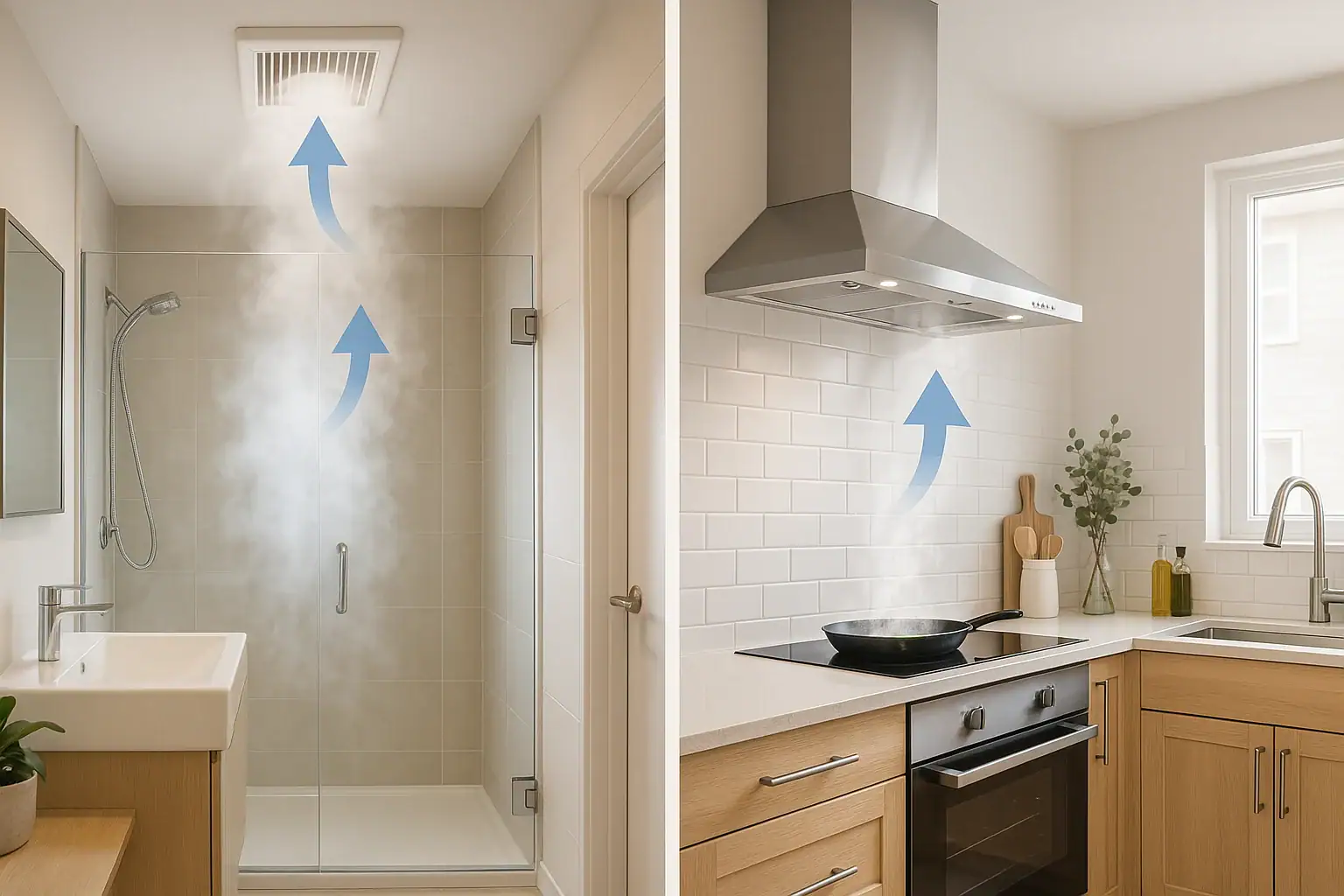
Exhaust fans are some of the hardest working but most overlooked tools in a home. When used correctly, they quietly remove excess moisture, odors, and airborne pollutants from bathrooms and kitchens. When used incorrectly, they can waste energy, leave lingering smells, and even contribute to mold growth and peeling paint. Understanding how to use exhaust fans correctly in both spaces is one of the simplest ways to improve indoor air quality, protect your home, and make daily life more comfortable.
On this page(click to collapse)
- Why Exhaust Fans Matter for Home Airflow
- How Bathroom Exhaust Fans Work
- How Kitchen Exhaust Fans Work
- Choosing the Right Size Exhaust Fan
- Ventilation and Airflow Best Practices
- Maintenance Tips for Quiet, Effective Exhaust Fans
- Common Exhaust Fan Mistakes to Avoid
- Simple Checklist for Better Bathroom and Kitchen Airflow
- Related guides
This guide walks through how bathroom and kitchen exhaust fans work, how long to run them, common mistakes to avoid, and simple tips to keep them performing well. You will also learn how to choose the right size fan and how to use fans together with windows and doors to get the best airflow throughout your home.
Why Exhaust Fans Matter for Home Airflow
Everyday activities like showering, boiling water, and frying food release moisture and pollutants into the air. Without a way to remove them, they build up indoors and can cause problems over time.
Key benefits of using exhaust fans correctly
- Moisture control: Reduces condensation on walls, ceilings, and windows, which helps prevent mold and mildew.
- Odor removal: Clears out lingering bathroom and cooking smells more quickly and effectively.
- Healthier air: Helps remove airborne particles, fumes, and humidity that can aggravate allergies or breathing issues.
- Home protection: Limits peeling paint, warped wood, and damage to cabinets, trim, and drywall caused by trapped moisture.
- Comfort and cleanliness: Keeps bathrooms and kitchens feeling fresher, drier, and easier to maintain.
To get these benefits, the fan has to be the right size, vented correctly to the outdoors, and used for the right amount of time. The details matter.
How Bathroom Exhaust Fans Work
Bathroom exhaust fans pull humid, stale air from the room and push it outdoors through ductwork. As the fan removes air, drier air from the rest of the home replaces it, which helps dry out the space after showers and baths.
How long to run a bathroom exhaust fan
Many people turn the fan off as soon as they leave the bathroom. That is usually too soon. Moisture continues to evaporate from walls, floors, and towels long after the water is turned off.
- Before showering: Turn the fan on 5 minutes before you start the shower or bath to start pulling in drier air.
- During showering: Keep the fan running the entire time you shower or bathe.
- After showering: Let the fan run for 15 to 20 minutes after you finish to clear remaining humidity.
If you see condensation on mirrors or walls that lingers more than 20 minutes, you may need a stronger fan or longer run time.
Best practices for bathroom fan use
- Keep the door slightly open: A small gap under the door or the door slightly open allows replacement air to enter. Without this, the fan struggles to move air.
- Use a timer switch: A wall timer lets you set the fan to run for 20 to 30 minutes and shut off automatically, so you do not have to remember.
- Use a humidity sensor if available: Some fans or switches sense moisture and turn on or off automatically when humidity rises or falls.
- Run the fan during other moisture-heavy tasks: Use it when mopping floors, washing pets, or air-drying clothes in the bathroom.
Signs your bathroom fan is not doing its job
- Foggy mirrors that stay cloudy long after a shower
- Peeling paint or bubbling drywall on ceilings or walls
- Musty or damp smells that do not go away
- Visible mold or dark spots on caulk, grout, or ceilings
- A fan that is very noisy but does not seem to move much air
If you notice these issues, you may need to clean the fan, improve venting, or upgrade to a larger unit.
How Kitchen Exhaust Fans Work
Kitchen exhaust fans are usually installed above the range or cooktop. Their main job is to capture steam, smoke, grease particles, and cooking odors and move them out of the home. This protects cabinets, ceilings, and walls while improving indoor air quality.
Ducted vs. recirculating kitchen fans
- Ducted fans: Vent air to the outdoors through a duct. These remove heat, moisture, smoke, and odors from the home and are generally the most effective option.
- Recirculating fans: Filter air through a grease and odor filter and blow it back into the room. These help with some odors and grease but do not remove moisture or heat.
If possible, a ducted fan that vents outside is the best choice for overall kitchen airflow and comfort.
How to use a kitchen exhaust fan correctly
- Turn it on early: Start the fan 3 to 5 minutes before cooking so it can establish airflow and capture steam and smoke as soon as they appear.
- Match the fan speed to the task: Use a low or medium speed for simmering or boiling, and a higher speed for frying, searing, or cooking with high heat.
- Keep it running after cooking: Let the fan run for 10 to 15 minutes after you finish cooking to clear remaining odors and moisture.
- Use the right cookware placement: Center pots and pans under the hood or fan intake so rising steam and smoke are captured instead of drifting into the room.
- Use lids when possible: Covering pots and pans reduces the amount of steam and grease released into the air, making the fan more effective.
When to run the kitchen fan longer
Some cooking tasks release more moisture and particles than others. Consider longer fan run times when you:
- Fry foods or cook with a lot of oil
- Use high heat for searing or broiling
- Boil large pots of water for pasta or soups
- Cook foods with strong odors that tend to linger
In these cases, running the fan 20 minutes or more after cooking can help clear the air and keep the kitchen more comfortable.
Choosing the Right Size Exhaust Fan
Even perfect fan usage will not help much if the fan is too small for the space. Fan capacity is usually measured in cubic feet per minute, often shown as CFM. This number tells you how much air the fan can move every minute.
Bathroom fan sizing basics
A common rule of thumb for bathrooms is:
- At least 1 CFM per square foot of bathroom floor area, for standard ceiling heights.
For example, a 7 by 10 foot bathroom is 70 square feet, so it generally needs at least a 70 CFM fan. Larger bathrooms, or those with high ceilings, separate toilet rooms, or large tubs, may need higher capacity or multiple fans.
Kitchen fan sizing basics
Kitchen fan sizing can depend on whether you have a standard range or a larger cooktop, and whether the fan is mounted under a cabinet, on a wall, or above an island.
- Many guidelines suggest at least 100 CFM for light cooking in a small kitchen.
- Larger ranges or frequent high-heat cooking may require significantly higher CFM.
If your kitchen fills with smoke or steam even when the fan is on high, or if odors linger for hours, the fan may be undersized or not capturing air effectively.
Ventilation and Airflow Best Practices
Exhaust fans work best as part of an overall airflow strategy in your home. That means giving them enough replacement air, avoiding blocked vents, and using them together with windows and doors when needed.
Give fans a path for replacement air
For any exhaust fan to work, air has to be able to flow into the room to replace the air being removed. Without this, the fan will struggle and may become noisy without moving much air.
- Do not seal rooms completely: Leave a small gap under bathroom and kitchen doors, or keep the door slightly open when the fan is running.
- Avoid blocking air returns: Do not cover or block supply or return vents with furniture or rugs.
- Use nearby rooms as air sources: Air from hallways or adjacent rooms can help replace the air being exhausted.
Coordinate fans with windows and doors
Opening a window can be helpful, but timing and placement matter.
- Bathroom: During mild weather, you can crack a nearby window while the fan runs to bring in drier air and speed up drying. Avoid wide-open windows in very humid weather, since that can bring in more moisture.
- Kitchen: A slightly open window on the opposite side of the room from the fan can help create a gentle flow of fresh air toward the range and out through the exhaust.
Try to avoid strong cross-breezes that blow steam and smoke away from the fan intake. The goal is to guide air toward the fan, not around it.
Balance comfort and energy use
Exhaust fans remove conditioned air, so they can slightly increase heating or cooling needs. The key is to run them long enough to remove moisture and pollutants, but not all day.
- Use timers or humidity sensors in bathrooms to avoid accidentally leaving fans on for hours.
- In kitchens, run the fan during cooking and for 10 to 20 minutes afterward, then turn it off.
- Consider lower fan speeds when full power is not needed to reduce energy use and noise.
Maintenance Tips for Quiet, Effective Exhaust Fans
Dust, grease, and moisture buildup can reduce airflow and make fans noisier. A few simple maintenance steps can keep both bathroom and kitchen exhaust fans working well.
Bathroom fan maintenance
- Clean the grille: Every few months, turn off power to the fan, remove the cover, and gently wash it with warm soapy water. Let it dry completely before reinstalling.
- Vacuum dust buildup: Use a vacuum with a soft brush attachment to remove dust from the fan housing and blades.
- Check for obstructions: Make sure insulation or debris is not blocking the fan or duct in the attic or ceiling space.
- Inspect the exterior vent: Outside, confirm that the vent flap opens freely and is not blocked by leaves, nests, or other debris.
Kitchen fan maintenance
- Clean or replace filters: Metal grease filters can often be washed with warm, degreasing soapy water. Charcoal or fabric filters may need regular replacement according to the instructions for your fan type.
- Wipe the hood and nearby surfaces: Grease buildup on the hood and surrounding cabinets can reduce airflow and create sticky surfaces that attract dust.
- Check the duct: If accessible, confirm that the duct is securely connected, not crushed or kinked, and properly sealed at joints.
- Inspect the exterior vent: Make sure the outdoor vent flap opens when the fan runs and is free from blockages.
Regular cleaning not only improves performance but can also reduce fan noise and help the fan last longer.
Common Exhaust Fan Mistakes to Avoid
Even with good equipment, a few common habits can limit how well your fans work. Avoiding these mistakes can make an immediate difference in airflow and comfort.
- Turning the fan off too soon: Shutting off the bathroom or kitchen fan immediately after use leaves behind moisture, odors, and particles.
- Never using the fan: Relying only on open windows often is not enough, especially in humid or cold weather.
- Blocking air paths: Sealing doors tightly or blocking vents prevents proper airflow and weakens the fan’s performance.
- Ignoring loud or rattling fans: Extra noise can signal loose parts, dust buildup, or failing components that reduce airflow.
- Ventilating into attics or crawl spaces: Exhaust air should always be vented outdoors, not into enclosed spaces where moisture can cause damage.
- Skipping maintenance: Dirty filters and grilles reduce airflow and make fans work harder than necessary.
Simple Checklist for Better Bathroom and Kitchen Airflow
Use this quick checklist to dial in your exhaust fan habits and improve airflow throughout your home.
Bathroom exhaust fan checklist
- Turn the fan on 5 minutes before showers or baths.
- Run the fan during use and for 15 to 20 minutes afterward.
- Keep the door slightly open or ensure a gap under the door.
- Clean the fan grille and housing a few times a year.
- Check for condensation, musty smells, or mold and adjust fan use if needed.
Kitchen exhaust fan checklist
- Turn the fan on a few minutes before cooking.
- Use higher speeds for frying, searing, and high-heat cooking.
- Run the fan 10 to 20 minutes after cooking finishes.
- Center pots and pans under the fan intake.
- Clean or replace filters regularly and wipe down the hood.
With the right habits and basic maintenance, your bathroom and kitchen exhaust fans can quietly protect your home from moisture damage, improve indoor air quality, and make everyday living more comfortable.
For more ways to improve airflow and comfort throughout your home, explore additional air and comfort guides and consider how ventilation, filtration, and humidity control can work together for a healthier indoor environment.
Related posts
Browse this topic →
Smoke and Wildfire Season: Sealing, Filtration, and Safe Ventilation at Home
Why VOC Readings Spike After Cleaning (And What To Do About It)
Air Quality Monitor Basics: PM2.5, VOC, CO2—What Numbers To Trust

CO2 Levels at Home: What’s Normal and How to Improve Ventilation
Mold in the Bathroom: A Practical Humidity Control Checklist

How to Stop Condensation on Windows: Humidity and Airflow Fixes That Work
Keep reading
About this site
Signature Home Guide publishes practical, independent home guides. We aim to be clear, helpful, and transparent.
Affiliate disclosure
As an Amazon Associate, we earn from qualifying purchases. Some links on this site may be affiliate links. If you buy through these links, we may earn a small commission at no extra cost to you. This helps support our content. Learn more.