Quick answer: To declutter your bathroom without making a mess, set out separate containers for ordinary waste, laundry, misplaced items, donations, and items needing disposal guidance. Clear obvious surface clutter first, then complete one drawer or shelf at a time. Before stopping, return keepers and empty or securely stage every outgoing container.
How to declutter your bathroom when it is full
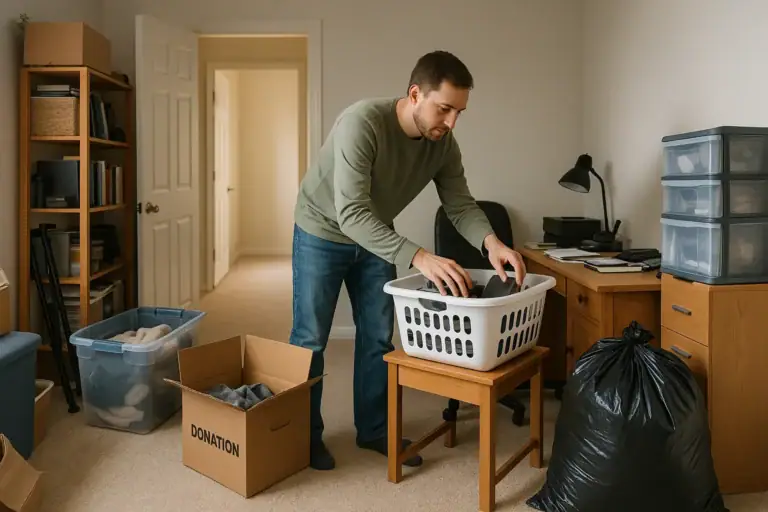
Do not empty every cabinet onto the floor. Start with a contained sorting setup near the bathroom, but outside the main walking area if possible. Gather a small trash bag, a container for recycling accepted where you live, a laundry hamper, a handled basket for items that belong elsewhere, and a box for donations that a chosen recipient has confirmed it accepts.
Use separate holding areas for items that need disposal guidance. Keep medicines secure and separate from ordinary waste. Put used needles and other sharps directly into an appropriate sharps-disposal container, not into a basket or bag. Keep cleaners, aerosols, and unidentified products upright in their original containers while you check their labels and local disposal options.
Make a first pass for only three easy categories: obvious trash, laundry, and clearly misplaced items. This opens usable counter and floor space without creating one large mixed pile.
Declutter one bathroom zone at a time
Choose one bounded zone: the counter, one drawer, one cabinet shelf, the shower ledge, or one towel group. Finish that zone before opening another one.
- Remove only the contents of the chosen zone. Keep them on one cleared counter section or a towel so they remain contained.
- Group similar items. Gather dental supplies, hair accessories, daily-use products, and unopened backstock separately.
- Choose a destination. Decide whether each item will stay, move elsewhere, be donated if accepted, be recycled if locally accepted, go in ordinary trash, or wait for disposal guidance.
- Return what stays. Put daily-use items in the easiest-to-reach space. Give backstock one defined shelf, bin, or section.
- Close the zone. Return keepers and place outgoing items in their correct container before moving to another drawer or shelf.
If you find a leaking, corroded, unlabeled, or otherwise questionable container, avoid handling it more than necessary. Keep children and pets away and contact your local household hazardous-waste program or other local authority for instructions.
Make a clear decision for each category
Keep an item in the bathroom when it is usable, belongs there, and has an assigned home. Relocate it when another room is its logical home. Donate only items that are usable, unopened when required, and accepted by a specific organization. Follow product labels and local program rules for recycling and disposal.
| Item category | Decision | Immediate destination |
|---|---|---|
| Empty packaging | Recycle only if your local program accepts the material; otherwise discard it. | Recycling container or trash bag |
| Towels and clothing | Wash, keep, repurpose, or donate if a recipient accepts them. | Hamper, rag bag, or donation box |
| Items belonging elsewhere | Relocate after the current zone is complete. | One handled relocation basket |
| Unopened usable duplicates | Keep only within a defined backstock area, or donate if accepted. | Assigned shelf or sealed donation box |
| Medicines | Follow the label and disposal guidance; use a take-back option when available. | Secure holding area pending disposal |
| Used needles and other sharps | Do not put them loose in sorting bags, trash, or recycling. | Sharps-disposal container |
| Cleaners, aerosols, and unknown liquids | Keep labels on, do not mix products, and check local guidance. | Separate stable tray or area |
| Cosmetics and toiletries | Keep products you use and evaluate changed or unwanted products individually. | Daily-use area, backstock area, or appropriate disposal route |
| Broken grooming electronics | Check local electronic-waste rules before discarding. | Labeled outbound box |
Separate items that need special handling
Unused or expired medicines
The FDA recommends take-back options for most unused or expired medicines. The DEA collection-site locator can help identify year-round locations, although each collector may accept different items.
If a take-back option is unavailable, consult the FDA’s instructions and the medicine label. Only medicines on the FDA flush list should be flushed. For other eligible medicines, the FDA describes a household-trash method that includes mixing the medicine with an undesirable substance, sealing the mixture, and removing or obscuring personal information on the packaging. Check labels and local guidance for inhalers and aerosol medicines.
Used needles and other sharps
The FDA advises placing used sharps immediately in a sharps-disposal container. Keep the container away from children and pets, and follow local rules for disposal when it is about three-quarters full. Community programs vary and may include supervised collection, household hazardous-waste facilities, mail-back services, or special pickup.
Cleaners, aerosols, and unknown products
Read the product label before deciding where an item goes. The EPA advises keeping leftover hazardous products in their original labeled containers and never mixing them. Contact your local environmental, health, or solid-waste agency for current household hazardous-waste instructions. Local programs differ in what they accept, along with schedules and fees.
Do not pour out an unknown liquid or combine partly used products to save space. If a container is corroded, seek local handling instructions rather than transferring its contents yourself.
Cosmetics and toiletries
Do not use one universal discard date for every cosmetic. The FDA notes that ordinary cosmetics are not universally required to carry expiration dates. Review product instructions and consider storage history, contamination, separation, drying, and changes in odor, color, or texture. Products regulated as drugs, including sunscreen and some acne treatments, have expiration dates that should guide the decision.
Hypothetical one-drawer example
Imagine a vanity drawer with daily dental supplies, an unopened duplicate tube of toothpaste, hair ties, expired sunscreen, an old prescription bottle, and lotion with a changed odor.
Return the dental supplies and hair ties to defined sections. Put the sealed toothpaste in the limited backstock area or a donation box only after confirming a recipient accepts it. Follow the sunscreen label because it is regulated as a drug. Keep the prescription bottle secure while arranging take-back or reviewing FDA disposal instructions. Set the changed lotion aside to review its label and determine the appropriate local disposal route. The drawer is finished only when every item has a destination; nothing becomes an unsorted hallway pile.
Finish without moving clutter elsewhere
Process each outbound container as part of the project rather than leaving it for later:
- Take ordinary trash and locally accepted recycling to their normal collection points.
- Start laundry or place the hamper where it belongs in your usual routine.
- Empty the relocation basket by putting each item directly in its assigned room.
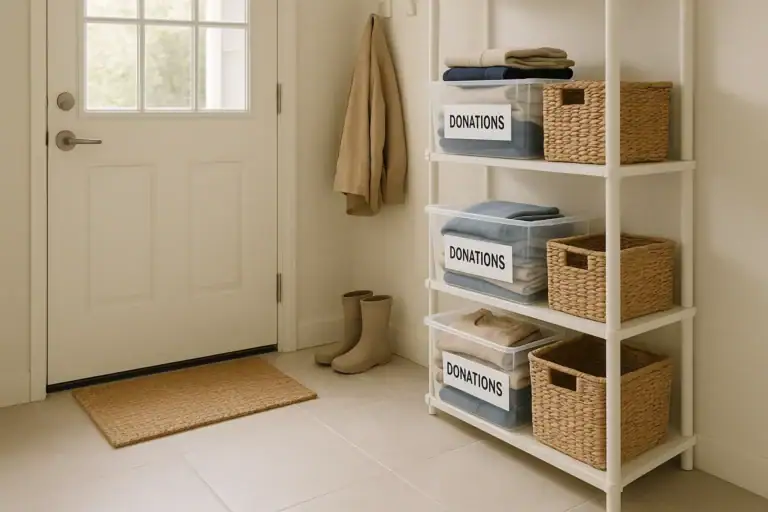
- Seal donation items and make a specific drop-off plan. A donation staging zone can keep a ready-to-go box from returning to the bathroom.
- Store medicines and other special-disposal items securely while you confirm their destination.
Wait to buy organizers until you know what remains and have measured the finished space. A container can divide a shelf, but it cannot solve excess products or unresolved disposal decisions.
Bathroom reset checklist
- The counter and floor are clear enough for normal use.
- Each opened drawer, cabinet, or shelf has been completed.
- Medicines, sharps, chemicals, and unknown products are separate from ordinary trash.
- Trash and accepted recycling have left the bathroom.
- The relocation basket has been emptied rather than parked elsewhere.
- Donation items are sealed and have a departure plan.
- Kept items have assigned homes, including a limited backstock area.
- Any new organizers will be selected only after measuring the finished space.
For more practical household routines, visit the Cleaning & Organization guide.
 How to Organize a Cluttered Room Without Feeling Overwhelmed
 How to Set Up a Donation Staging Zone for Decluttering