Quick answer: Furnace short cycling is repeated stopping and restarting before the thermostat’s heat request is met. If there is no gas odor, carbon monoxide alarm, smoke, or unfamiliar burning odor, check thermostat settings, a manual-approved filter, and visible register obstructions. If the pattern continues, turn the system off and arrange qualified service.
Furnace short cycling: start with safety
Do not troubleshoot a furnace if you smell sulfur or rotten eggs, hear hissing near gas equipment, see smoke or fire, or hear a carbon monoxide (CO) alarm.
- Suspected gas leak: Leave immediately. Do not touch the thermostat, switches, plugs, or other potential ignition sources. From outside, call 911 and the emergency number for your gas utility. This follows gas-emergency guidance from National Grid; use the emergency contact for the utility that serves your home.
- CO alarm or possible CO symptoms: Get outside into fresh air immediately, call 911 or the fire department, and seek medical help for symptoms. The U.S. Consumer Product Safety Commission lists headache, fatigue, nausea, dizziness, and shortness of breath among possible CO symptoms.
- Smoke, visible fire, or sparking: Evacuate and call 911.
Soot, an unfamiliar or burning odor, visible vent damage, or a furnace that cannot heat properly also warrant qualified attention. Do not continue operating the furnace while waiting to see whether those signs disappear.
What counts as furnace short cycling?
Short cycling is a repeated pattern in which a furnace starts, stops before the thermostat’s heat request is satisfied, and then starts again. A heating cycle that ends because the home reached the requested temperature is not automatically a problem.
Carrier’s homeowner guidance notes that cycles under roughly 5 to 10 minutes can be a warning sign. That is not a universal diagnostic threshold: equipment controls, staging, weather, and thermostat operation can affect runtime. The more useful question is whether the same early-shutdown pattern repeats while the thermostat is still requesting heat.
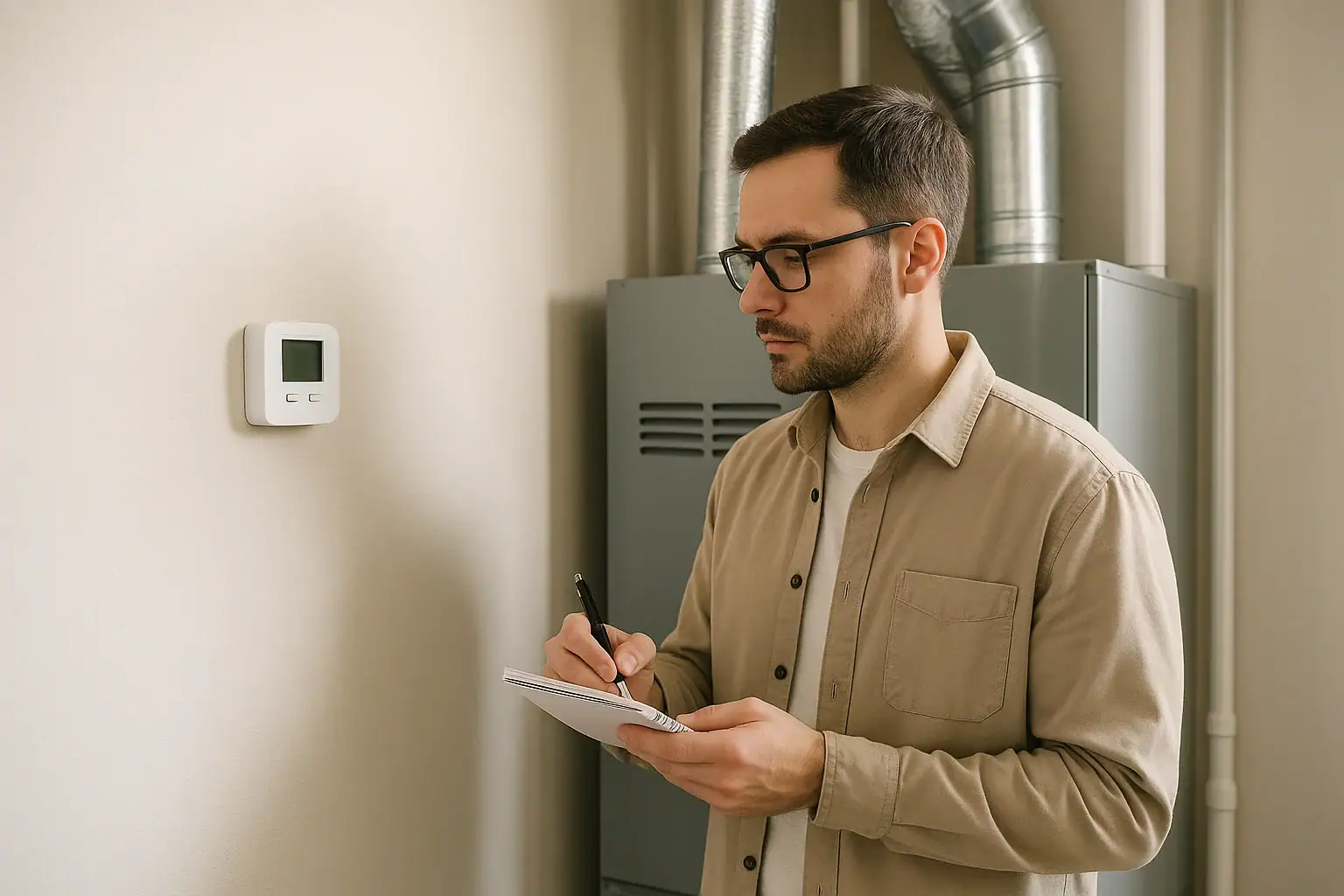
Observe one cycle with the furnace closed
Keep furnace panels in place. From the thermostat and normal living area, make a brief record of:
- Room temperature, requested temperature, and thermostat mode
- Whether the thermostat still requests heat when heating stops
- Approximate time from startup to shutdown
- Whether heating stops while the blower continues to run
- Whether the system retries, remains off, or reaches the set temperature
- Any message visible on an accessible display
- Any unusual odor, noise, soot, or visible vent damage
If an accessible display shows a message, a photo can be useful for a technician. Do not remove a cover or open a combustion or electrical compartment to look for codes.
Safe checks before calling for service
Check the thermostat
Confirm that the thermostat is set to Heat and that its requested temperature is above the displayed room temperature. Check whether a schedule, temporary hold, or energy-saving setting may be ending the heat request. If the thermostat has accessible batteries and its instructions allow homeowner replacement, replace them as directed.
Also consider whether direct sun, a nearby lamp, a supply register, or a draft could affect the thermostat reading. Do not change wiring, calibration, installer settings, or equipment configuration. If the displayed temperature seems inaccurate, see Thermostat Reads the Wrong Temperature: Simple Fixes.
Inspect only the filter identified in the manual
If your furnace or air-handler manual identifies a homeowner-serviceable filter, follow its instructions for access, size, orientation, and replacement type. Replace a visibly loaded filter or one due for replacement with the specified filter. The U.S. Department of Energy advises cleaning or replacing furnace filters monthly or as recommended for the equipment.
Do not run the system without a required filter or cabinet cover, and do not substitute a different filter type based on a generic recommendation.
Clear visible register obstructions
Make sure accessible warm-air registers and return grilles are not visibly covered by furniture, rugs, drapes, or stored items. DOE advises keeping warm-air registers clear. This is not an invitation to adjust dampers, close multiple registers, or alter ductwork. If you need help identifying openings, review Supply Vent vs. Return Vent: How to Tell the Difference.
Short-cycling symptom and next-step checklist
| What you observe | Safe next step |
|---|---|
| Rotten-egg or sulfur odor, or hissing near gas equipment | Leave without touching thermostats or switches. From outside, call 911 and your serving gas utility. |
| CO alarm or possible CO symptoms | Go outside immediately, call 911 or the fire department, and seek medical help for symptoms. |
| Smoke, visible fire, or sparking | Evacuate and call 911. |
| Soot, unfamiliar burning odor, or visible vent damage | Do not continue operating the furnace. Request qualified service. |
| Heating stops after warm-up while the blower continues and the thermostat still requests heat | Record the pattern. Check only the manual-approved filter and obvious register obstructions. If it repeats, turn the system off and request service. |
| The thermostat ends the heat request unusually quickly | Check mode, setpoint, schedule, accessible batteries, and nearby sun, drafts, or heat sources. Do not alter wiring or installer settings. |
| The furnace stops within seconds, repeatedly retries, or repeats the same displayed message | Stop repeated testing and arrange qualified service. Do not bypass controls or repeatedly reset power. |
| The furnace reaches the requested temperature and remains off normally | Record the timing and conditions. Runtime alone does not establish a fault. |
Why a blower-only period is worth noting
A blower may continue briefly after heating stops. When heating repeatedly stops before the thermostat is satisfied and the blower continues, record that sequence rather than trying to identify a failed part. Carrier notes that restricted airflow can raise furnace temperature and activate a limit control, but timing alone cannot identify the cause. Internal controls and combustion-related components require model-specific testing by a qualified technician.
Make one careful recheck
After correcting a straightforward issue, such as replacing a due filter with the specified type or uncovering a register, observe one normal thermostat-requested cycle. Avoid repeatedly raising the setpoint, resetting power, or forcing more ignition attempts.
If the furnace again stops before satisfying the thermostat, switch it off using the normal thermostat control, provided there is no suspected gas leak that requires immediate evacuation. Then arrange HVAC service.
Hypothetical example: what to record
Assumptions: There is no gas odor, CO alarm, smoke, soot, or unfamiliar burning odor. The thermostat remains in Heat mode and still requests heat. Heating stops after several minutes, the blower continues, and the furnace later starts again.
The homeowner checks the filter using the equipment manual, finds that it is due for replacement, installs the specified replacement, and clears an obstructed register. They observe one cycle. If the same early shutdown returns before the set temperature is reached, the useful conclusion is that service is needed—not that a particular control has failed.
What to tell the technician
- Furnace make and model, if available without removing a panel
- Thermostat reading, setpoint, mode, and schedule status
- Approximate runtime before each shutdown
- Whether the thermostat still requested heat
- Whether the blower continued to run
- Any accessible display message and whether it repeated
- When the filter was last changed and the replacement type used
- Recent thermostat, filter, duct, or furnace work
- Outdoor conditions when the pattern occurred
For more heating and indoor-comfort guidance, visit the Air & Comfort guide.
 Thermostat Reads the Wrong Temperature: Simple Fixes
 Ceiling Fan Wobbling: Safe Checks Before Balancing
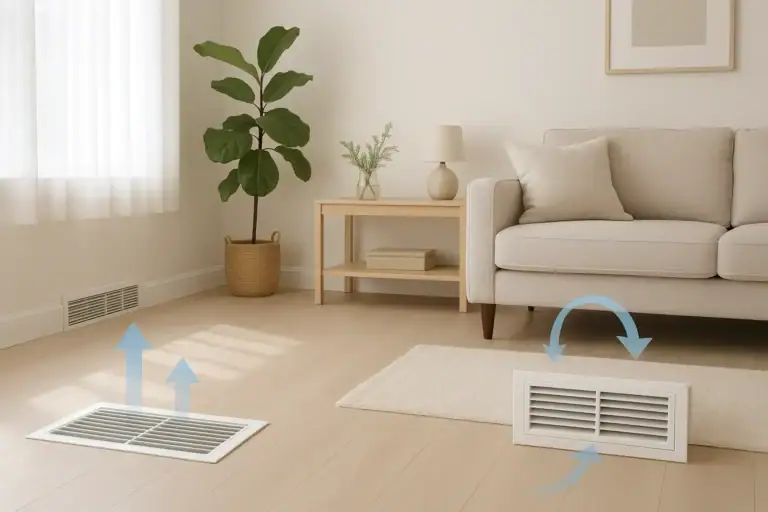 Supply Vent vs Return Vent: How to Tell the Difference in Your Home