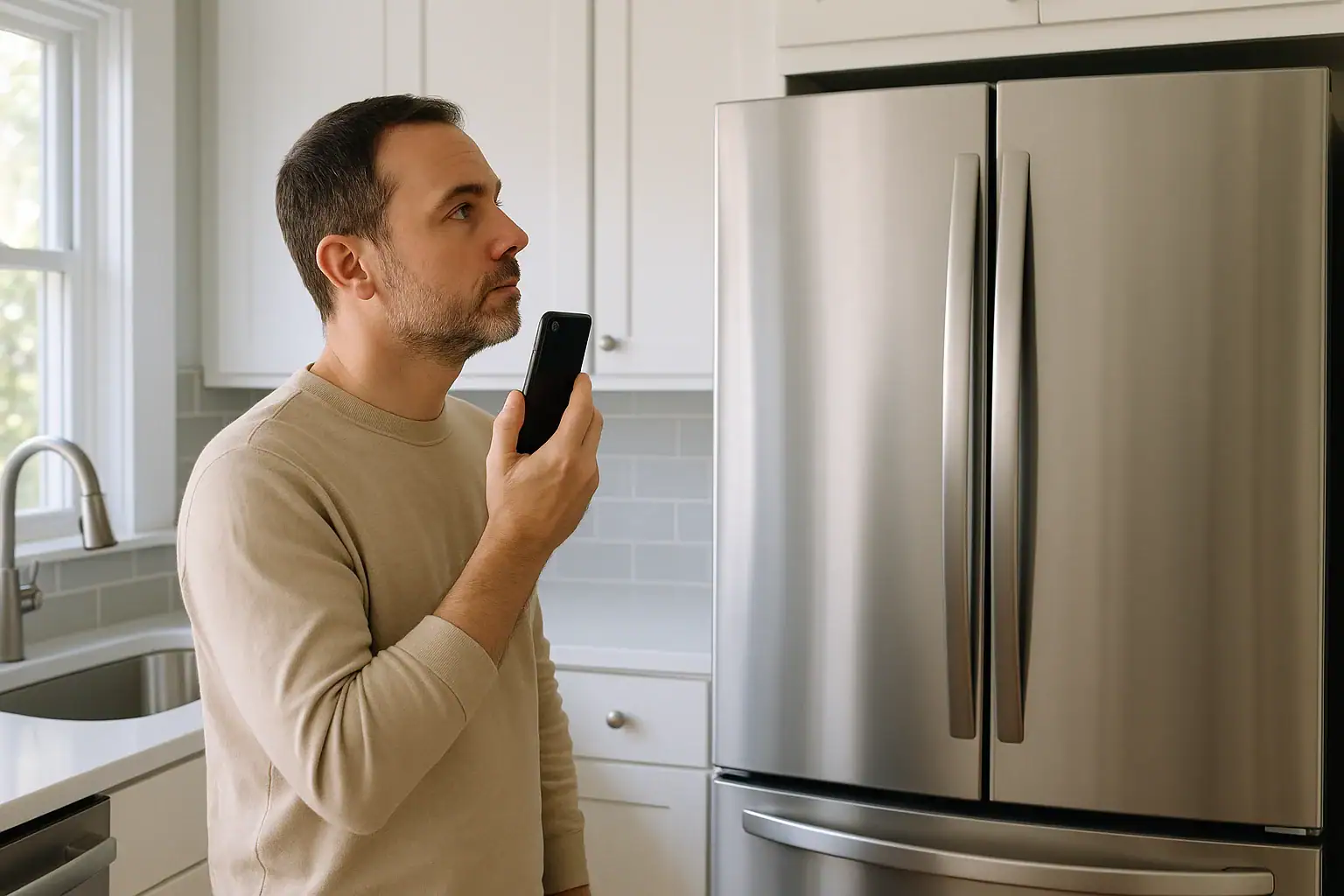
Quick answer: A refrigerator making noise may be operating normally when the sound is brief and cooling is stable. Note when and where it happens, then compare it with the model manual. Arrange service for new loud or persistent sounds, scraping, or noise paired with poor cooling, frost, water, or an error code.
How to troubleshoot a refrigerator making noise
Start with the pattern rather than trying to name a failed part. Note when the sound occurs, where it seems loudest, whether it is new or changing, and whether the refrigerator is still cooling normally. Terms such as humming, buzzing, and knocking are subjective, and the sound alone rarely identifies one cause.
On applicable models, brief clicks, gentle gurgling, defrost-related dripping or sizzling, ice dropping, and water-valve activity can be normal operating sounds. GE Appliances lists these sounds as normal for applicable refrigerators. Use your refrigerator’s model number to find its manual and compare the pattern with the manufacturer’s guidance.
Quick refrigerator noise decision table
| What you observe | Practical next step |
|---|---|
| Brief clicking, gurgling, hissing, popping, or a moderate operating hum while cooling remains stable | Observe the pattern and compare it with the sound section of the model manual. |
| Ice drops into the bin, or grinding occurs only while actively dispensing ice | This can be normal on an ice-equipped model. Record and investigate a major change in volume or grinding when the dispenser is not in use. |
| A rattle changes after nearby items are moved, or the refrigerator rocks | Move objects away from the cabinet and follow the model manual’s leveling instructions if needed. |
| A recurring buzz occurs with the ice maker enabled and water is unavailable | Verify that water is available. If there is no water supply, turn off the ice maker using the model-specific instructions. |
| Scraping or a fan-strike-like sound occurs, especially if it changes when a door opens | Arrange model-specific appliance service. Do not remove panels or attempt to clear internal ice. |
| A new loud or persistent noise occurs with weak cooling, frost, water, or an error code | Minimize door opening, document the symptoms, and arrange service. |
| Smoke, sparks, or a visibly damaged plug are present | Do not continue home troubleshooting. Stop using the appliance and seek qualified assistance. |
What common refrigerator sounds can indicate
Humming or buzzing
A refrigerator can hum during ordinary operation. On some models, a repeating buzz can also occur when an enabled ice maker attempts to fill without water. GE notes this pattern for applicable models and advises checking whether water is supplied to the appliance. If no water supply is available, use the manual’s instructions to disable the ice maker.
Do not treat humming or buzzing as proof that a compressor has failed. A meaningful change in the sound, repeated starting attempts, weak cooling, or an error message gives service personnel more useful information than the sound label alone.
Clicking, popping, hissing, or gurgling
Brief clicks and fluid-like sounds may be associated with normal cooling and defrost operation. GE includes refrigerant gurgling and defrost dripping or sizzling among normal sounds for applicable refrigerators. A hiss by itself does not establish that refrigerant is leaking.
Pay closer attention when a formerly brief sound becomes persistent or very loud, or when it appears with warming temperatures, visible water, frost, or a display message.
Rattling or knocking
Check simple external sources first. A container on top of the refrigerator, an object touching the cabinet, or loose removable contents can vibrate as the appliance runs. Move those items away and listen again without moving the refrigerator or accessing its rear components.
If the refrigerator visibly rocks, consult the manual for the correct leveling procedure for that model. Avoid adjustments that require unsafe moving, panel removal, or access to electrical parts.
Grinding or scraping
Grinding during active ice dispensing may be expected on some ice-equipped refrigerators. However, Samsung advises service for very loud grinding or grinding when ice is not being dispensed. Samsung also identifies a fan-hitting-ice sound that stops when a door opens as a service situation on its models.
That door-opening behavior is a useful clue, not a universal diagnosis. Do not reach toward a fan, remove refrigerator panels, or use a hair dryer, heat gun, sharp tool, or open flame to remove suspected ice. Samsung specifically warns against using a hair dryer or other heat source for defrosting. If frost is visible around the door area, see this guide to checking freezer frost around the door for safe external checks.
A no-disassembly observation checklist
- Make a short recording. Capture the sound and, if relevant, the control display.
- Note the timing. Write down whether it happens during cooling, after a door closes, during ice filling, or while dispensing ice.
- Identify the general area. Listen near the freezer, fresh-food compartment, ice maker, and lower exterior without removing panels.
- Check related symptoms. Look for an error code, visible frost, water, unusual odors, or a change in thermometer readings.
- Rule out external vibration. Move objects away from the cabinet and check whether the appliance rocks.
- Find the model number. Use it to locate the manufacturer’s sound and troubleshooting instructions.
- Provide useful details to service. Share the recording, timing, location, display code, and cooling symptoms rather than guessing which component has failed.
Worked example: separating vibration from an internal noise
Hypothetical example: A refrigerator begins rattling during cooling, but its temperatures remain stable and there are no error codes, leaks, frost, or electrical warning signs.
First, record the noise and note that it occurs while the refrigerator is running. Next, move a tray resting on top of the cabinet and any item touching its sides. If the rattle stops after external contact is removed, continue observing without taking the refrigerator apart. If external changes do not affect the sound and it becomes a persistent scrape or cooling declines, stop the external checks and arrange service.
When cooling and food safety take priority
If a noise is paired with weak cooling, keep doors closed as much as practical while you document the condition and arrange service. If the concern includes an actual power outage, FoodSafety.gov states that a closed refrigerator generally keeps food safe for up to four hours.
For an outage, use the agency’s food-specific chart rather than applying one rule to every item. The chart directs consumers to discard many perishable foods held at 40°F (4°C) or above for more than two hours. Do not taste food to decide whether it is safe.
When to arrange professional service
Contact the manufacturer or a qualified appliance technician when a sound is new and very loud, persistent, scraping, or paired with weak cooling, heavy frost, water, or an error code. GE states that a freezer sound resembling a fan blade hitting something is not normal and recommends service for that condition.
Do not remove panels, test energized components, handle refrigerant lines, force diagnostic modes, or attempt to diagnose a compressor from sound alone. For more practical appliance and plumbing guidance, visit the Water & Kitchen guide.
Frequently asked questions
Does a noise that stops when the refrigerator door opens mean the fan is bad?
Not necessarily. Opening a door can change fan operation, airflow, vibration, and the refrigerator’s control state. Samsung treats a fan-hitting-ice sound that stops when a door opens as a service clue for its models, but the behavior does not prove one cause across every brand.
Why is my refrigerator suddenly louder even though it still cools?
Check for external objects touching the cabinet, an unstable refrigerator, loose removable contents, and recent ice-maker or dispenser activity. Record the pattern and compare it with the model manual. Arrange service if the increase persists, becomes very loud, or is joined by frost, water, an error code, or declining cooling.
Can sound alone confirm a failing compressor?
No. Humming, buzzing, clicking, and knocking can occur for several reasons, including normal operation. A diagnosis requires the sound pattern, operating behavior, cooling performance, model information, and sometimes professional testing.
 How to Safely Remove a Stuck Refrigerator Water Filter
 Microwave Sparking Inside: Safe Checks and Next Steps
 Coffee Maker Descaling Schedule for Better Taste: A Simple Checklist