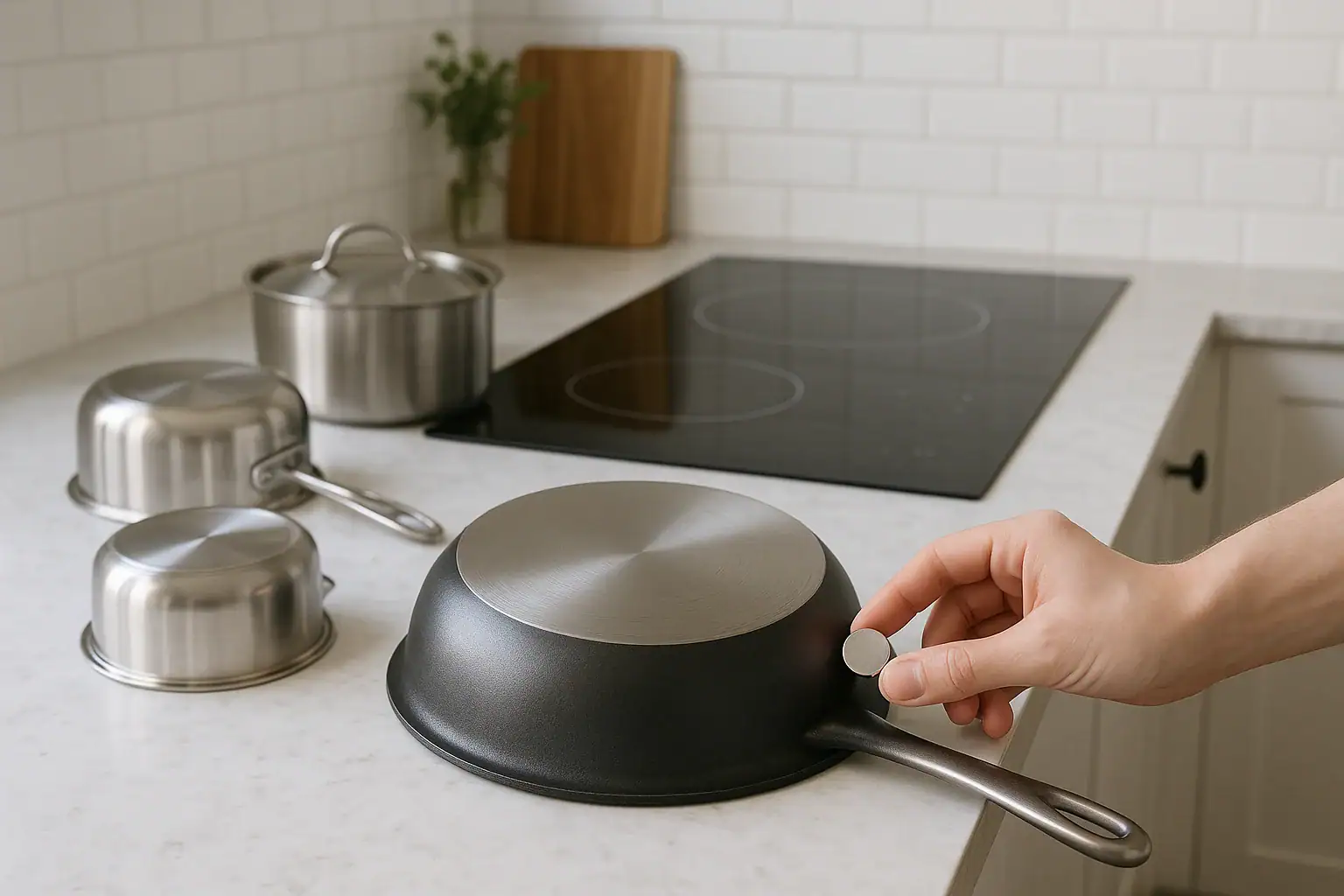
How the magnet test tells you if cookware works on induction
Induction cooktops only heat cookware made with magnetic metal. A simple refrigerator magnet is usually enough to tell you if a pot or pan will work.
Press a magnet firmly against the bottom of your cookware. If it sticks with clear pull and does not slide off easily, the pan is generally compatible with induction. If the magnet does not stick at all, that piece will not heat on an induction burner.
This checklist walks you through the magnet test step by step, plus a few extra checks so you do not damage your cooktop or waste time with the wrong pans. For more kitchen basics and water-related tips, you can also visit the Water & Kitchen hub at Signature Home Guide.
Quick induction magnet test checklist
1. Gather what you need
- A small, plain refrigerator magnet (no thick rubber backing if possible)
- A clean, dry pot or pan
- A flat surface with good light
2. Check the bottom of the pan first
- Turn the cookware upside down so the base is facing up.
- Wipe off any grease or food so the magnet makes direct contact with the metal.
- Place the magnet flat on the center of the base.
Result guide:
- Strong, secure hold: The magnet sticks firmly and is a bit hard to slide or pull off. This usually means the pan is induction compatible.
- Weak or patchy hold: The magnet sticks in some spots but not others, or feels like it could fall off. The pan may heat unevenly or may not work well on all induction burners.
- No hold: The magnet will not stick anywhere on the base. This pan will not work on an induction cooktop.
3. Test more than one spot
Some pans have a layered or disc-style base. To avoid surprises:
- Move the magnet around the base: center, near the edge, and across any visible seams or discs.
- Note any areas where the magnet suddenly loses grip; those spots may not heat evenly.
4. Check the size and flatness
Even if your magnet test is strong, the pan still needs to match your cooktop’s size and surface requirements:
- Diameter: Compare the base of the pan to the marked cooking zone on your induction cooktop. Most manufacturers specify a minimum and maximum pan size for each zone in the user manual.
- Flatness: Set the pan on a flat counter and gently press on opposite sides of the rim. If it rocks, the base may be too warped to make consistent contact with the glass surface.
Using undersized or badly warped pans can cause poor heating or error codes. For safety and performance details, follow your cooktop’s manual and, when available, guidance from the manufacturer.
Material-by-material magnet test checklist
Use this quick guide to understand what your magnet test is telling you for different types of cookware.
Cast iron and enameled cast iron
- Expected result: Magnet sticks very strongly almost everywhere.
- Notes: Bare and enameled cast iron are usually excellent for induction. Just make sure the base is smooth enough not to scratch the glass surface.
Carbon steel
- Expected result: Strong magnet hold across the base.
- Notes: Carbon steel pans are typically induction compatible if the base is reasonably flat.
Stainless steel
- Expected result: Varies. Some stainless is magnetic, some is not.
- Checklist:
- If the magnet sticks firmly: usually induction compatible.
- If the magnet only sticks in the center: likely a magnetic disc bonded to a non-magnetic body; may still work, but heat may be more concentrated in that area.
- If the magnet does not stick anywhere: not compatible.
Aluminum, copper, glass, and ceramic
- Expected result: Magnet does not stick at all, unless there is a special magnetic base.
- Checklist:
- Test the very center of the base and the outer ring.
- If the magnet sticks to a visible metal disc, the pan may be designed for induction.
- If there is no spot where the magnet holds, the pan will not work on induction.
Extra checks beyond the magnet test
Look for an induction symbol or labeling
Many manufacturers mark the bottom of the pan or the packaging with an induction symbol (often a series of loops or coils). If you see that symbol and your magnet test is strong, the pan is very likely suitable for induction use.
Consider weight and comfort
Induction-compatible pans, especially cast iron and multi-layer stainless, can be heavy. Before you commit to using a piece regularly:
- Lift it as if you were moving it full of food.
- Check that the handle feels secure and comfortable in your hand.
Check your cooktop manual for limits
Induction cooktops can have specific limits on pan size, weight, and base material. For safe operation, review the manufacturer’s instructions that came with your appliance. The U.S. Consumer Product Safety Commission home safety guidance also encourages following appliance manuals closely to reduce fire and burn risks.
What to do if your favorite pan fails the magnet test
If the magnet does not stick, you have a few options:
- Use that pan on another heat source: Keep it for gas or electric coil burners if you have them.
- Look for a similar pan in a magnetic material: For example, replace a non-magnetic stainless skillet with a magnetic stainless or carbon steel version.
- Induction interface discs: Some products act as a magnetic plate between the cooktop and a non-magnetic pan. These can work, but they may reduce efficiency and can add heat stress to the cooktop surface. Check your cooktop manual; some manufacturers advise against them.
Simple safety checklist when using induction cookware
- Only use cookware with flat, smooth bases to reduce the chance of scratching or chipping the glass surface.
- Keep the cooktop surface clean and dry before placing a pan to avoid trapped food or grit that can damage the glass.
- Do not slide very heavy pans aggressively across the surface.
- Follow the appliance’s guidance on maximum pan size and weight for each burner.
- Unplug portable induction units when not in use and keep cords away from hot surfaces, as recommended in general small-appliance safety guidance from the U.S. Consumer Product Safety Commission on home kitchen appliances.
Putting it all together
The magnet test is a quick, practical way to check induction compatibility at home:
- If a magnet sticks firmly to the base, the pan is generally induction ready.
- If the magnet does not stick, that pan will not heat on an induction cooktop.
- Flatness, size, and manufacturer instructions still matter for safe, even cooking.
Use this checklist when you sort through your existing cookware or shop for new pieces, and keep your broader kitchen setup in mind. For more practical kitchen guidance, you can explore the Signature Home Guide Water & Kitchen collection.
 Freezer Frost Around the Door: Simple Fixes and Checks
 How to Clean an Induction Cooktop Without Scratches: Step-by-Step Guide
 Fridge Door Seal Test Checklist for Better Energy Use and Food Safety