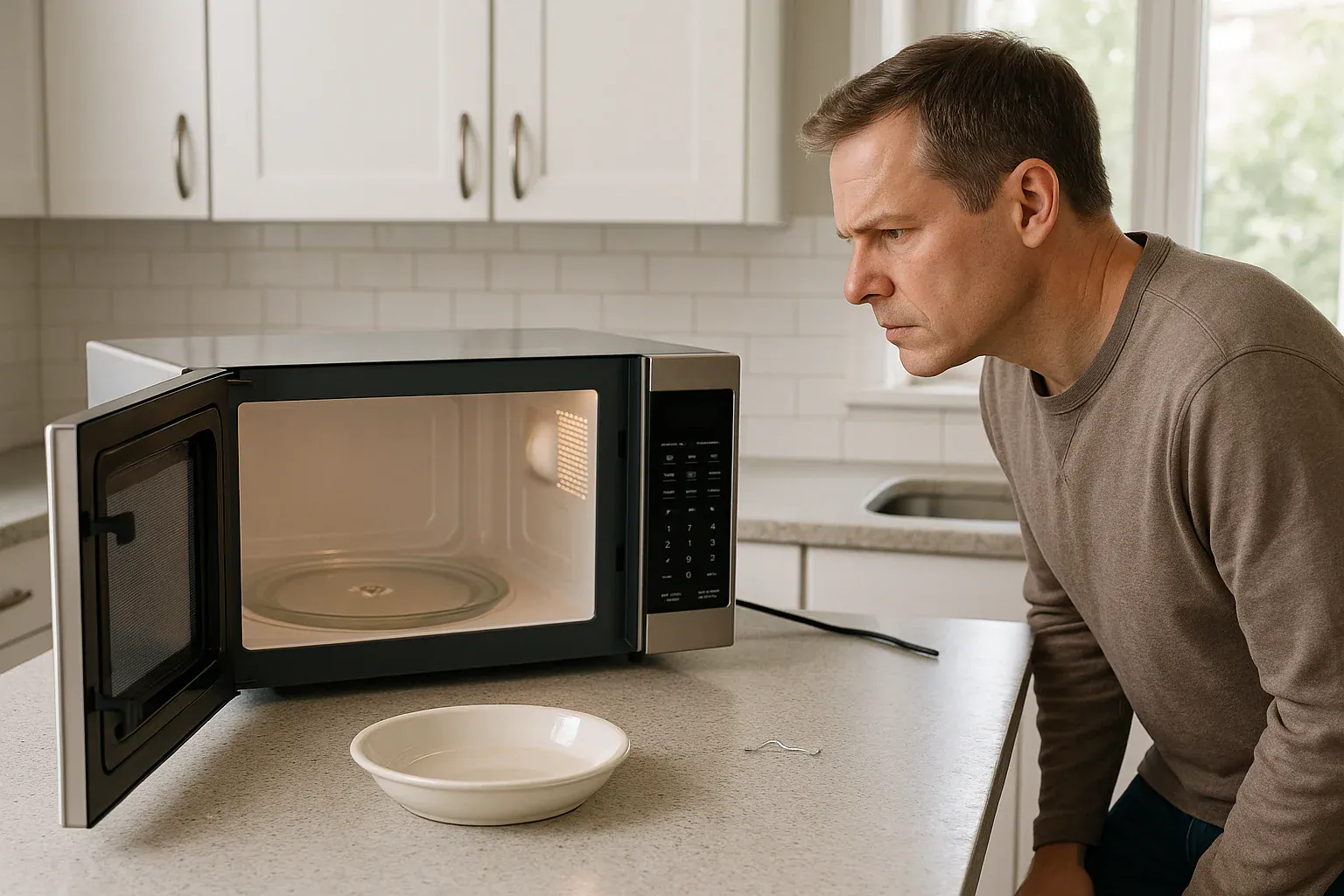
Quick answer: Stop the microwave immediately. If smoke or flame is active, keep the door closed and turn it off; disconnect power only if it is safely reachable. Once cool, inspect visible areas for metal, residue, incorrect accessories, or damage. Do not use it again if sparks recur, damage is visible, or the cause is unclear.
What to do when a microwave is sparking inside
Stop the cycle as soon as you see a spark. A forgotten utensil or twist tie may explain an arc, but it is still worth checking the cooking compartment for marks or damage before considering further use.
If there is active smoke or flame, keep the door closed and turn the microwave off. The U.S. Fire Administration advises not opening the door until the fire is out. Disconnect power only if the plug or breaker is safely accessible. Leave the home and call 911 if the fire persists, spreads outside the appliance, or makes the area unsafe.
After a stopped spark event, allow the appliance and its contents to cool. Then examine only what is visible inside the cooking compartment. Do not remove the outer cabinet or any fixed internal part.
Safe checks after the microwave cools
Use good lighting and inspect the food, container, accessories, and visible cavity surfaces. Do not run the microwave empty while trying to identify the cause. LG lists empty operation, unsuitable cookware, rack placement, food spills, and cavity damage among potential sources of arcing.
Check food, containers, and packaging
Look for utensils, twist ties, poultry pins, foil seals, or metallic handles. Check dishes and cups for metallic rims or decoration. A container that looks plain may have metallic paint or trim.
Do not assume all metal accessories are prohibited. A manufacturer-supplied rack, probe, or limited foil use may be allowed for a particular model. Follow the manual for your exact microwave rather than guidance for another appliance.
Check a supplied rack or probe
A rack or probe used incorrectly can arc. If a supplied rack touched a cavity wall or appears out of position, leave it out until you have checked the exact model manual. Do not substitute an accessory from a different microwave.
Check for deposits and visible damage
Food deposits and grease can be associated with arcing. With the appliance cool and disconnected from power, clean accessible surfaces only as the manual directs. Do not scrape aggressively or remove a fixed panel to reach residue.
Look for heavy scorching, a hole, peeling coating, or a burned, cracked, loose, or missing interior cover or panel. LG directs owners to discontinue use when the cooking cavity is damaged. If you cannot tell whether a mark is removable residue or damaged material, leave the microwave unused and contact the manufacturer or a service provider.
Microwave sparking inside: observation and next-step guide
| What you observe | Conservative next step |
|---|---|
| Active smoke or flame | Keep the door closed and turn the microwave off. Disconnect power only if safely reachable. Leave and call 911 if the fire persists or escapes the appliance. |
| A fork, twist tie, foil seal, or metallic-trimmed dish was inside | After the cycle has stopped and items are cool enough to handle, remove the item and inspect the cavity for marks or damage before considering further use. |
| A supplied rack touched a wall or seems incorrectly positioned | Leave the rack out and consult the manual for the exact model. |
| Food residue is visible but no material damage is apparent | Disconnect power, let the microwave cool, and clean only as the manual directs. Stop use if a mark remains or appears damaged. |
| Sparks recur with cookware approved by the model manual | Stop using the microwave and arrange professional service or ask the manufacturer for model-specific guidance. |
| A burned panel, hole, peeling coating, or significant scorching is visible | Do not use the appliance. Contact the manufacturer about appropriate service or replacement guidance for the model. |
| The source is unknown or an electrical odor continues | Leave the microwave disconnected and seek service rather than trying additional cycles. |
Less-obvious sources of arcing
Metal is not always obvious. GE Appliances lists metallic decoration, twist ties, poultry pins, some recycled paper towels, improperly used probes, and incorrectly positioned racks as possible sources of arcing.
GE also notes that some foods, including green beans and carrots, may spark in certain cooking conditions, such as when little water surrounds them. That possibility does not explain away repeated or unexplained sparking. Stop the cycle and inspect for an obvious source or damage.
When to stop using the microwave
Cleaning may remove food residue, and removing an obvious non-approved item may remove the immediate source of a spark. Neither finding confirms that the microwave is undamaged.
Keep the appliance out of service when any of the following applies:
- Sparking returns after an obvious item has been removed.
- You cannot identify the source through a visual inspection.
- An interior cover or panel is burned, cracked, loose, or missing.
- The cavity has peeling coating, a hole, or substantial scorching.
- Smoke, an ongoing electrical odor, or unusual electrical noise occurs with the sparks.
- The cord, plug, or outlet appears heat-damaged.
Do not remove the microwave cabinet
Microwaves contain high-voltage parts that can be hazardous even after the appliance is unplugged. The U.S. Consumer Product Safety Commission warns against do-it-yourself internal microwave repairs, noting that unplugged ovens can still cause serious injury.
Do not remove the outer case, attempt to discharge internal parts, or diagnose internal components from the color, sound, or location of a spark. Any work requiring cabinet removal belongs with a qualified appliance technician.
How to help prevent future sparks
- Check the exact model manual before using foil, racks, probes, or specialty cookware.
- Remove twist ties, utensils, and foil seals before starting a cycle.
- Avoid dishes with metallic rims or metallic decoration unless their maker identifies them as microwave-safe.
- Clean spills after the microwave cools, following the model manual.
- Do not operate the microwave empty unless the manufacturer gives a model-specific instruction to do so.
- Stop the microwave promptly if sparking, smoke, or an unusual odor appears.
For more home appliance and kitchen guidance, visit the Water & Kitchen hub.
Frequently asked questions
Can food itself make a microwave spark?
Manufacturer guidance indicates that certain foods can spark in particular conditions. Stop the cycle and check for metal, residue, accessory placement, and visible damage. Do not assume food is the cause when arcing repeats or the source is unclear.
Can I replace a burned interior cover myself?
Follow the instructions for your exact model. Do not use a microwave with a visibly damaged interior panel or cover, and never remove the outer cabinet. Contact the manufacturer or a qualified service provider to determine the appropriate next step.
 How to Safely Remove a Stuck Refrigerator Water Filter
 Garbage Disposal Humming but Not Spinning: Safe Reset and Fix Steps
 Refrigerator Making Noise: What Needs Attention?