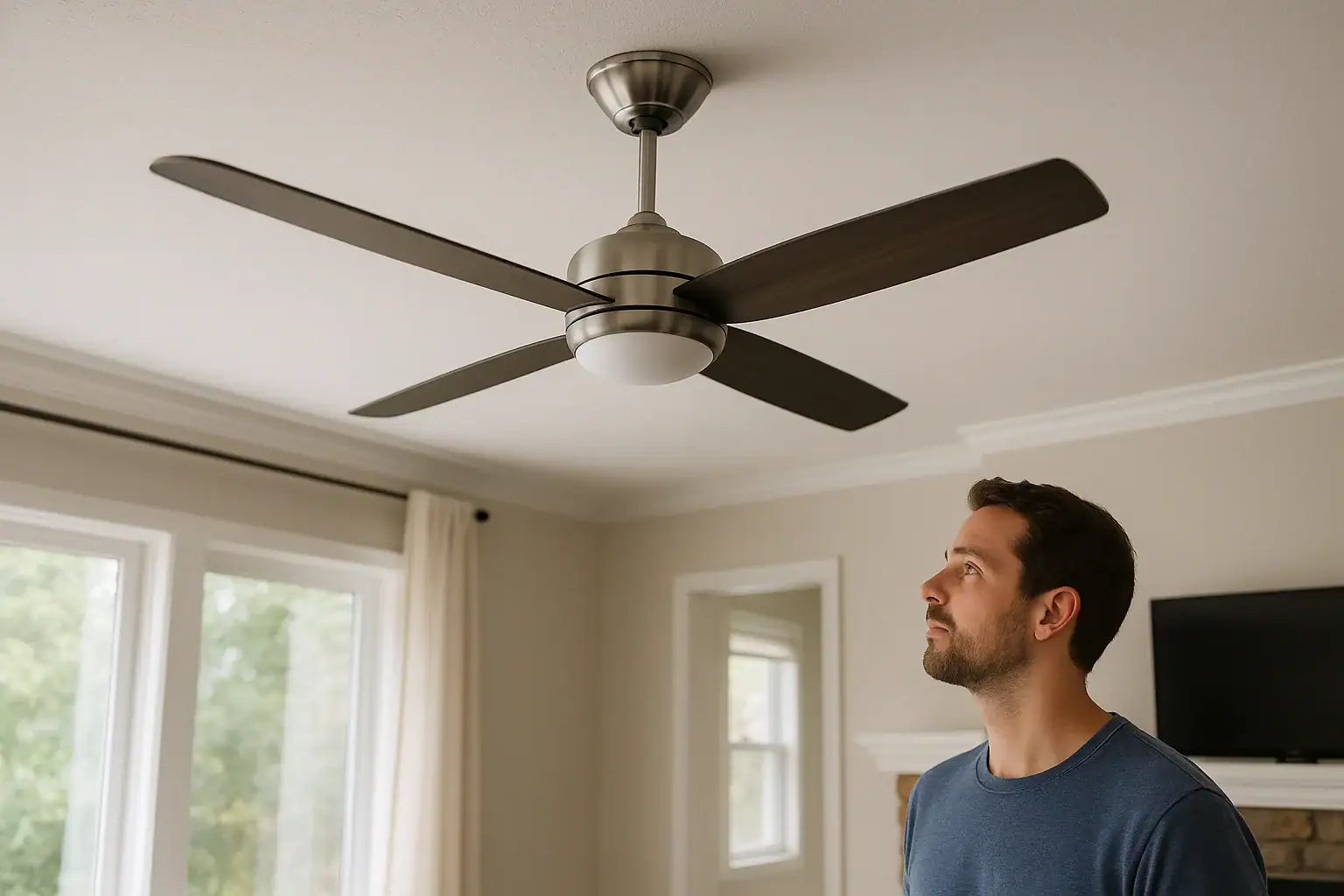
Quick answer: If a ceiling fan wobbling issue is sudden, noisy, or visible at the ceiling, turn it off and do not try to balance it first. With power disconnected, use the exact model manual to inspect blade condition and compare blade height at one consistent point. Check recalls before further use.
How to check a wobbling ceiling fan safely
Turn the fan off when its movement is sudden, worsening, noisy, or visible where the fan meets the ceiling. Wait until it has stopped completely, and keep people clear of the area below it while it is running down.
Do not begin with a balancing kit if a blade looks cracked, warped, loose, drooping, or separated at its attachment. Likewise, do not treat movement at the canopy, downrod, or ceiling surface as a routine blade-balance issue. Use the fan’s model-specific instructions and arrange appropriate inspection when the support area appears to move.
Before touching the fan or using a ladder, turn off power at the electrical panel. This is a stated precaution in the Hampton Bay Glendale AM212-WH manual. This article does not provide instructions for opening the canopy or working on wiring.
Blade movement or movement at the mount?
Observe the fan only from a safe position while it is operating. The location of the motion can help you choose the next question to investigate, but it does not diagnose the cause by itself.
- Possible blade-tracking or balance concern: the ceiling and canopy appear still, while one blade seems to run higher or lower than another or the motor housing oscillates below a stationary mount.
- Possible mounting or support concern: the canopy shifts against the ceiling, the downrod moves at its upper connection, or the ceiling surface around the fan appears to flex, gap, crack, or move.
If the mount or ceiling area appears to move, keep the fan off. Balancing weights address blade balance; they are not a substitute for inspection of the fan’s mounting and support.
Power-off visual checklist
With the circuit off and the fan stationary, use the exact manual as the authority for accessible fasteners, replacement parts, and permitted adjustments. A cautious visual check can include:
- Each blade for cracking, splitting, warping, discoloration, drooping, or separation near its attachment.
- The gaps between blades and the motor body for an obvious difference.
- Loose light shades, bulbs, pull chains, trim, or other visible parts that could account for a sound.
- The canopy and surrounding ceiling for visible gaps, damage, or movement.
- Dust on the blades, cleaned only by the method allowed in the model instructions.
Do not bend blade arms to make blades line up unless the exact manufacturer instructions expressly allow it. The Glendale AM212-WH manual specifically says not to bend its blade arms during cleaning or balancing.
Compare blade height at one consistent point
A repeatable comparison is more useful than measuring each blade at a different location. The Glendale manual directs owners to compare every blade at the same ceiling point. Other models can have different instructions, so check your own manual before using a measurement to decide what to do next.
- Disconnect power and wait for the blades to stop.
- Select the ceiling point or blade position identified by the model manual.
- Measure from that same point to the designated part of the first blade.
- Move the next blade into the identical position without forcing or bending any part.
- Record the result for every blade and compare the readings using the model’s instructions.
For the Glendale AM212-WH only, the manual uses a 1/8-inch deviation in its troubleshooting sequence: continued wobble within that amount leads to its balancing-kit procedure, while a larger difference leads to replacement brackets. That is not a universal ceiling-fan tolerance.
When a balancing kit may be appropriate
Use a balancing procedure only when the exact manual provides one or identifies a compatible kit, the mount and ceiling appear stationary, and no blade or attachment looks damaged or loose. Follow the kit’s placement directions rather than improvising weights or adhesives.
Hunter’s wobble guidance tells owners to check specified clearances and hardware before using the supplied balance kit. If wobble continues, Hunter directs owners to contact its support team with model information. Treat that as Hunter-specific guidance and defer to the instructions for your exact fan.
Ceiling fan wobbling: symptom-to-next-step checklist
| What you observe | Conservative next step |
|---|---|
| A blade is cracked, warped, loose, drooping, or separating | Keep the fan off. Consult the exact manual or manufacturer for approved parts or service directions rather than attempting to balance the blade. |
| Blade heights differ when compared at the same point | Use only the measurement method, limit, and remedy in the model manual. Do not apply another fan’s tolerance to your model. |
| The canopy, downrod, outlet-box area, or ceiling surface appears to move | Keep the fan off and arrange inspection of the mounting and support. Do not use weights to mask the movement. |
| The mount appears still, parts look intact, and the manual provides a balance-kit procedure | Follow that model-specific procedure, including its kit and placement instructions. Stop and contact the manufacturer if it does not resolve the wobble. |
| The fan matches a recall, or its identity cannot be confirmed | Follow the recall or manufacturer instructions before further use. Do not identify a fan by appearance alone. |
Check the model number and recall record
Find the brand and full model number in the manual, purchase records, product label, or manufacturer account. Use the manufacturer’s identification directions rather than making an unsafe climb to search for a label.
Then check the manufacturer and the U.S. Consumer Product Safety Commission recall notice for Hampton Bay Mara fans. For identified recalled Mara models, CPSC instructed consumers to stop using the fan and inspect it under the recall instructions. The notice identifies blade movement, uneven blade-to-body gaps, and clip movement as conditions requiring contact with the company for a replacement. Recall directions take priority over general troubleshooting.
Choose the right help
Contact the manufacturer for model identification, recall information, a compatible balancing kit, and approved replacement blades or brackets. For visible movement at the mount or ceiling, use a qualified professional who can assess the installation and support within the requirements that apply locally. If inspection would require opening the canopy or handling wiring, use a qualified electrical professional rather than proceeding with a blade-balancing task.
For more home comfort guidance, visit the Air & Comfort guide.
 Ceiling Fan Remote Not Working? Safe Steps to Try
 Furnace Short Cycling: Safe Checks Before Calling Service
 Thermostat Reads the Wrong Temperature: Simple Fixes