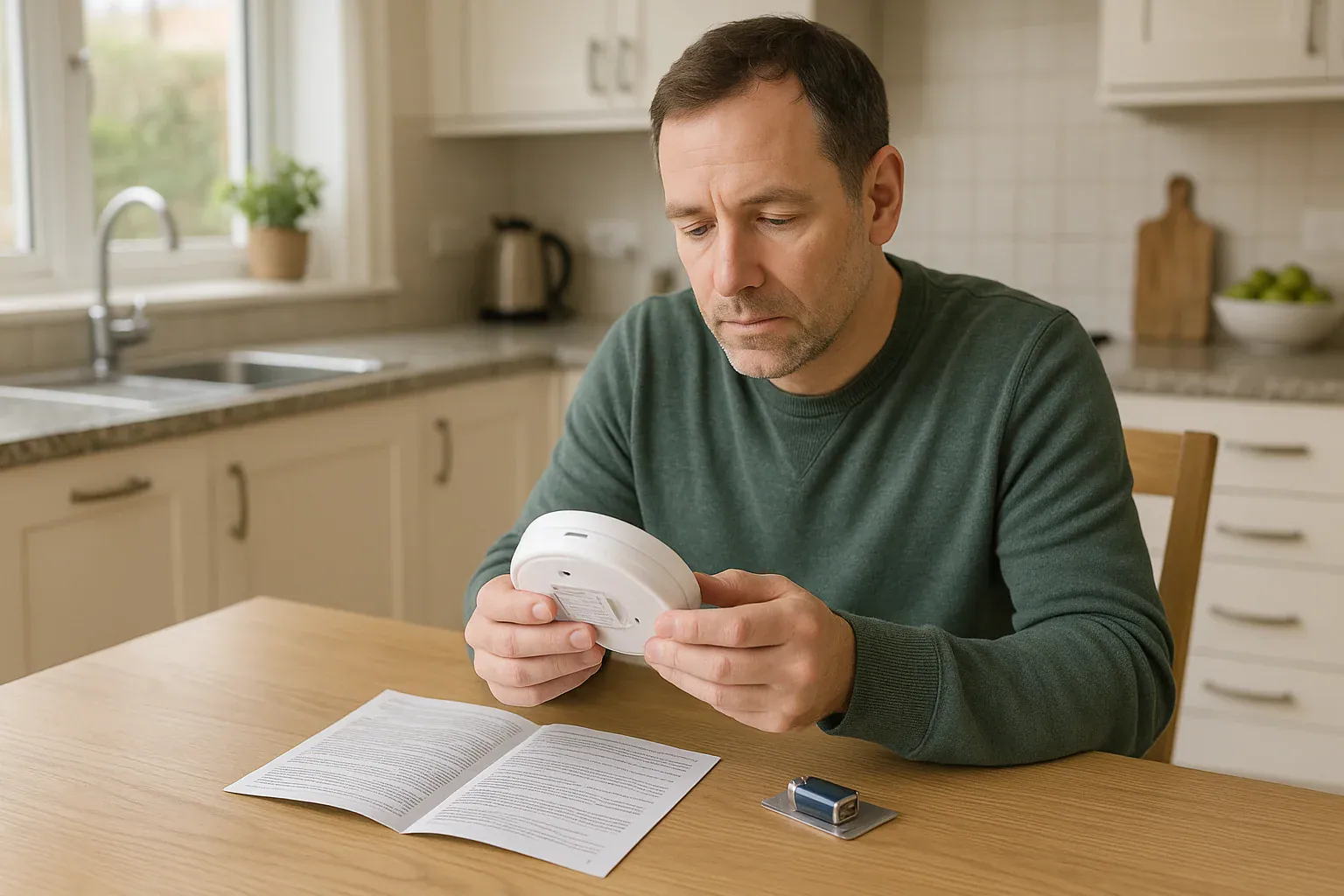
Quick answer: Before smoke alarm battery replacement, find the exact model and manual. Confirm whether the battery is removable, a hardwired backup, or sealed; use only the approved type; reassemble the unit as directed; then check its normal status and perform the manual-specified test.
Start smoke alarm battery replacement with the model
Do not assume a smoke alarm uses a 9-volt battery or has a user-replaceable battery. Read the label on the alarm and record its complete model number and date or manufacture information. Then find the manual for that exact model.
The manual is the controlling source for the approved battery type, battery access, locking features, power-disconnection sequence, normal status indication, and test method. The U.S. Fire Administration distinguishes disposable-battery alarms, long-life alarms with nonreplaceable batteries, and hardwired alarms, and advises following manufacturer instructions for maintenance.
Identify the battery design before opening the alarm
Removable battery
A battery-only alarm may have a rear compartment, front drawer, or another model-specific access point. Some alarms have a tamper pin or locking tab. Follow the manual’s release instructions rather than prying at the compartment or forcing the alarm off its mounting plate.
Hardwired alarm with backup battery
Hardwired describes the alarm’s main power source; it does not establish whether the backup battery is removable. Some hardwired alarms have a replaceable backup battery, while others have a sealed backup. On models with a removable backup, access may require taking the alarm down and disconnecting a quick-connect harness. Follow the manual’s stated sequence for circuit power, harness handling, battery access, reassembly, and power restoration.
If the manual calls for turning off a circuit, identify the correct breaker before proceeding. Stop and seek qualified electrical help if the electrical connection, connector, or wiring appears damaged, or if you cannot safely identify the circuit.
Sealed battery
A sealed-battery alarm has no user-replaceable battery. Confirm that design in the manual rather than relying only on the absence of a visible battery door. Do not open or modify the enclosure. Follow the manufacturer’s directions for deactivating and replacing the complete alarm when required.
Manufacturer instructions can vary substantially by model. For example, Kidde’s battery-replacement guidance describes different access methods for front-loading, rear-loading, and hardwired alarms, including models with a quick-connect harness.
Steps for smoke alarm battery replacement
- Record the label information. Note the brand, complete model number, and date information before taking the alarm down.
- Read the exact model manual. Confirm that the battery is replaceable and identify its required size, chemistry, and any approved battery list. Do not substitute a different battery type unless the manual permits it.
- Follow the specified access method. Release a battery drawer, mounting lock, tamper pin, or wiring harness only as the manual directs.
- Inspect before installing a new battery. Stop if the compartment, contacts, enclosure, or connector is cracked, corroded, loose, or otherwise damaged. Do not force, tape, or modify the alarm.
- Install the approved battery. Match the positive and negative markings on the battery to the compartment markings and make sure the contacts engage normally.
- Close the compartment without force. A drawer that will not close can indicate reversed polarity, an incorrect battery, an obstruction, or damage. Recheck the manual and the installation rather than defeating a lock or latch.
- Reassemble the alarm. Reconnect the harness, remount the alarm, and restore AC power only in the model’s specified order.
- Recommission the unit. Confirm the normal status indication described in the manual and perform its specified test. See how to test a smoke alarm safely for the separate testing task.
Condition-to-next-action guide
| Condition | Next action |
|---|---|
| Removable battery | Install the exact manual-approved battery in the indicated orientation, close the compartment, and complete the manual-specified test. |
| Sealed battery | Do not open the enclosure. Follow the manual’s directions for replacement of the complete alarm. |
| Hardwired alarm with removable backup | Treat the battery as backup power. Follow the model-specific directions for the breaker, harness, battery, reassembly, and power restoration. |
| Damaged compartment, contacts, connector, or enclosure | Do not force, tape, or modify the unit. Contact the manufacturer for model-specific direction, or replace the alarm if it cannot be secured and recommissioned as directed. |
| Alarm fails its manual-specified test | Check the approved battery, polarity, compartment closure, and power connections only as the manual directs. Replace the alarm if it still fails or the manual calls for replacement. |
| End-of-life indication | Replace the complete alarm according to its manual; another battery may not resolve the indication. |
| Recalled model | Follow the exact recall remedy. A new battery does not correct a recalled product defect. |
If the alarm signals again after replacement
Do not assume a sound or light pattern means the new battery is defective. Use the exact model’s sound-and-indicator table to identify whether it indicates a low or missing battery, AC-power loss, a fault, an end-of-life condition, or an alarm event. Signal meanings and permitted reset steps vary by model.
If the alarm gives no sound, an erratic sound, or inadequate sound during the test described in its manual, follow that manual’s failed-test direction. Do not leave a unit disabled while trying unrelated batteries or unlisted reset methods.
Check recall status before relying on the alarm
Search the CPSC recall database using the complete brand and model number. Recall remedies are product-specific. For example, CPSC’s 2026 recall notice for certain Treatlife combination smoke and carbon monoxide detectors provides a refund, replacement, and disposal process; changing AA batteries is not the stated remedy.
Smoke alarm battery replacement checklist
- Brand, full model number, and date information recorded
- Exact model manual located
- Removable, sealed, or hardwired-backup design confirmed
- Manual-approved battery obtained, if the battery is replaceable
- Lock, drawer, or compartment released as directed
- Battery polarity checked
- Compartment closed securely without force
- Harness reconnected where applicable
- Alarm remounted securely
- AC power restored where applicable
- Normal status indication confirmed
- Manual-specified test completed
- Recall status checked
- Old battery set aside for locally compliant disposal or recycling
Dispose of the old battery under local rules
Battery disposal depends on chemistry and local requirements. The EPA’s household battery guidance says alkaline and zinc-carbon batteries may be accepted in household trash in many communities, but recommends checking state and local waste requirements and recycling options. EPA says single-use lithium and rechargeable batteries should not go in household trash or municipal recycling bins. Isolate their terminals with nonconductive tape or place batteries in separate bags before using an appropriate collection program.
Keep the alarm’s manual and model information with household records after it is back in service. Visit the Smart Home & Safety guide for more home-safety maintenance guidance.
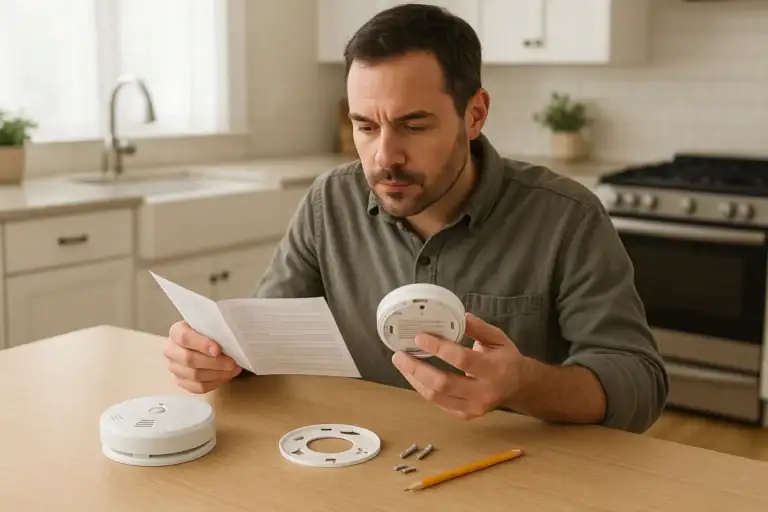 Smoke Alarm Installation: Manual-First Steps for Homeowners
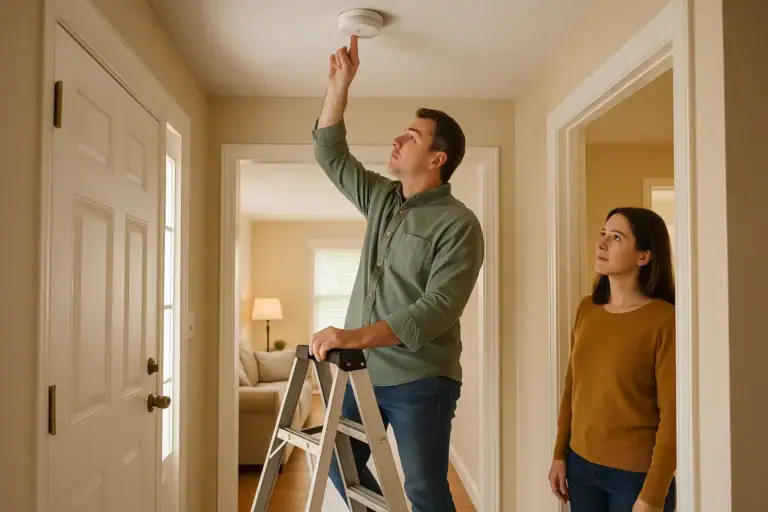 How to Test a Smoke Alarm Safely: Simple Checklist