Quick answer: Smoke alarm sound meanings vary by exact model. Treat a loud repeating alarm, a fire voice warning, or a combination-alarm carbon monoxide warning as an emergency: get outside, stay outside, and call 911. A periodic chirp needs prompt model-manual verification after an emergency is ruled out.
Smoke alarm sound meanings: make the safe decision first
A loud, repeating alarm is not the time to count beeps or search for the unit that started it. The U.S. Consumer Product Safety Commission advises people to respond to an alarm immediately, get out, stay out, and call 911. NFPA similarly says that a continuing set of three loud beeps means smoke or fire: get out, call 911, and stay out.
Sound codes are not universal. Use the table to decide what to do immediately, then use the label and manual for your exact alarm only when it is safe to do so.
| Sound category | Likely meaning | Immediate action | Verification step |
|---|---|---|---|
| Loud repeating alarm or a voice warning that identifies fire | Possible smoke or fire warning | Get everyone outside, stay outside, and call 911. Do not investigate first. | Do not go back inside to identify the sound. Check the exact model manual only after the emergency has been addressed. |
| Three loud beeps, a pause, then repetition | Smoke or fire warning on many alarms | Treat it as an emergency and evacuate. | Confirm the model-specific code later. NFPA uses this pattern in its public smoke-alarm guidance, but the device manual remains the model-specific reference. |
| Four beeps, a pause, then repetition from a combination alarm | Possible carbon monoxide warning on many combination models | Move outside, call 911 or emergency services, account for occupants, and do not search for the source. | After reaching safety, confirm the alarm type and model. Follow the manual and CPSC carbon monoxide guidance. |
| One brief chirp at a regular interval | Often a battery-related signal; other status meanings are possible | First confirm that it is not a loud alarm, voice warning, or possible carbon monoxide warning. Give the chirp prompt attention. | Read the alarm’s label and exact user manual. NFPA notes that a chirp every 30 or 60 seconds is commonly associated with a low battery and directs users to the guide. |
| A group of brief chirps at a regular interval | Possible fault, end-of-life, or another model-specific status | Do not ignore it; use the model manual promptly. | Note the number of chirps and any indicator-light pattern. For example, some First Alert SM6 and SC6 models assign different meanings to one, three, and five chirps, but those codes do not apply to every alarm. |
| Sound begins while someone intentionally presses Test | Test sequence | No evacuation is needed only when a deliberate test is confirmed and there are no signs of danger. | Compare the sound and linked-alarm response with the manual. See how to test a smoke alarm safely for the separate testing task. |
| Unidentified or irregular sound | Unknown device or condition | If the sound may be an active alarm, is loud and repeating, or danger may be present, leave and call 911. | Locate the source only when safe, then identify the brand and exact model before relying on an online sound chart. |
Manufacturer documentation illustrates why a generic beep chart cannot settle every question. The First Alert SM6 and SC6 sound chart, for example, identifies one chirp per minute as a low or missing battery, three chirps as a malfunction, and five chirps as end of life for the models it covers.
When should occupants leave immediately?
Leave immediately for a loud repeating alarm, a voice warning that identifies fire, visible smoke or flames, signs of burning, or a possible carbon monoxide alarm from a combination unit. Do not wait for a clearer pattern if you may be hearing an active warning.
Do not use a silence or hush control as a way to investigate a possible fire. CPSC’s fire-safety guidance is to get out, stay out, and call 911. For a carbon monoxide alarm, CPSC says to move outside, call emergency services or 911, account for everyone, and not reenter until responders permit it.
How to identify the initiating unit in an interconnected system
Interconnected alarms can all sound when one unit detects a condition. During a possible fire or carbon monoxide event, do not walk through the home to find the initiating unit. Evacuate first.
After an emergency has been ruled out and it is safe to inspect the system, use the manual for each exact model to look for an initiating-alarm, alarm-memory, or latched-indicator description. Indicator colors and flashing behavior vary by product. For certain compatible Kidde interconnected alarms, the initiating unit may flash red or green rapidly during an alarm; that detail is limited to the covered Kidde equipment and is not a universal rule.
- Record the brand and complete model number for the alarms in the interconnected group.
- Find the manual section describing an initiating unit, alarm memory, or indicator light.
- Compare the observed light behavior with that manual only when conditions are safe.
- If the alarms continue to activate and the manual does not explain the indication, contact the manufacturer or a qualified alarm professional rather than disabling the system.
Where to find the sound-code chart
Look first at the exterior or back label. Some alarms include a model-specific beep guide there. The City of Madison Fire Department directs residents to inspect the back of the alarm for this guide, and Kidde says its model number is usually printed in bold below the logo on the back label. Layouts differ by manufacturer.
Use this short observation checklist when it is safe:
- Sound: loud repeating alarm, single chirp, grouped chirps, or spoken words.
- Pattern: the number of sounds in a group and the pause before it repeats.
- Indicator: the light color and whether it is steady, flashing, or off.
- Identity: the brand, complete model number, and whether the unit is smoke-only or a combination alarm.
Search the manufacturer’s support site using the full model number, including letters or suffixes, and use that manual’s sound-code chart. Do not rely on a chart for a similar-looking alarm. If the manual identifies a battery condition, use its approved instructions or see how to replace a smoke alarm battery safely. For broader household protection planning, visit the Smart Home & Safety hub.
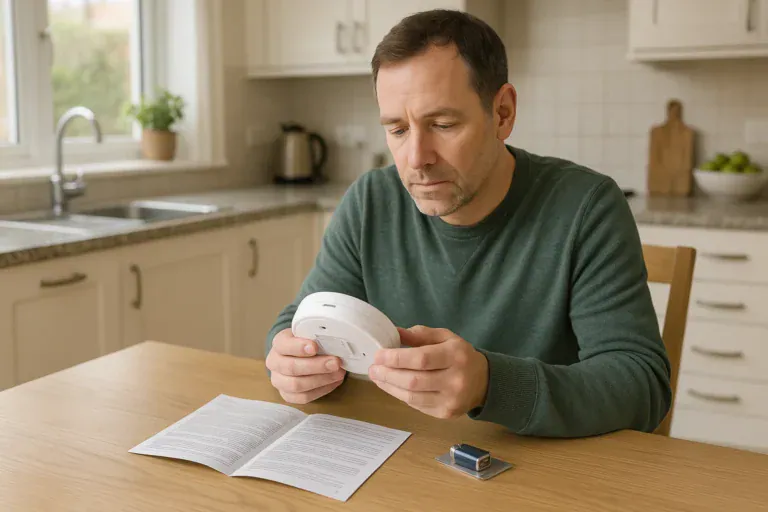 How to Replace a Smoke Alarm Battery Safely
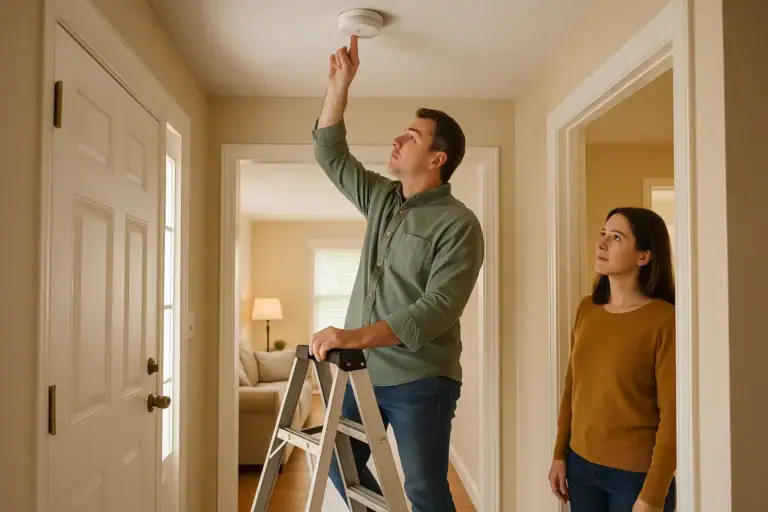 How to Test a Smoke Alarm Safely: Simple Checklist
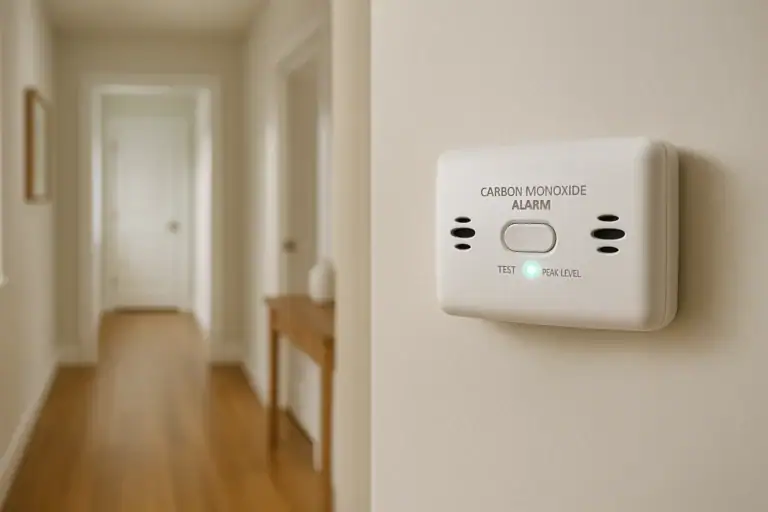 Carbon Monoxide Alarm End-of-Life Beeps: Troubleshooting and Safe Replacement