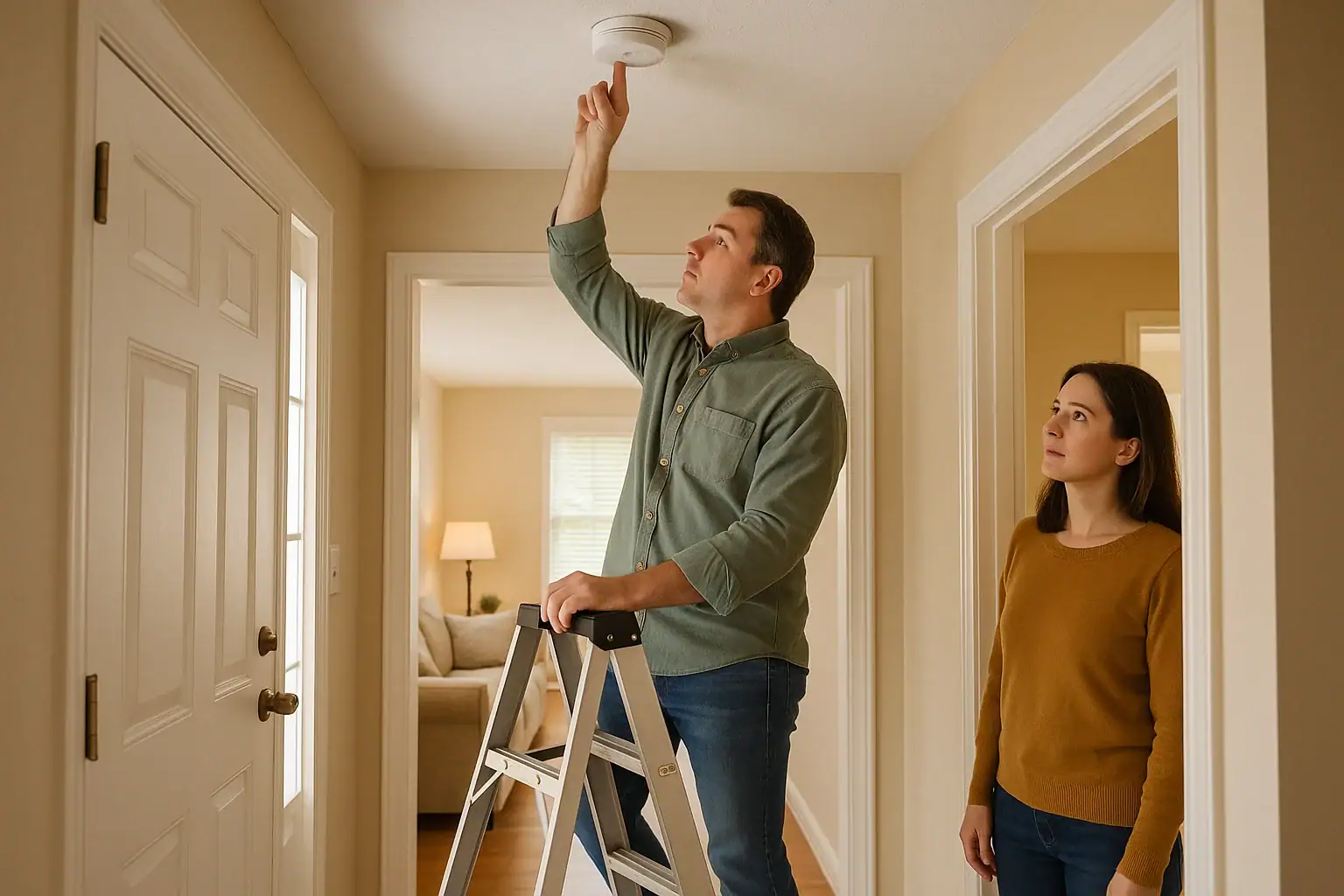
Quick answer: To test a smoke alarm safely, find its model manual, warn people nearby, and use the built-in test control exactly as instructed. Step away before the horn sounds, confirm the complete expected response, and check linked alarms when the manual says they should respond. Record failures and follow only approved user-level steps.
Before You Test a Smoke Alarm
Start with the alarm’s model number and its own instructions. Test-button actions, sounds, lights, voice prompts, app checks, and linked-unit behavior can differ by model. A routine test result covers only the functions the manufacturer says that test covers.
Do not continue with a routine test if there is smoke, fire, or another possible emergency. Leave the home and contact emergency services from outside.
- Identify the alarm: Check whether it is smoke-only, a smoke and carbon monoxide combination alarm, replaceable-battery, sealed-battery, hardwired, interconnected, or app-connected.
- Find the right manual: Use the model number, not instructions for a similar-looking unit.
- Warn people nearby: Let household members know the alarm may sound. If an alarm system reports to a monitoring provider, follow that provider’s testing instructions.
- Reach the control safely: Use a stable stepladder only when needed, stay centered, and do not overreach. Get help if you cannot safely reach the alarm.
- Move away from the sounder: Do not keep your face or ears close to the alarm when starting its test.
For example, Kidde’s instructions for certain covered alarms say to hold the Test/Hush button for at least five seconds, while Google’s Nest Protect Safety Checkup has generation-specific button and app routines. Neither procedure should be assumed to apply to another model.
How to Test a Smoke Alarm With Its Manual
- Confirm normal conditions. Make sure this is a planned test, not a response to smoke, fire, carbon monoxide, or an active alarm event.
- Use the built-in test control as directed. Press, hold, release, or repeat the control only as the manual specifies. Do not guess at a button-hold time.
- Wait for the full listed response. Listen and watch for the horn, voice prompt, light pattern, or app result described for that model. A status light alone is not a passed test unless the manual says it is.
- Check expected linked alarms. If the instructions say interconnected units should respond, confirm that each expected unit does so. Walk through the home or have another adult listen from a safe location.
- Test other initiating units when required. A successful test started from one alarm does not necessarily show that every unit can initiate its own required test.
- Record the result. Note the date, location, initiating alarm, response of linked units, and any fault or end-of-life message.
A complete expected response is a pass for that model’s stated test routine. Do not assume that every alarm test checks the same sensors, power source, wireless connection, or notifications.
Test Result and Safe Next Step
| Observed result | Safe next step |
|---|---|
| The complete expected sequence occurs | Record the result and repeat testing on the schedule in the manual and applicable guidance. |
| The initiating alarm responds, but an expected linked alarm stays silent | Do not treat the linked system as fully confirmed. Consult the manuals or manufacturer support. For rental, hardwired, or system-level issues, notify the responsible property manager, alarm provider, or qualified professional as appropriate. |
| A replaceable-battery alarm is silent | Use only manual-listed checks, such as the specified battery type, orientation, battery drawer, activation step, or pull tab. Retest and follow the manual’s replacement directions if it still does not respond. |
| A sealed-battery alarm is silent | Confirm any model-specific activation step. If it remains silent, use the manufacturer’s support or replacement instructions. Do not open the alarm or attempt to replace a sealed battery. |
| A hardwired alarm is silent | Check only user-visible indicators and user-level steps listed in the manual. Do not open an electrical box or handle wiring. |
| The response is weak, erratic, or reports a fault or end-of-life condition | Match the exact pattern to that model’s manual. Replace a battery or the alarm only when its instructions direct you to do so. |
| Smoke, fire, or another possible emergency is present | Stop testing, leave the home, and contact emergency services from outside. |
Hypothetical Example: A Linked Alarm Does Not Respond
Example only: A home has three interconnected alarms, and their shared manual says that testing one unit should trigger a horn and voice sequence from all three. The bedroom unit begins its expected sequence, but the hallway unit stays silent.
This is not a complete confirmation of the linked response described in that manual. The homeowner records the location of the silent unit, follows only the approved troubleshooting or pairing checks in the instructions, and contacts manufacturer support, the property manager, or an appropriate professional if the issue remains. After correction, the household repeats the manual-directed test.
Recurring Smoke Alarm Test Checklist
The U.S. Fire Administration recommends monthly testing for replaceable-battery, sealed long-life, and hardwired smoke alarms while directing households to follow manufacturer instructions. The Consumer Product Safety Commission also recommends monthly testing for alarms. Use a more frequent schedule if the manual or applicable local requirement calls for one.
- Test each alarm at least monthly, following its specific manual.
- Test after installation, activation, or a battery change when the manual directs it.
- Test each initiating unit when required by the system instructions.
- Confirm expected linked alarms, voice announcements, lights, and app notices when those functions are included in the model’s test routine.
- Keep model numbers, manuals, installation or replacement dates, and test results in one household log.
- Replace batteries and complete alarm units only according to the manufacturer’s instructions.
- Report rental-housing alarm failures promptly to the responsible landlord or property manager and keep a record of the notice.
- Check with the local fire marshal or housing authority because local testing and maintenance responsibilities can vary.
Never use matches, candles, cigarettes, burning paper, or another improvised flame or smoke source to test an alarm. Kidde specifically warns against open-flame testing. Use a simulated-smoke method only when the exact alarm manual approves a specific product and procedure.
For related household alarm and monitoring planning, visit the Smart Home & Safety guide.
 How to Install a Smart Thermostat Safely
 Outlet Overload Signs and Safe Power Strip Use at Home
 How to Test GFCI Outlets Safely in Bathrooms and Kitchens: A Simple Checklist