Quick answer: Swedish death cleaning is a gradual review of belongings that helps you decide what stays, what leaves, and what information others may need later. Start with a small, personally owned, low-sentiment area. Postpone shared property, valuables, records, and sentimental archives until you have a clear decision and routing routine.
Swedish death cleaning in plain English
Swedish death cleaning, or döstädning, is a gradual way to review belongings before other people may have to manage them. Margareta Magnusson’s book, The Gentle Art of Swedish Death Cleaning, describes letting go of unnecessary possessions while keeping selected meaningful items, such as photographs, letters, and children’s artwork. The publisher presents it as an approach that can fit different ages and life stages, not as a fixed timetable or mandatory room order.
The difference from an ordinary decluttering session is the longer view. Along with deciding what you want to keep, consider who owns an item, whether someone actually wants it, where it can go, and what context or records should stay with it.
This is not a requirement to empty your home or discard sentimental possessions. The practical goal is to make each item’s status easier to understand.
How to start Swedish death cleaning without overwhelm
Begin with one small area containing items that are personally owned and unlikely to carry a difficult decision. Duplicate kitchen tools, extra linens, an everyday clothing category, or a single storage shelf can be manageable starting points.
Leave photographs, letters, heirlooms, legal and financial papers, valuable collections, and jointly owned items for later. Those categories may need research, consent, secure storage, or more time.
Use a simple decision loop
- Review: Take out only the amount you can sort without blocking the room.
- Decide: Choose keep, gift, donate, sell, recycle, discard, special handling, or owner review required.
- Label: Give outgoing items a clear destination instead of making one mixed pile.
- Record: Note useful details, such as a recipient, an item story, an ownership question, or a donation receipt location.
- Remove: Set a pickup, delivery, listing, or disposal plan so sorted items do not become a new storage category.
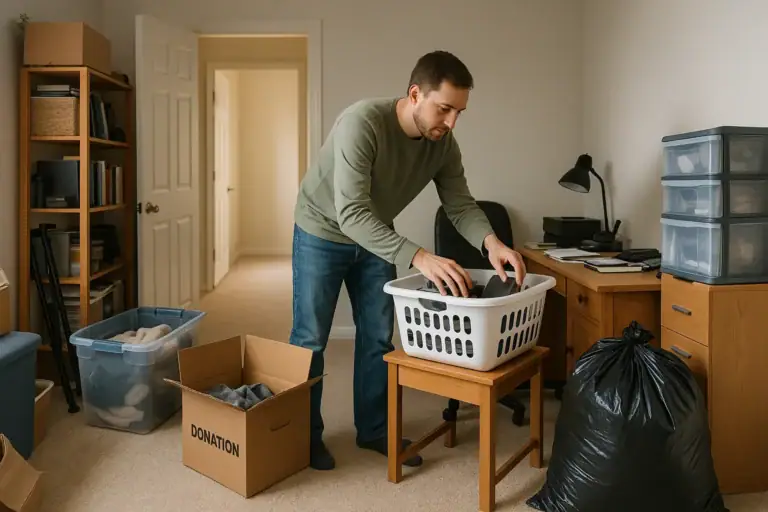
If accepted donations need to wait briefly, use a limited donation staging zone and give it a planned departure date.
Room-by-room Swedish death cleaning checklist
Kitchen
- Review duplicate utensils, cookware, dishes, food-storage containers, and serving pieces.
- Keep the tools and quantities that suit how the household currently cooks and entertains.
- Ask a proposed recipient before setting aside family cookware or special dishes as a gift.
- Before donating a small appliance, check that it is complete, clean, and currently accepted by the receiving location.
- Follow product labels and local instructions for food and household products rather than assuming every container belongs in curbside recycling.
Bathroom and linen storage
- Remove empty packaging and review products you do not plan to use.
- Sort excess towels, sheets, blankets, and unopened personal-care supplies separately.
- Keep medicines out of ordinary donation bags and check current local take-back or disposal instructions.
- Treat products with warning labels as a separate category. Do not pour together, mix, or repackage leftover products.
Bedroom and closets
- Review everyday clothing before formalwear, jewelry, inherited items, and keepsakes.
- Separate clean, wearable items from damaged or incomplete items.
- Make a secure location note for valuables or documents that another authorized person may need to find.
- Ask before assigning clothing or jewelry to a family member.
- Check pockets, folders, and bags for private papers or account information before donating anything.
Living and dining areas
- Review books, media, decorative objects, lamps, occasional furniture, and entertaining supplies.
- Confirm that a recipient wants a proposed gift and can receive it.
- Check acceptance policies directly before donating furniture, appliances, or other large items. Habitat notes that ReStore inventory and pickup services vary by location.
- Add a short story or provenance note to an object when that information matters to the people who may receive it.
- Do not move undecided items from room to room without a label and a review plan.
Home office and household records
- Separate routine paper from legal, financial, tax, insurance, property, and identity records.
- Do not destroy records until you have confirmed any applicable retention need with the issuer or an appropriate adviser.
- Store essential-document location information securely rather than leaving sensitive details in an open area.
- Review computers, phones, tablets, drives, printers, and memory cards for personal data before donation or recycling.
- Back up information you intend to keep, then follow the device maker’s instructions for removing personal information.
Garage, basement, attic, and utility storage
- Review duplicate tools, unused project supplies, seasonal equipment, and empty packaging.
- Set aside property that belongs to another household member and label it owner review required.
- Keep paints, cleaners, oils, batteries, pesticides, and similar products in their original labeled containers.
- Do not mix leftover products. Ask the local environmental, health, or solid-waste agency which program applies in your community.
- Confirm local instructions for bulky items, electronics, batteries, scrap material, and appliances before transporting them.
Photographs, letters, artwork, and heirlooms
Save sentimental material until the decision routine feels familiar. Work in small groups rather than opening every box at once.
- Keep selected originals that are personally meaningful or useful to the family.
- Ask intended recipients whether they want an heirloom before assigning it to them.
- Record names, dates, relationships, and an object’s story while that information is available.
- When appropriate, retain a photograph and short note if the story matters more than the physical object.
- Put unresolved shared items in a clearly labeled review container rather than making a one-sided decision.
How to handle shared belongings
Possession does not always mean sole ownership. Wedding gifts, inherited property, collections, tools, furniture, photographs, and household records may involve a spouse, relative, co-owner, or another interested person.
If ownership or authority is uncertain, do not donate, sell, or discard the item. Mark it owner review required, note the question, and ask the appropriate person. For property connected with an estate, trust, separation, guardianship, or a dispute, seek appropriate legal guidance before transferring it.
A practical gift process has three parts: identify a proposed recipient, ask whether they want the item, and arrange a transfer. This avoids turning another person’s home into storage for an unwanted object.
Choose a route for each item
Donation acceptance, recycling programs, hazardous-waste options, and bulky-item services vary by location. Confirm the destination before loading a vehicle or arranging a pickup.
| Route | Decision prompt | Next action | Record to retain |
|---|---|---|---|
| Keep | Is it used, needed, personally meaningful, or required by the household? | Assign it an accessible, labeled home. | A secure location note for important documents or valuables, when useful. |
| Gift | Has a specific person agreed to take it? | Confirm the recipient and arrange transfer rather than storing it indefinitely. | An optional story or photograph; a transfer note for valuable property when appropriate. |
| Donate | Is it clean, complete, usable, and currently accepted? | Check the receiving location’s policy and deliver it promptly. | Receipt, item list, contribution date, condition, and valuation information if claiming a deduction. |
| Sell | Is the likely return worth the work and delay? | Choose a listing method and a firm deadline, then reroute the item if it does not sell. | Sale receipt and relevant ownership or provenance records. |
| Recycle | Does a municipal, retailer, or specialty program explicitly accept it? | Follow that program’s preparation and drop-off instructions. | A drop-off receipt for sensitive electronics, if one is provided. |
| Discard | Is it unusable, nonhazardous, and not accepted for recycling? | Use a locally permitted trash or bulky-waste route. | A scheduled-pickup confirmation, if applicable. |
| Special handling | Is it a chemical, battery, medicine, data-bearing device, or appliance subject to special rules? | Stop and check the product label, manufacturer guidance, and local authority instructions. | A facility or service receipt, when provided. |
Donation and tax records
A donation does not automatically create a tax benefit. IRS Publication 526 states that donated clothing and household goods generally must be in good used condition or better to qualify for a deduction. For a noncash contribution of less than $250, the IRS generally advises retaining a receipt that identifies the organization, date and location of the contribution, and an adequate description of the property. If obtaining a receipt is impractical, reliable written records may be used in the circumstances described by the publication.
For a claimed contribution of $250 or more, the IRS generally requires a contemporaneous written acknowledgment from the organization. Contributions over $500 generally involve Form 8283, and claims over $5,000 generally have additional documentation and qualified-appraisal requirements, subject to exceptions. Check the IRS guidance and forms for the tax year in which you file, and seek tax advice when needed.
Hazardous products and electronics
The EPA identifies paints, cleaners, oils, batteries, and pesticides as household products that may need special handling. Keep them in their original labeled containers, never mix leftovers, and contact the local environmental, health, or solid-waste agency because collection options differ.
Before donating or recycling electronics, delete personal information and check local recycling options. The EPA says lithium-ion batteries and devices containing them should not go into household trash or curbside recycling.
A hypothetical first session
Imagine that a homeowner starts with one kitchen cabinet of personally owned, low-sentiment items. The household uses one set of everyday dishes, while duplicate serving pieces and an unused appliance occupy the remaining space.
- The everyday dishes are marked keep and returned to an assigned shelf.
- A relative is asked whether they want one serving piece. It remains labeled pending until they respond.
- The homeowner checks a local charity’s current policy before setting aside the complete appliance for donation.
- An incomplete item is checked against local recycling instructions instead of automatically going into a recycling bin.
- The donation receives a delivery plan. If the homeowner may claim a deduction, any receipt is stored with an item list.
The point is not to finish the kitchen in one session. It is to give every reviewed object a destination or a clearly marked question.
Finish with a simple handoff note
The goal is not an empty home. It is a home whose important contents and instructions are easier to understand.
Keep a short note in a secure place explaining where authorized people can find essential household records, keys, valuable-item information, family-history notes, and unresolved ownership questions. Tell a trusted, authorized person how to locate that note without leaving passwords or sensitive account details exposed.
Revisit the process as possessions, relationships, and local disposal options change. For more household systems, visit the Cleaning & Organization guide.
Frequently asked questions
How long should Swedish death cleaning take?
There is no required deadline. It can happen one shelf, category, or room at a time. A routine that includes a next step for outgoing items can be more practical than creating many unfinished sorting piles.
What should I avoid discarding at the beginning?
Postpone jointly owned items, unresolved heirlooms, important records, valuables needing research, sentimental archives, hazardous products, and electronics containing personal data. These categories may require consent, verification, secure handling, or local instructions.
 How to Organize a Cluttered Room Without Feeling Overwhelmed
 Scent Free Cleaning Routine for Sensitive Noses: A Practical Guide
 How to Use a Microfiber Cloth Color Coding System for Stress-Free Home Cleaning