Reconsider only the clothes that create a specific risk of regret
This article is not a complete wardrobe-sorting method. It is an editorial framework for items that remain unresolved after ordinary clothing decisions: specialized or difficult-to-replace garments, memorabilia, aspirational clothing tied to a realistic future use, repairs awaiting a concrete commitment, and genuine uncertainties suitable for a sealed decision box.
The suggestions below are practical prompts, not a universal or professionally recognized decluttering standard. They can provide additional deliberation, but they cannot guarantee that you will never reconsider a decision.
Consider replacement difficulty
Before removing an item, ask what would happen if you needed it again. Give extra consideration to specialized workwear, formal clothing required for particular occasions, weather-specific outerwear, uniforms, altered garments, and pieces that are unusually difficult to fit.
Replacement difficulty is not the same as original cost. A costly item can still be unnecessary, while an inexpensive but hard-to-match uniform piece may be worth retaining.
Handle sentimental and aspirational clothing separately
Sentimental clothing
Decide whether the item is clothing you expect to wear or memorabilia you want to preserve. If it is memorabilia, place it in a defined memory container rather than letting it occupy active wardrobe space.
Set the container’s boundary before reviewing sentimental pieces. When it is full, compare the memories represented and choose what matters most. Photographing an item before releasing it is an option, but only if a photograph would be meaningful to you.
Aspirational clothing
Give each aspirational item a named use condition, such as returning to a specific activity, attending a planned type of event, or reassessing fit after a known life transition. Add a decision date or relevant seasonal trigger.
If you cannot identify a realistic use, or if you repeatedly choose not to use the item when the opportunity occurs, move it toward an appropriate outgoing destination.
Require a next action for repairs
A repair category is useful only when you are prepared to complete the work or arrange it.
Give each repair a concrete next step, such as obtaining a quote, buying the required component, or scheduling the work. If you are unwilling to take that step, assess an appropriate outgoing route instead of leaving the item indefinitely in a repair pile.
Keep unresolved items from returning to active storage
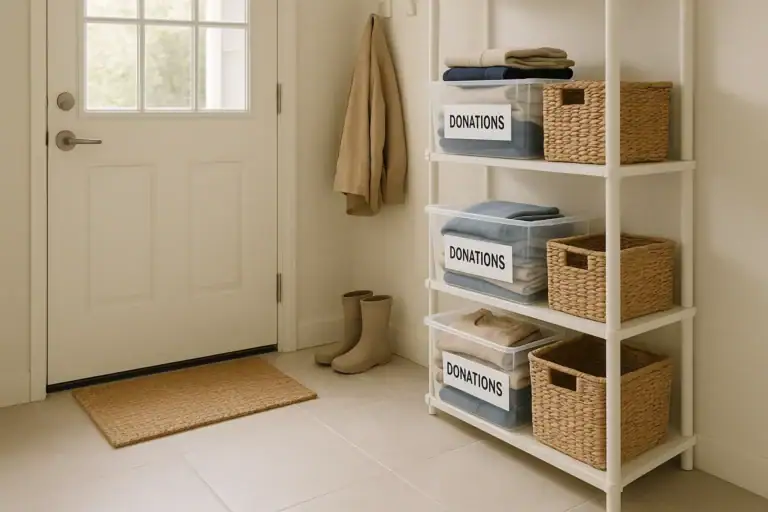
Do not put uncertain clothing back among active garments. Place it in a closed box, write the date and decision trigger on the outside, and store it outside the wardrobe.
The trigger might be the next relevant season, a planned event, or another date that makes sense for the item. There is no universal trial period. When the trigger arrives, make a final decision based on whether you needed, retrieved, or intentionally chose the piece.
An inventory on the box can help you locate a specific garment without reopening and casually returning everything. If you take something out to wear and it works well, keep it. Otherwise, complete the appropriate outgoing step rather than starting another open-ended trial.
Verify acceptance before releasing an unresolved item
If you decide to release the item, check whether the exact recipient or recovery program accepts its type and present condition. Follow that operator’s current preparation requirements. If no available outlet accepts it, consult the responsible municipality’s current disposal instructions.
A hypothetical decision example
Assume a reader is uncertain about a formal jacket, a keepsake dress, and shoes with a damaged heel.
- Formal jacket: It fits, is in good condition, serves an occasional requirement, and would be difficult to replace quickly. It stays.
- Keepsake dress: It is not worn but represents an important memory. It goes into the reader’s defined memory container rather than back into the active wardrobe.
- Damaged shoes: The reader would wear them after repair. They go into the repair group only after the reader sets a concrete next step, such as contacting a repair shop. Without that commitment, the reader checks whether an available recipient or program accepts their current condition and otherwise follows the applicable municipal disposal guidance.
The decisions differ because each item serves a different purpose. None returns to the wardrobe solely because the reader feels uncertain.
For more practical organizing help, visit the Cleaning & Organization guide.
Frequently asked questions
Should I release specialized clothing because I wear it infrequently?
Not necessarily. Formalwear, specialized garments, uniforms, weather-specific protection, altered clothing, and unusually difficult-to-fit pieces may warrant additional consideration even when used infrequently. Ask whether releasing the item would create a realistic need that would be difficult to meet later.
What if I regret donating something?
Use the final-decision box for genuine uncertainty, especially when an item is specialized, sentimental, or hard to replace. Give the box a defined trigger and keep it outside the wardrobe. This creates time for a deliberate decision without allowing the item to resume active status indefinitely.
Can damaged clothes go in a donation bin?
Only if that specific program says it accepts damaged textiles. Check the operator’s current acceptance and preparation rules rather than assuming every donation bin handles damaged clothing.
 How to Remove Water Stains on Glass Tables, Mirrors, and Shower Glass
 How to Set Up a Donation Staging Zone for Decluttering