Quick answer: If your dryer is taking too long to dry clothes, first check whether the washer left the load unusually wet, confirm a heated cycle, and use a load that can tumble freely. Then clean the lint screen and, for a vented dryer, check accessible exhaust airflow. Stop using it for smoke, gas odor, or persistent burning or electrical odor.
Slow drying does not automatically mean the dryer needs an internal repair. Start with the laundry, settings, and accessible airflow conditions. Do not remove appliance panels, test live electrical parts, handle gas connections, or bypass a safety device.
- Check how wet the load was after washing. If laundry is much wetter or heavier than comparable loads, the washer may not have spun or drained normally. Address recurring washer spin or drainage symptoms before assuming the dryer is at fault.
- Confirm the cycle selection. Make sure an unheated Air, Fluff, or similarly named setting was not selected. Sensor, Eco, and timed-cycle behavior differs by model, so use the instructions for the exact dryer.
- Adjust the load. Untangle items and separate very heavy pieces from lightweight fabrics when practical. ENERGY STAR notes that clothes need room to tumble and circulate air; both very large and very small loads can perform poorly.
- Clean the lint screen. Remove lint and reinstall the screen as the manufacturer directs. The U.S. Fire Administration advises cleaning the lint filter before and after each load.
- Check accessible exhaust airflow on a vented dryer. Look for a visibly crushed, sharply kinked, disconnected, or damaged accessible duct. During normal operation, observe from outside whether the exterior vent covering opens and exhaust air escapes. Do not disconnect the exhaust for a test unless the exact model instructions authorize it.
- Keep existing room-air openings clear. If the dryer is installed in a closet or compact laundry area, do not block its existing louvers or ventilation openings. Installation clearances and ventilation requirements are model-specific.
- Observe heat without disassembly. After selecting a heated cycle, note whether the load and drum become warm. A cool load on a correctly selected heated cycle calls for the model manual and may require qualified service.
There is no single drying time that applies to every appliance, fabric, load, cycle, or installation. Compare the result with similar loads that previously dried normally and with the guidance for your model.
Why clothes can stay damp when the dryer feels hot
Drying depends on heat and air movement. Heat helps moisture leave fabric, while moving air carries moisture away. On a vented dryer, clothes that are hot but still damp can be consistent with restricted exhaust airflow. The Consumer Product Safety Commission identifies longer-than-normal drying and damp clothes after a typical cycle as possible signs of a blocked lint screen or exhaust duct.
That symptom is not a diagnosis by itself. A load may also stay damp when it entered unusually wet, contains tangled or very different fabric weights, or uses a cycle that ends before thicker items are dry. Check these low-risk possibilities first.
Airflow problem or weak heat?
Use several observations together rather than relying on one symptom.
- Hot, damp clothes and weak outdoor airflow: On a vented dryer, this pattern supports the possibility of a restriction in the lint screen, accessible duct, exterior covering, or another part of the exhaust path.
- Hot, damp clothes with outdoor airflow that appears normal: Recheck the washer spin, load size, fabric mix, and selected cycle. An exterior observation cannot confirm that the full exhaust path is clear.
- Cool clothes after a heated cycle: First confirm that an unheated setting was not selected. If the setting is correct, a power, fuel, heating, or control issue may need model-specific diagnosis.
- Heat or cycle behavior seems inconsistent: Sensor, thermostat, airflow, and internal component issues cannot be identified safely from an exterior check alone.
Some electric-dryer manuals note that the drum can tumble without heat if part of the required electrical supply is interrupted. You may look for an obviously tripped breaker at the home electrical panel if doing so is safe and consistent with the appliance manual. If a breaker trips again, stop using the dryer and contact a qualified electrician or appliance technician.
Slow-drying symptom checklist
The observations below are conservative checks drawn from CPSC, USFA, ENERGY STAR, and manufacturer troubleshooting guidance. They do not replace the use and installation instructions for your specific dryer.
| What you notice | Safe check | What the check can tell you | When to stop or call |
|---|---|---|---|
| The load enters unusually wet or heavy | Compare it with a similar load after a normal washer spin and note ongoing washer drain or spin symptoms. | Slow drying that follows unusually wet loads points back to the washer or laundry preparation. | Arrange washer diagnosis if poor spinning or drainage continues. |
| Only bulky or mixed loads remain damp | Untangle items and try a freely tumbling, more uniform load using an approved cycle. | If the result improves, load makeup or cycle choice may have contributed. | Seek dryer service if ordinary loads remain slow after the other checks. |
| Clothes are hot but damp | Clean the lint screen. For a vented dryer, inspect accessible ducting and observe the outdoor vent covering during normal operation. | Weak outdoor airflow or a covering that does not open supports an exhaust restriction somewhere in the path. | Stop using the dryer if it overheats, the accessible duct is damaged or disconnected, or smoke or odor occurs. Arrange qualified service. |
| Clothes stay cool on a heated cycle | Confirm the cycle is not Air or Fluff and consult the model manual. Check only for an obviously tripped labeled breaker; do not open the appliance. | Continued lack of warmth may indicate a supply, heating, fuel, or control issue. | Call a qualified technician or electrician if heat remains absent or a breaker trips again. |
| An automatic cycle ends with damp clothes | Review the model manual’s load and sensor-cycle directions. Use a manual-recommended comparison cycle, if one is provided. | A different result on an approved cycle can help identify a settings or load-related issue. | Request service if the manual’s recommended checks do not resolve the issue. Clean sensors only as the manual directs. |
| The dryer or laundry area becomes unusually hot | Stop the cycle. Check the lint screen, accessible duct, exterior vent covering on a vented dryer, and existing room-air openings. | Restricted air movement is possible, but an internal fault cannot be ruled out. | Do not continue operating with smoke, scorching, or a persistent burning or electrical odor. |
Different checks for ventless dryers
Do not use an outdoor-vent-covering check for a ventless heat-pump or condenser dryer. These dryers manage moisture differently from conventional vented models. Follow the exact model instructions for filters, condensate collection or drainage, and any accessible heat-exchanger maintenance. Do not transfer diagnostic codes, button sequences, or cleaning procedures from another model.
When to stop using the dryer
Turn the dryer off and arrange qualified service when you notice smoke, sparks, scorching, a persistent burning or electrical odor, repeated breaker trips, a damaged or disconnected exhaust duct, or continued lack of heat after checking the selected cycle and following the manual’s permitted checks.
If you smell gas or see smoke from a gas dryer, leave the building and contact emergency services from outside. Do not operate switches, appliances, or phones inside. This follows emergency guidance in Samsung’s dryer smoke and odor instructions.
If the likely issue is routine lint or vent maintenance rather than an appliance fault, see our guides to cleaning a dryer lint-trap housing safely and cleaning a dryer vent safely. Find more household care guides in Cleaning & Organization.
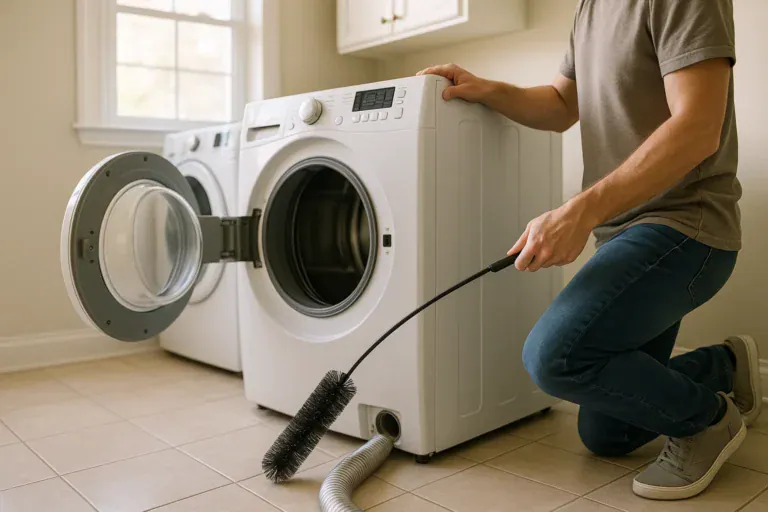 How to Clean a Dryer Vent Safely at Home
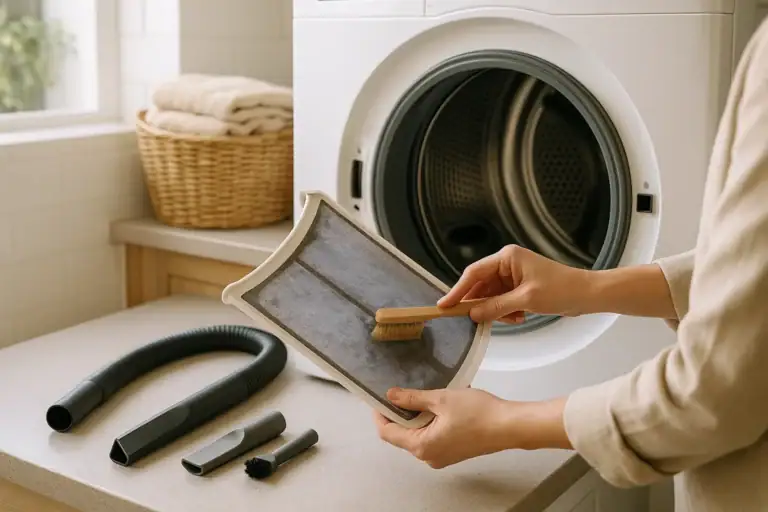 How to Clean a Dryer Lint Trap Housing Safely
 Is Your Floor Safe for a Steam Mop?