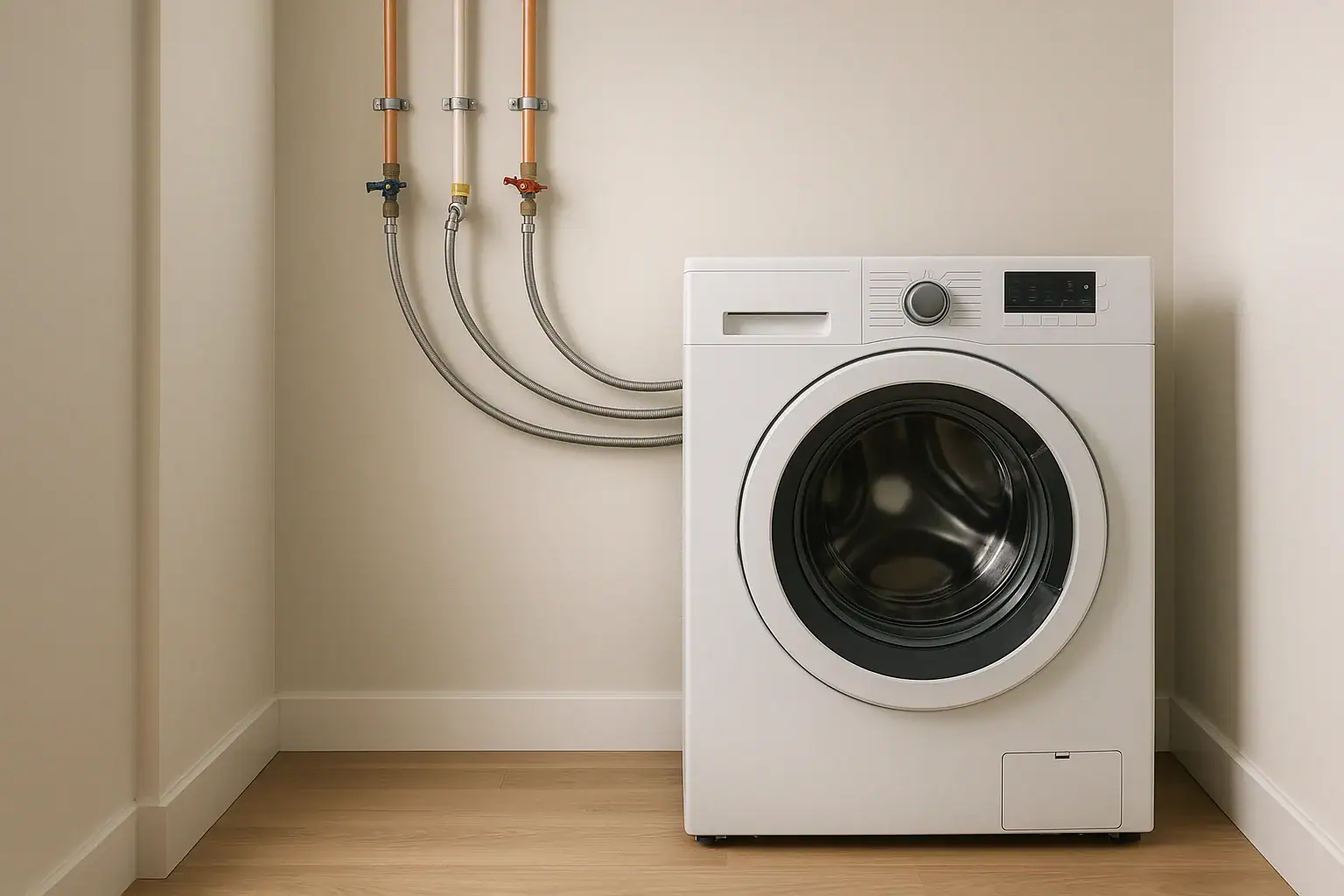
Why you hear banging pipes after a dishwasher or washer
If you hear loud banging, knocking, or thudding in the pipes right after your dishwasher or washing machine runs, you are likely dealing with water hammer. Water hammer is a pressure surge that happens when fast-moving water is forced to stop or change direction suddenly, usually when a valve closes quickly.
Dishwashers and modern washing machines use fast-acting, electrically controlled valves. When these valves snap shut at the end of a fill, the sudden stop in water flow can send a shock wave through your plumbing, making pipes rattle or bang against framing.
In most homes, occasional mild noise is more of a comfort and wear-and-tear issue than an immediate safety emergency. But repeated, strong water hammer can stress pipes, fittings, and valves over time. The steps below walk you through simple checks you can do yourself, when to try basic adjustments, and when it is better to bring in a plumber.
Step 1: Confirm it is water hammer
Before changing anything, pay attention to when and where the noise happens:
- Timing: Does the bang happen right when the dishwasher or washer stops filling, or when the cycle ends and the machine stops using water?
- Location: Do you hear it near the appliance, in a nearby wall, or throughout the house?
- Other fixtures: Do you get similar bangs when you close a faucet quickly or when a toilet finishes filling?
If the noise is tied to the moment water flow stops and sounds like a sharp thud or series of knocks in the walls or floor, water hammer is the most likely cause.
Step 2: Check that pipes are secured
Loose pipes make water hammer much louder. Even a small pressure surge can sound dramatic if a pipe is free to slap against wood framing.
With the water running to the dishwasher or washer, look and listen:
- Check accessible supply lines under sinks, in basements, or in utility rooms while the appliance fills.
- Look for copper or PEX lines that move or vibrate when the machine starts or stops filling.
- Note any spots where a pipe touches wood or metal without a cushion.
What you can do:
- Use plastic or padded pipe clamps to secure loose pipes to framing where you can reach them.
- Add short sections of foam pipe insulation where pipes rub against wood or metal to soften contact.
Do not overtighten clamps on plastic pipe, and avoid drilling or fastening into hidden electrical or gas lines. If most of your plumbing is hidden in finished walls or ceilings, you may only be able to address a few accessible spots yourself.
Step 3: Make sure shutoff valves are fully open
Partially closed valves can increase velocity and turbulence in the line, which can make water hammer worse.
Locate the small shutoff valves that feed the appliance:
- For a dishwasher, these are often under the kitchen sink or in a nearby cabinet.
- For a washing machine, they are usually the hot and cold valves on the wall behind the machine.
Turn each valve fully counterclockwise to open it, then back a quarter turn to keep it from seizing in place. If a valve is corroded, leaks, or will not turn, it is safer to have a plumber replace it rather than forcing it.
Step 4: Test your home water pressure
High water pressure makes water hammer more likely and more forceful. Many plumbing codes and manufacturers recommend keeping residential pressure around 40–60 psi. The U.S. Environmental Protection Agency’s WaterSense program notes that typical household pressures are often in this range.
How to check pressure:
- Buy a simple water pressure gauge that screws onto a hose bibb (often labeled for garden hoses).
- Choose an outdoor spigot or the drain on a laundry sink that is close to where the main water line enters the house.
- Make sure no water is running in the house.
- Attach the gauge, open the valve fully, and read the pressure.
What the reading means:
- Under ~40 psi: Water hammer is less likely to be driven by high pressure. Noise may be more about pipe support or valve behavior.
- 40–60 psi: Common range. Water hammer can still occur, especially with fast-closing appliance valves.
- Over ~80 psi: Many plumbing codes consider this too high. A pressure-reducing valve (PRV) on the main line is typically recommended and should be adjusted or installed by a plumber.
If you have a PRV and your pressure is high, a licensed plumber can adjust or replace it. Keeping pressure in a reasonable range can reduce stress on your plumbing and help with water hammer.
Step 5: Try a controlled shutoff test
This simple test helps confirm that fast valve closure is the main trigger:
- Start a fill cycle on the dishwasher or washer so it is actively taking in water.
- While it is filling, slowly close the appliance’s shutoff valve by hand until the machine stops filling and the valve inside the appliance closes.
- Listen for banging in the pipes as the flow stops.
If closing the valve slowly produces little or no hammer, but the normal automatic shutoff during a cycle causes loud banging, that points strongly to the appliance’s quick-closing internal valve interacting with your plumbing layout and pressure.
Step 6: Consider water hammer arrestors
If basic checks do not solve the problem, water hammer arrestors are a common next step. These are small devices that absorb the shock wave when water flow stops suddenly.
Where they are used:
- On washing machine supply lines, often as screw-on fittings between the hose and the shutoff valve.
- On dishwasher supply lines, typically as a tee fitting installed in the rigid or flexible line feeding the appliance.
What to know before installing:
- Some arrestors are designed for vertical installation; others can be installed in different orientations. Follow the manufacturer’s instructions.
- For screw-on washing machine arrestors, turn off the water, relieve pressure, then install them snugly without overtightening.
- For hard-piped dishwasher lines or copper piping, it is often best to have a plumber sweat, crimp, or press-fit the arrestor into place.
Arrestors can reduce or eliminate water hammer in many setups, but they are not a cure-all. If your pressure is very high or your pipes are poorly supported, you may still need additional work.
Step 7: Look at appliance hoses and connections
The type and condition of the hoses feeding your dishwasher or washer can affect how pressure waves travel.
- Old rubber hoses: Can bulge or weaken over time. While they may slightly cushion shocks, they also pose a risk of bursting as they age.
- Braided stainless hoses: Common on washers. They are more durable but can transmit pressure spikes more directly into the plumbing.
- Dishwasher supply lines: Often flexible braided or plastic tubing connected to a shutoff under the sink.
If hoses are more than several years old, show cracking, bulging, or corrosion at fittings, replacing them is usually a good idea. Follow the appliance manufacturer’s installation instructions and local plumbing codes when selecting replacement hoses or lines.
When to call a plumber
It is reasonable to call a licensed plumber if:
- The banging is very loud or getting worse over time.
- You see signs of leaks, corrosion, or movement at pipe joints.
- Your water pressure is high and you do not have a pressure-reducing valve.
- You are not comfortable installing arrestors or working with rigid piping.
A plumber can evaluate your whole system, including hidden piping, and recommend a combination of supports, pressure adjustments, and arrestors that fits your home. For broader water and kitchen topics, you can also review the guidance at Signature Home Guide’s Water & Kitchen hub.
Safety notes and realistic expectations
Most water hammer issues related to dishwashers and washing machines are nuisance problems, but it is still wise to take them seriously:
- Repeated strong hammer can contribute to long-term wear on pipes, valves, and joints.
- Any visible leak, damp spot, or staining near plumbing should be investigated promptly to avoid hidden water damage or mold growth. The U.S. Environmental Protection Agency’s guidance on moisture and mold explains why controlling water issues early is important.
- Do not open walls, modify structural framing, or alter main water lines unless you understand local codes and safety practices.
By checking pipe supports, confirming valves are open, measuring water pressure, and adding water hammer arrestors where appropriate, many homeowners can significantly quiet or eliminate banging after dishwasher and washing machine cycles. For more plumbing and kitchen water tips, see the resources collected on the Water & Kitchen guide.
 How to Fix a Leaking Faucet-Mount Water Filter
 Range Hood Backdraft Damper Stuck: How to Fix It
 Fixing Low Hot Water Pressure at One Faucet