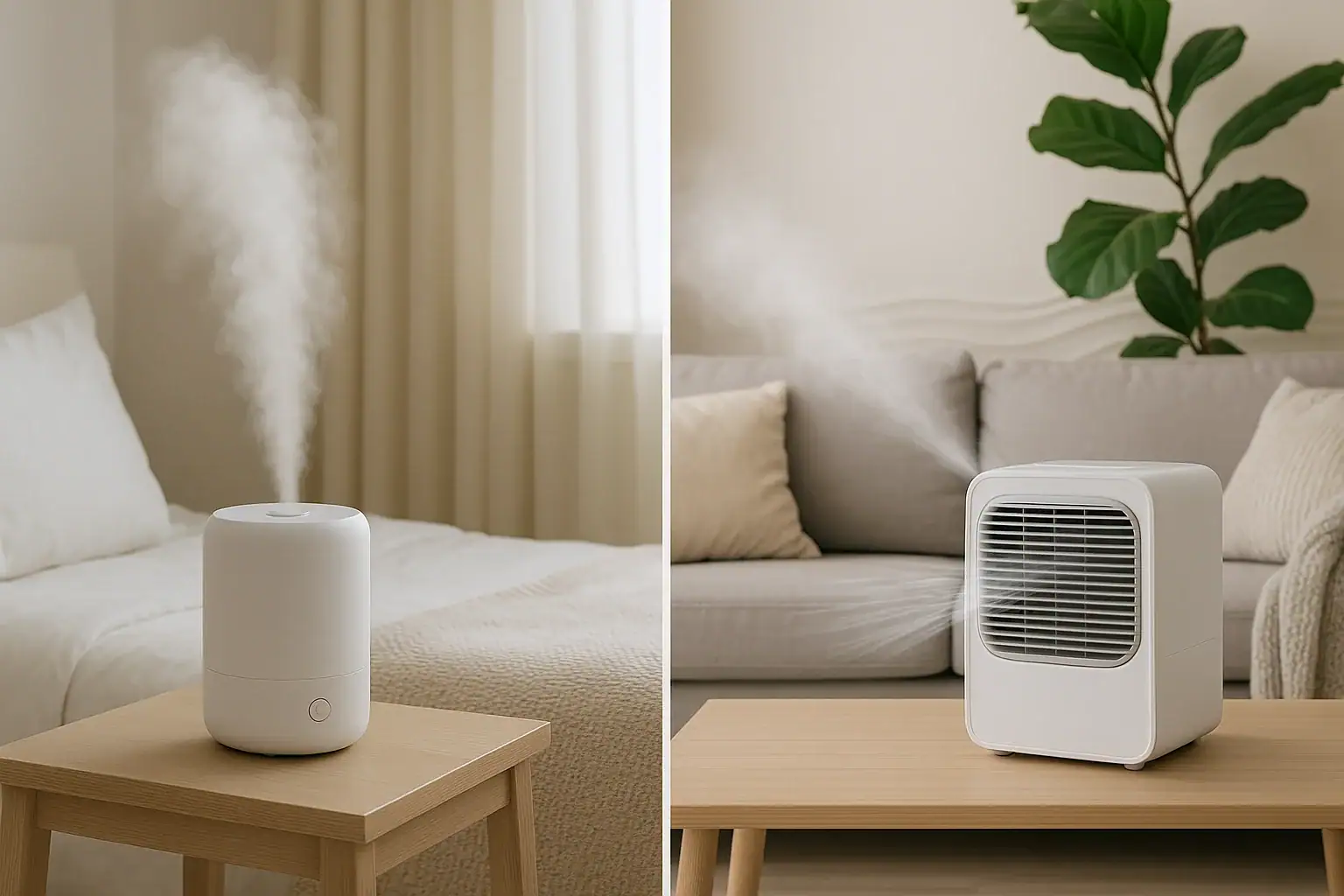
Dry indoor air can lead to scratchy throats, irritated sinuses, and static shocks every time you touch a doorknob. A humidifier can help, but choosing the right type matters just as much as deciding to buy one. Two of the most common options are evaporative and ultrasonic humidifiers. At first glance they may look similar, yet they work very differently and come with unique benefits and drawbacks. Understanding these differences can help you pick a model that fits your home, health needs, and budget instead of guessing and hoping for the best.
This guide breaks down how each type works, their pros and cons, and who each humidifier is best suited for. You will also find practical tips on noise levels, maintenance, white dust, water quality, and safety. By the end, you should feel confident choosing between evaporative and ultrasonic humidifiers for your bedroom, nursery, or whole home comfort plan.
How Humidifiers Help Indoor Air Comfort
Humidifiers add moisture to indoor air, which can make your home feel more comfortable during dry seasons or in climates with low humidity. Indoor humidity is usually most comfortable between about 30 and 50 percent. When levels drop much lower than that, you may notice:
- Dry or itchy skin and chapped lips
- Scratchy throat or dry cough
- Worsened sinus irritation or congestion
- Static electricity and small shocks
- Cracking in wood furniture or floors over time
Both evaporative and ultrasonic humidifiers can help raise humidity, but they do it in different ways and come with different tradeoffs in cost, care, and performance.
How Evaporative Humidifiers Work
Evaporative humidifiers rely on a simple, natural process: water evaporation. A fan pulls dry room air across a wet wick, filter, or pad. As the air passes over the moist surface, some of the water evaporates into the air, increasing humidity. The fan then blows the now-moist air back into the room.
Because they use a fan and a wick or filter, evaporative units have a few built-in characteristics that affect how they perform and how much maintenance they require.
Pros of Evaporative Humidifiers
- Self-regulating output: As room humidity rises, evaporation naturally slows down. This makes it harder to over-humidify a space compared with some other types.
- Lower risk of white dust: Minerals in tap water tend to stay trapped in the wick or filter instead of being released into the air, which means less white dust on furniture.
- Good for larger areas: Many evaporative models move a lot of air and can be effective for medium to large rooms, depending on their size and design.
- Uses simple technology: The basic design has been around for a long time and is generally reliable when maintained properly.
Cons of Evaporative Humidifiers
- Filter and wick replacement: The wick or filter must be replaced regularly. Mineral buildup and organic growth can reduce performance and create odors if neglected.
- Fan noise: The fan that moves air through the unit can be noticeable, especially on higher settings. This may bother light sleepers.
- Bulky design: Some models are larger and less sleek than ultrasonic units, which may matter in smaller rooms or minimalist spaces.
- Energy use: The fan uses more electricity than the small vibrating element in an ultrasonic unit, though most models are still relatively efficient.
How Ultrasonic Humidifiers Work
Ultrasonic humidifiers use high-frequency vibrations to turn water into a fine mist. A small metal or ceramic plate vibrates at ultrasonic speeds, breaking water into tiny droplets that are then released into the air. Many units let you see the cool mist coming out of the top or side of the device.
Because they do not rely on a fan to move air across a wick, ultrasonic models can be very quiet and compact. However, they handle minerals and water quality differently than evaporative units.
Pros of Ultrasonic Humidifiers
- Very quiet operation: With no large fan running, many ultrasonic units are nearly silent on low settings, making them popular for bedrooms and nurseries.
- Compact and lightweight: These humidifiers often have a smaller footprint and more modern appearance, which can be easier to fit on a nightstand or desk.
- Fine control of output: Many models offer adjustable mist levels and can quickly raise humidity in a small to medium-sized room.
- Energy efficient: The vibrating element uses little electricity compared with some fan-based designs.
Cons of Ultrasonic Humidifiers
- White dust from minerals: If you use hard tap water, minerals can be dispersed into the air and settle as a fine white dust on surfaces.
- More sensitive to water quality: Because everything in the water can be turned into mist, using distilled or demineralized water is often recommended, which adds cost and effort.
- Risk of over-humidifying: Without careful monitoring or a built-in humidistat, it is easy to run an ultrasonic unit too long and create excess moisture in the room.
- Cleaning is still essential: The water tank and internal parts need regular cleaning to prevent slime and microbial growth, just like any humidifier.
Side-by-Side Comparison: Evaporative vs Ultrasonic
Both types can improve comfort, but they shine in different situations. The comparison below highlights the main differences that matter for daily use.
Noise Level
- Evaporative: Uses a fan, so there is a noticeable hum or whooshing sound. Some people find it soothing, while others find it distracting at night.
- Ultrasonic: Typically very quiet, with only a soft hum or gurgle. Often preferred for bedrooms, nurseries, and home offices where silence matters.
Maintenance and Filters
- Evaporative: Requires periodic replacement of wicks or filters. Regular cleaning of the tank and base is also important to prevent buildup and odors.
- Ultrasonic: Usually does not use a traditional wick, but still needs frequent cleaning. Some units include optional demineralization cartridges that must be replaced over time.
Water Quality and White Dust
- Evaporative: Minerals in tap water tend to remain in the filter, so less white dust settles on surfaces. However, mineral buildup can shorten filter life.
- Ultrasonic: More likely to create white dust if you use hard water. Using distilled or filtered water can reduce this but adds cost and effort.
Risk of Over-Humidifying
- Evaporative: Evaporation naturally slows as humidity rises, which helps prevent over-humidifying. Still, using a hygrometer to monitor levels is wise.
- Ultrasonic: Can continue pumping moisture into the air even when humidity is already high. A built-in humidistat or separate humidity monitor is very helpful.
Energy Use
- Evaporative: Uses more energy due to the fan, but most room-sized units are still relatively efficient for daily use.
- Ultrasonic: Generally uses less power, which can be appealing if you run the unit many hours per day.
Cost Considerations
- Evaporative: Often reasonably priced up front, but you must budget for ongoing filter replacements.
- Ultrasonic: Upfront cost can vary widely. Operating costs may include distilled water and optional cartridges, but there are no wicks to replace.
Health and Safety Considerations
Humidifiers can support comfort, but they can also introduce problems if not used and cleaned properly. The type you choose can influence how you manage these issues.
Microbial Growth and Cleaning
Standing water and damp surfaces can support microbial growth in any humidifier. To reduce this risk:
- Empty and refill the tank with fresh water daily when in use
- Rinse and wipe the tank and base regularly
- Follow the manufacturer instructions for weekly deep cleaning
- Allow the unit to dry completely between uses when possible
Neither evaporative nor ultrasonic designs are immune to microbial buildup. Consistent cleaning is more important than the type of device.
Minerals and Air Quality
Minerals in tap water can contribute to white dust with ultrasonic units and can accumulate in the filters of evaporative models. To manage this:
- Consider using distilled or low-mineral water, especially in ultrasonic units
- Replace filters or cartridges as recommended
- Dust and vacuum surfaces regularly if you notice residue
Ideal Humidity Range
Keeping indoor humidity in a moderate range is important. Very high humidity can encourage dust mites and mold, while very low humidity can dry out skin and airways. A small digital hygrometer is an inexpensive way to track levels and adjust your humidifier settings accordingly.
Who Should Choose an Evaporative Humidifier?
An evaporative humidifier may be the better fit if the following points match your situation:
- You use tap water and have hard water: If you do not want to buy distilled water regularly, an evaporative unit can help limit white dust on surfaces.
- You want a more self-regulating system: The natural slowing of evaporation at higher humidity can help prevent over-humidifying.
- You need to humidify a larger room: Many evaporative models move more air and can handle bigger spaces effectively.
- You do not mind some fan noise: If a gentle fan sound does not bother you or you even like it as background noise, the noise level may be acceptable.
- You are comfortable with filter changes: Replacing wicks or filters on a schedule is part of owning this type of unit.
Evaporative humidifiers are often a solid choice for living rooms, family rooms, and larger shared spaces where a bit of fan noise is less of an issue and white dust would be more noticeable.
Who Should Choose an Ultrasonic Humidifier?
An ultrasonic humidifier may be the better fit if these points line up with your needs:
- You prioritize quiet operation: For bedrooms, nurseries, or shared home offices, the near-silent performance is a major advantage.
- You prefer compact devices: If you have limited space or want something that blends in on a nightstand, ultrasonic units are often smaller and lighter.
- You are willing to manage water quality: Using distilled or filtered water can greatly reduce white dust and keep the unit cleaner.
- You want fast humidity changes in small rooms: Ultrasonic units can quickly raise humidity in bedrooms or small offices when needed.
- You value energy efficiency: If you plan to run the humidifier many hours a day, the lower power use can be appealing.
Ultrasonic humidifiers are especially popular in sleeping areas and quiet spaces, as long as you are prepared to pay attention to water quality and cleaning.
Practical Tips for Choosing Between Evaporative and Ultrasonic
Still unsure which type is right for your home? Use the questions below to narrow it down.
1. Where Will You Use the Humidifier?
- Bedroom or nursery: Quiet operation is key. Ultrasonic is often preferred here, especially if you are a light sleeper.
- Living room or open-concept space: Evaporative models can handle larger areas and fan noise may be less noticeable.
- Home office: Either type can work. Consider whether you prefer quiet calls (ultrasonic) or lower white dust (evaporative with tap water).
2. What Is Your Water Like?
- Hard tap water with lots of minerals: Evaporative units may be easier to manage, or you can pair an ultrasonic model with distilled water.
- Softened or filtered water: Either type can work well, though ultrasonic units will still benefit from lower mineral content.
3. How Much Maintenance Are You Willing to Do?
- Comfortable with filter changes: Evaporative may suit you, as long as you remember to replace wicks on schedule.
- Prefer no filters: Ultrasonic models often skip wicks but still need regular cleaning and may use cartridges.
4. Do You Have Concerns About Allergies or Sensitivities?
For people with allergies or sensitivities, cleanliness and humidity control matter more than the specific technology. In either case:
- Clean the unit thoroughly and regularly
- Avoid letting water sit in the tank for long periods
- Use a hygrometer to keep humidity in a moderate range
- Consider using cleaner water sources to reduce minerals and impurities
Using Your Humidifier Safely and Effectively
Once you choose a humidifier type, a few simple habits can help you get the most benefit with fewer hassles:
- Place it on a stable, water-resistant surface: Keep it a few feet away from walls, curtains, and electronics to avoid moisture damage.
- Aim the mist into open space: Direct the output toward the center of the room, not directly at furniture or windows.
- Use clean water: If possible, use filtered or distilled water, especially for ultrasonic units, to reduce mineral deposits and white dust.
- Monitor humidity: Aim for around 30 to 50 percent indoor humidity. Adjust settings or run time as seasons change.
- Follow a cleaning schedule: Regular cleaning keeps the unit working well and supports better indoor air quality.
Choosing the Best Humidifier for Your Home
Both evaporative and ultrasonic humidifiers can make a noticeable difference in comfort during dry months. Evaporative units tend to be better for managing minerals and larger spaces, while ultrasonic models shine in quiet, compact settings where low noise is essential. There is no single best choice for everyone. The right option depends on where you will use it, what kind of water you have, how sensitive you are to noise, and how much maintenance you are willing to take on.
If you want to explore more ways to improve indoor air quality and comfort in your home, you can continue with other air and comfort topics and build a complete plan that fits your space and lifestyle.
 Evaporative Cooler vs Portable AC for Home Comfort: Which Is Better?
 Washable vs Disposable HVAC Filters: Which Is Best for Your Home?
 Thermostat Fan Auto vs On: Best Settings for Comfort and Less Dust