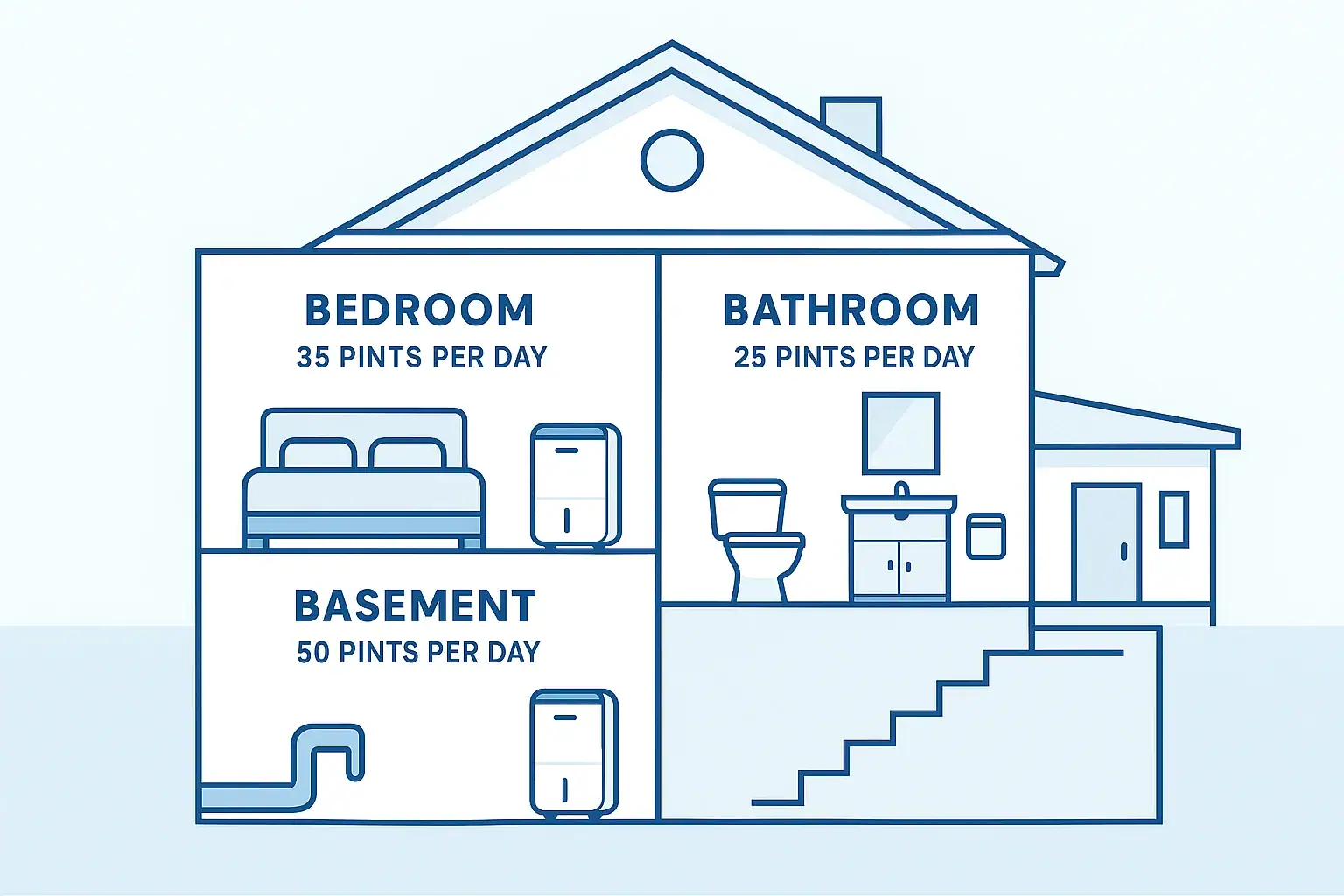
Choosing the right dehumidifier size is about more than just picking a model that fits your budget. If you choose one that is too small, it will run constantly, struggle to keep up, and leave your home feeling damp. If you choose one that is too large, you may spend more than you need to and risk uncomfortable over-drying in smaller rooms. The key is matching the dehumidifier's capacity, measured in pints of moisture removed per day, to the size and conditions of each space in your home.
This guide focuses on three of the most common problem areas in US homes: basements, bedrooms, and bathrooms. You will learn how dehumidifier capacity is measured, how room size and humidity level affect the number of pints per day you need, and how to use simple sizing charts to get close to the right choice. You will also find practical tips for placement, drainage, and energy use so your dehumidifier can work efficiently and quietly in the background.
How Dehumidifier Sizing Works
Dehumidifier capacity is usually listed in pints per day (PPD). This number describes how many pints of water the unit can remove from the air in a 24-hour period under specific test conditions.
Key factors that affect sizing
To choose the right capacity, think about these factors together:
- Room size (square footage): Larger rooms hold more air and more moisture.
- Ceiling height: Higher ceilings increase the volume of air beyond basic floor area.
- Starting humidity level: Damp or wet rooms need more capacity than rooms that are just a little sticky.
- Moisture sources: Showers, cooking, laundry, and groundwater seepage all add moisture.
- Climate: Humid regions of the US often require higher capacity, especially in summer.
- Air leakage and insulation: Drafty, poorly insulated spaces are harder to keep dry.
Most residential portable dehumidifiers fall in the 20 to 70 pint per day range. Smaller capacities are common for bedrooms and small bathrooms, while larger capacities are often used in basements and open-plan spaces.
Step 1: Estimate Your Room Size and Humidity Level
Before you look at any specific unit, estimate the basic sizing inputs for your space.
Measure room size
- Measure the length of the room in feet.
- Measure the width of the room in feet.
- Multiply length by width to get square footage.
Example: A 20-foot by 15-foot basement room is 300 square feet.
If your ceilings are much higher than 8 feet, consider the room as effectively larger. For ceilings around 9 to 10 feet, you can treat the room as about 10 to 20 percent bigger when using sizing charts.
Judge how damp the space feels
You can use a simple humidity meter, but your senses are also helpful. Use these descriptions as a guide:
- Slightly damp (around 55–60% relative humidity): Air feels a bit sticky in warm weather, but there is no musty odor.
- Moderately damp (around 60–70%): Air feels clammy; you may notice a mild musty smell, especially after the room is closed up.
- Very damp (around 70–80%): Surfaces may feel cool and damp; musty odors are obvious; you may see moisture on windows or pipes.
- Wet (above 80%): Visible condensation, damp spots on walls or floors, or standing water during wet weather.
The damper the space, the more pints per day you will need to bring humidity down to a comfortable range, generally 40–50% relative humidity for living spaces and 50–60% for basements.
Dehumidifier Sizing for Basements
Basements are often the dampest part of a home. They are below grade, close to soil moisture, and may have limited ventilation. For many US homes, the basement is where a dehumidifier can make the biggest difference in comfort and mold prevention.
Typical basement conditions
When sizing for basements, assume at least a moderately damp condition unless you are certain the space is dry. Consider these common moisture sources:
- Groundwater seepage through walls or floor
- Uninsulated or poorly sealed foundation walls
- Laundry appliances or utility sinks
- Storage of damp items such as cardboard boxes or fabric
Basement sizing guidelines by square footage
Use these general ranges for basements with typical 8-foot ceilings. If your basement is very wet or has frequent water intrusion, consider moving up one capacity level.
- Up to 500 sq ft (small basement room or partial basement):
Choose around 30–40 pints per day for slightly to moderately damp conditions. For very damp, consider 40–50 pints. - 500–1,000 sq ft (medium basement):
Choose around 40–50 pints for moderate dampness. For very damp or if you live in a humid climate, consider 50–60 pints. - 1,000–1,500 sq ft (large basement or mostly open layout):
Choose around 50–60 pints for moderate dampness. For very damp or partially finished basements, consider 60–70 pints. - 1,500–2,000 sq ft (full, open basement):
Choose around 60–70 pints and consider using more than one unit if the layout is broken up by walls or rooms.
Basement sizing example
Imagine a 900 square foot basement in a humid region that smells musty in summer and has some condensation on pipes. That is a moderately to very damp space. A good starting point would be a unit in the 50–60 pint per day range. If the basement is divided into several rooms, you may get better results with two smaller units placed in separate areas.
Basement setup tips
- Place near the center of the open area, away from walls, for better air circulation.
- Keep doors open between basement rooms if you want to dry more than one space with a single unit.
- Use continuous drainage by running a hose to a floor drain or condensate pump; this avoids constantly emptying the bucket.
- Seal obvious leaks and address standing water before relying on a dehumidifier alone.
Dehumidifier Sizing for Bedrooms
Bedrooms usually need less capacity than basements, but they are sensitive areas because of sleep comfort and indoor air quality. A properly sized dehumidifier can reduce that sticky feeling at night and help protect furniture, flooring, and closets from excess moisture.
Typical bedroom conditions
Bedrooms often become humid due to:
- Closed doors and limited air circulation at night
- Body moisture from people and pets
- Warm weather combined with mild or uneven air conditioning
- Closets packed with clothing that can trap moisture
Bedroom sizing guidelines by square footage
These ranges assume standard 8- to 9-foot ceilings and typical humidity in a home that may feel muggy in summer.
- Up to 150 sq ft (small bedroom or nursery):
Choose around 20–25 pints per day, especially if the door is often closed. - 150–300 sq ft (average bedroom or primary bedroom):
Choose around 25–35 pints depending on how humid your home tends to be. - 300–450 sq ft (large bedroom, suite, or bedroom with sitting area):
Choose around 30–40 pints, especially if you live in a humid climate or keep the door closed most of the time.
Bedroom sizing example
Consider a 200 square foot primary bedroom with a walk-in closet. The room feels muggy in the evening, and the closet sometimes smells musty. A unit in the 25–30 pint per day range is usually sufficient. If the bedroom is part of a larger open suite, moving up toward 30–35 pints can help.
Bedroom setup tips
- Choose a quiet model and use the lower fan setting at night to reduce noise.
- Place the unit away from the bed and not directly under a window where condensation may drip.
- Leave closet doors slightly open during the day to let dry air circulate.
- Coordinate with air conditioning; if you run central air, you may be able to use a smaller dehumidifier capacity.
Dehumidifier Sizing for Bathrooms
Bathrooms generate a lot of moisture in a short time from showers and baths. If ventilation is poor, humidity can linger, leading to peeling paint, mildew on grout, and musty odors. A small dehumidifier can help, especially in bathrooms without a vent fan or window.
Typical bathroom conditions
Bathrooms vary widely in size and use. Consider these factors:
- Shower frequency: Multiple daily showers add a lot of moisture.
- Ventilation: Lack of a fan or a fan that is rarely used increases humidity.
- Interior vs. exterior wall: Interior bathrooms with no window tend to trap moisture.
- Connection to other rooms: A bathroom that opens directly into a bedroom or hallway may share moisture with adjacent spaces.
Bathroom sizing guidelines by square footage
Bathrooms are usually small, so you rarely need a large-capacity unit just for that space.
- Up to 50 sq ft (small half bath or compact full bath):
Choose around 15–20 pints per day, especially if there is no vent fan. - 50–100 sq ft (average full bath):
Choose around 20–25 pints. If the bathroom is used heavily by several people, consider the upper end of that range. - 100–150 sq ft (large bath with tub and separate shower):
Choose around 25–30 pints, particularly if ventilation is limited.
Bathroom sizing example
Imagine a 70 square foot full bathroom used by a family, with no window and a weak vent fan. Moisture lingers on mirrors and walls for hours. A unit in the 20–25 pint per day range is usually appropriate. If the bathroom is connected to a walk-in closet or dressing area, you may benefit from a slightly larger unit or from placing the dehumidifier in the adjacent space and leaving doors open.
Bathroom setup tips
- Place the unit outside the direct splash zone of the shower or tub to avoid water damage.
- Use a timer or humidity control to run the dehumidifier after showers when humidity peaks.
- Combine with proper ventilation by running the bath fan during and after showers.
- Check local electrical codes regarding placement near water sources for safety.
Quick Sizing Reference: Pints Per Day by Room Type
The following summary pulls together the earlier sections into quick reference ranges. These are starting points; move up one level if your space is very damp or your climate is especially humid.
Basements
- Small (up to 500 sq ft): 30–40 pints (40–50 if very damp)
- Medium (500–1,000 sq ft): 40–50 pints (50–60 if very damp)
- Large (1,000–1,500 sq ft): 50–60 pints (60–70 if very damp)
- Very large (1,500–2,000 sq ft): 60–70 pints; consider multiple units
Bedrooms
- Small (up to 150 sq ft): 20–25 pints
- Average (150–300 sq ft): 25–35 pints
- Large (300–450 sq ft): 30–40 pints
Bathrooms
- Small (up to 50 sq ft): 15–20 pints
- Average (50–100 sq ft): 20–25 pints
- Large (100–150 sq ft): 25–30 pints
Other Factors That May Change Your Sizing Choice
Sizing charts are helpful, but real homes are not perfect rectangles with ideal conditions. Keep these additional factors in mind when deciding whether to go up or down in capacity.
Climate and season
- If you live in a humid region where summers are long and sticky, lean toward higher capacity.
- If your home is in a drier climate and humidity is only a problem for a few weeks each year, you may be fine at the lower end of the range.
Insulation and air leaks
- Poorly insulated basements or crawlspace connections can introduce extra moisture.
- Gaps around windows, doors, and rim joists can let humid outdoor air flow inside.
- If your space is drafty, consider stepping up one capacity level.
Open floor plans and multiple rooms
- Dehumidifiers work best when air can circulate freely around them.
- For multiple small rooms off a hallway, one central unit may not dry every corner equally.
- In some cases, two smaller units placed in separate areas give better overall results than one large unit.
Energy use and run time
A larger capacity unit can sometimes be more efficient than a smaller one because it does the job faster and may not need to run as many hours per day. However, if you choose a unit that is far larger than needed, it may cycle on and off more frequently and offer less precise humidity control in small rooms.
Using Humidity Targets to Fine-Tune Your Setup
Once you have chosen a capacity, you can fine-tune comfort by adjusting your humidity set point. Many modern units include a built-in humidistat that lets you set a target level.
- Basements: Aim for 50–60% relative humidity. Lower than 50% is helpful if you are trying to control mold or dust mites, but may not be necessary in all cases.
- Bedrooms: Aim for 40–50% for comfort and to help with allergies and dust mites.
- Bathrooms: Aim for 50–55% once the room has dried out after showers.
A small, inexpensive humidity meter can help you see how well your dehumidifier is performing and whether you might need to adjust capacity or placement.
When to Consider a Whole-Home Approach
If you find yourself placing portable dehumidifiers in several rooms, it may be worth looking at a more integrated approach. While this guide focuses on room-by-room sizing, some homes benefit from a system that connects to existing ductwork or is installed near the central heating and cooling equipment.
Signs you may need a broader solution include:
- Consistently high humidity on every level of the home
- Condensation on windows throughout the house
- Musty odors in multiple rooms, not just in the basement
- Visible mold growth in more than one area
In those cases, room-based sizing is still helpful for understanding your needs, but you may want to compare that total capacity with more centralized options.
Next Steps for a Drier, More Comfortable Home
Effective dehumidifier sizing starts with knowing your room size, understanding how damp the space is, and choosing a capacity that fits both. Basements usually call for higher pints per day, bedrooms fall in the small to medium range, and bathrooms often need compact units that can handle quick bursts of moisture.
By using the guidelines in this article and adjusting for your climate, insulation, and room layout, you can select a dehumidifier that runs efficiently and keeps humidity in a healthy range. That means fewer musty odors, less risk of mold, and a more comfortable home for you and your family.
For more ways to improve air and comfort throughout your home, explore additional guides and tips at Signature Home Guide's air and comfort hub.
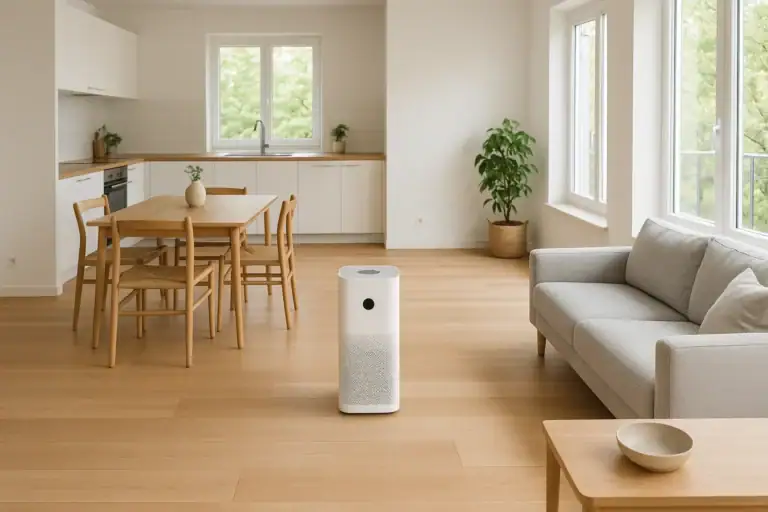 Air Purifier Placement in an Open Floor Plan: Practical Guide and Realistic Expectations
 What Happens When Furniture Blocks a Return Vent? Troubleshooting Guide
 How Often to Change HVAC Filters With Pets: A Practical Homeowner Checklist