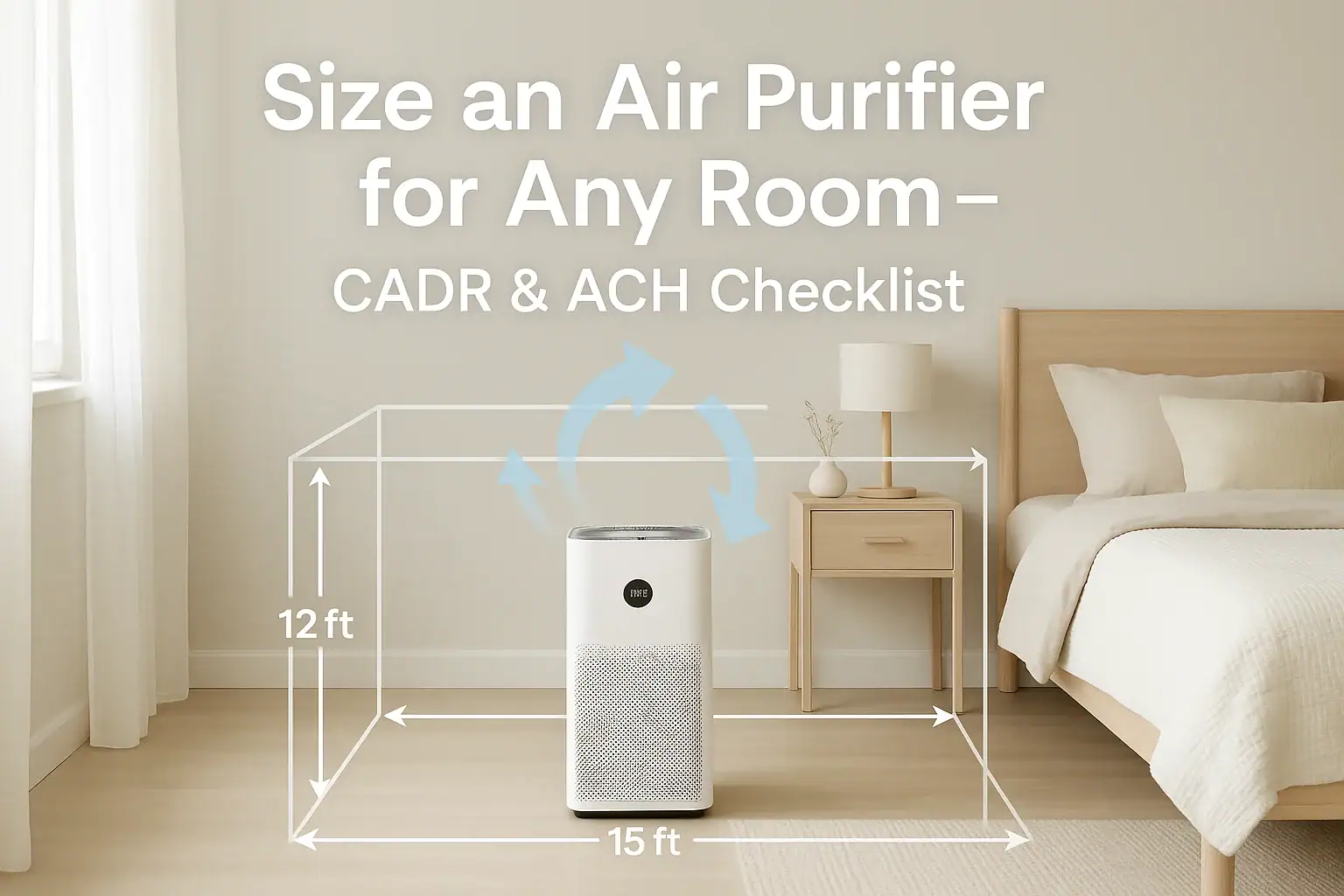
Choosing an air purifier is not just about picking a popular model and hoping for the best. To actually clean the air in your home, the purifier has to be powerful enough for the room you put it in. That means matching the purifier to your room size and your air quality goals using two key numbers: CADR and ACH. When you understand these, you can confidently compare options and avoid units that are too weak or unnecessarily oversized.
This step‑by‑step checklist walks you through how to size an air purifier for any room in your home. You will learn what CADR and ACH really mean, how to measure your room, how to decide what level of air cleaning you need, and how to quickly check whether a purifier is a good fit. Keep this guide handy when you shop so you can make a clear, informed choice instead of guessing.
Quick Checklist: Sizing an Air Purifier the Right Way
Use this high‑level checklist, then read the sections below for details and examples.
- Measure your room length, width, and ceiling height.
- Calculate room volume in cubic feet.
- Decide your target ACH (air changes per hour) based on your needs.
- Use volume and ACH to calculate the minimum CADR you need.
- Check the purifier label or specs for CADR values.
- Match CADR to your room size and preferred fan speed.
- Adjust for open floor plans or multiple rooms if needed.
- Confirm filter type and noise level at the CADR you plan to use.
Step 1: Understand CADR and ACH
What is CADR?
CADR stands for Clean Air Delivery Rate. It tells you how much clean air an air purifier can deliver each minute. CADR is usually measured in cubic feet per minute (CFM). A higher CADR means the purifier can clean more air, faster.
Most air purifiers list separate CADR ratings for:
- Smoke (very small particles)
- Dust (medium‑sized particles)
- Pollen (larger particles)
For room sizing, the smoke CADR is often the most useful because smoke particles are among the smallest and hardest to remove. If a purifier can handle smoke well, it usually does well with dust and pollen too.
What is ACH?
ACH stands for Air Changes per Hour. It tells you how many times per hour the air purifier can filter the entire volume of air in a room. A higher ACH means the air is being cleaned more frequently.
Typical ACH targets:
- 2 ACH: Light cleaning for general comfort in rooms with mild air issues.
- 4 ACH: Better cleaning for most bedrooms and living rooms.
- 5–6 ACH: Strong cleaning for allergies, asthma, or smoke concerns.
- 8+ ACH: Very high cleaning, often used in more demanding situations.
CADR and ACH work together. CADR is the purifier's power; ACH is how thoroughly you want your room cleaned. You size the purifier by matching its CADR to the ACH you want in your specific room volume.
Step 2: Measure Your Room
To size an air purifier correctly, you need to know the room's volume, not just the floor area.
Measure length, width, and height
Use a tape measure to find:
- Length of the room (in feet)
- Width of the room (in feet)
- Ceiling height (in feet)
Calculate room volume
Use this simple formula:
Room volume (cubic feet) = length × width × height
Example:
- Length: 15 ft
- Width: 12 ft
- Height: 8 ft
Room volume = 15 × 12 × 8 = 1,440 cubic feet.
Keep this number handy; you will use it with ACH to find the CADR you need.
Step 3: Choose Your Target ACH
Your target ACH depends on how clean you want the air to be and what problems you are trying to solve. Use the checklist below to pick a realistic target.
ACH checklist by situation
- General use, no major issues: 2–3 ACH is usually enough for basic comfort and light dust control.
- Seasonal allergies: 4–5 ACH helps reduce pollen and common allergens more effectively.
- Asthma or strong sensitivity: 5–6 ACH or higher is often recommended for more consistent particle removal.
- Smoke or wildfire season: 5–8 ACH can help reduce fine smoke particles and odors more quickly.
- Pets with dander and hair: 4–6 ACH can help manage dander and dust stirred up by activity.
If you are unsure, 4–5 ACH is a solid starting point for bedrooms and main living spaces where you want noticeably cleaner air.
Step 4: Convert ACH and Room Size into Required CADR
Once you know your room volume and target ACH, you can estimate the minimum CADR you need.
The basic formula
Use this formula to estimate CADR in cubic feet per minute (CFM):
CADR (CFM) = (Room volume × ACH) ÷ 60
The "60" converts air changes per hour into air changes per minute.
Example: Bedroom sizing
Imagine a bedroom that is 12 ft × 12 ft with an 8 ft ceiling.
- Room volume = 12 × 12 × 8 = 1,152 cubic feet
- Target ACH = 5 (for allergies or asthma)
CADR = (1,152 × 5) ÷ 60 = 5,760 ÷ 60 = 96 CFM.
In this case, you would look for an air purifier with a smoke CADR of at least about 100 CFM to reach 5 ACH at its higher setting.
Example: Living room sizing
Now consider a larger living room, 20 ft × 15 ft with a 9 ft ceiling.
- Room volume = 20 × 15 × 9 = 2,700 cubic feet
- Target ACH = 4 (general family use)
CADR = (2,700 × 4) ÷ 60 = 10,800 ÷ 60 = 180 CFM.
You would want a purifier with a smoke CADR of at least about 180 CFM to maintain 4 ACH in that living room.
Step 5: Check CADR Ratings on the Purifier
Once you know the CADR you need, compare it to the CADR listed on the air purifier's packaging or product page.
What to look for
- Smoke CADR: Use this as your main reference for room sizing.
- Dust and pollen CADR: These should be similar or higher than smoke CADR for balanced performance.
- Maximum fan speed: CADR ratings are often based on the highest fan setting.
If the smoke CADR is lower than your calculated requirement, the purifier will not reach your target ACH unless you use it in a smaller room. If the smoke CADR is higher, you can either enjoy higher ACH or run the purifier at a lower, quieter speed.
Step 6: Decide on Noise vs. Performance
CADR ratings are typically measured at the highest fan speed, which can be loud for bedrooms or quiet spaces. It helps to think about how you actually plan to use the purifier.
Checklist: Matching CADR to real‑world use
- For bedrooms: Consider a purifier that exceeds your calculated CADR so you can run it on a medium or low setting at night.
- For living rooms: You may tolerate a higher fan speed during the day, but still aim for a unit that can reach your target ACH at a comfortable noise level.
- For home offices: Balance noise and performance; you may prefer a slightly oversized unit to keep fan speeds lower during calls or meetings.
When comparing units, look for any published noise levels (in decibels) at different fan speeds and imagine how that will feel in your space.
Step 7: Adjust for Open Floor Plans and Multiple Rooms
Many homes have open layouts where air flows between rooms. If your purifier will sit in a space that connects to others, you may need to adjust your calculations.
Open floor plan checklist
- Combine connected areas: If the purifier is meant to serve a living room and dining area with no doors between them, treat them as one larger room.
- Recalculate volume: Add the length and width of the connected spaces (or calculate each volume separately and add them together).
- Recalculate CADR: Use the combined volume and your desired ACH to find the new CADR requirement.
- Consider multiple units: For very large or oddly shaped spaces, two smaller purifiers placed in different areas can sometimes work better than one large unit.
Doors, hallways, and staircases can limit how well air mixes. If a room can be closed off, size a purifier just for that room rather than trying to cover the entire level with a single unit.
Step 8: Confirm Filter Type and Air Quality Goals
CADR and ACH tell you how much air is cleaned, but filter type tells you what is being removed. Once you know a purifier is strong enough for your room, confirm that it targets your main air quality concerns.
Filter checklist
- Particle filter: Look for a high‑efficiency filter that captures fine particles such as dust, pollen, and smoke.
- Gas and odor filter: If you are concerned about odors or certain gases, look for an additional filter designed for those pollutants.
- Pre‑filter: A washable or replaceable pre‑filter can catch larger particles and extend the life of the main filter.
Make sure replacement filters are easy to find and that you are comfortable with the recommended replacement schedule. A purifier that is perfectly sized but rarely maintained will not deliver the ACH and CADR you planned for.
Step 9: Double‑Check Placement for Best Performance
Even a well‑sized air purifier can underperform if it is placed poorly. Air needs room to flow into and out of the unit.
Placement checklist
- Keep the purifier a few feet away from walls or large furniture that block vents.
- Avoid tight corners where airflow is restricted.
- Place the purifier in the room where you spend the most time, or where air quality issues are worst.
- Close windows and doors when you want the purifier to be most effective, especially during smoke events or high pollen days.
- Run the purifier continuously on a lower setting rather than turning it on and off frequently.
Good placement helps you reach your target ACH more reliably without needing to oversize the unit.
Putting It All Together: Example Checklists
Example 1: Allergy‑friendly bedroom
- Room: 11 ft × 14 ft, 8 ft ceiling
- Volume: 11 × 14 × 8 = 1,232 cubic feet
- Goal: Reduce pollen and dust for seasonal allergies
- Target ACH: 5
- Required CADR: (1,232 × 5) ÷ 60 ≈ 103 CFM
- Shopping target: Smoke CADR of at least 110–120 CFM for some extra margin and quieter operation at night
Example 2: Family room with pets
- Room: 18 ft × 16 ft, 9 ft ceiling
- Volume: 18 × 16 × 9 = 2,592 cubic feet
- Goal: Control dander, dust, and everyday odors
- Target ACH: 4
- Required CADR: (2,592 × 4) ÷ 60 ≈ 173 CFM
- Shopping target: Smoke CADR around 180–200 CFM, with a good pre‑filter for hair and larger particles
Example 3: Small home office near a busy road
- Room: 10 ft × 10 ft, 8 ft ceiling
- Volume: 10 × 10 × 8 = 800 cubic feet
- Goal: Reduce fine particles from outdoor pollution
- Target ACH: 5–6
- Required CADR at 5 ACH: (800 × 5) ÷ 60 ≈ 67 CFM
- Required CADR at 6 ACH: (800 × 6) ÷ 60 ≈ 80 CFM
- Shopping target: Smoke CADR around 90–100 CFM so it can run quietly on a medium setting during work hours
Final Room‑Sizing Checklist for Air Purifiers
Use this condensed checklist when you are ready to choose a purifier:
- Measure your room: Length, width, and height in feet.
- Calculate volume: Multiply length × width × height.
- Set your ACH goal:
- 2–3 ACH: Basic comfort
- 4–5 ACH: Allergies and everyday use
- 5–6+ ACH: Asthma, smoke, or higher sensitivity
- Calculate required CADR: (Room volume × ACH) ÷ 60.
- Check purifier specs: Make sure smoke CADR meets or exceeds your requirement.
- Consider noise: Aim for a unit that reaches your target ACH at a fan speed you can live with.
- Adjust for layout: Combine volumes for open spaces or consider multiple units.
- Confirm filters: Choose filters that match your main concerns, such as allergens, smoke, or odors.
- Place it well: Give the purifier space for airflow and run it consistently.
Once you walk through these steps, you will know exactly how to size an air purifier for any room in your home using CADR and ACH. That means cleaner air, more comfort, and a better return on the money you invest in your indoor air quality.
 Portable AC Hose Insulation Placement Tips for Better Cooling
 Ceiling Fan Direction for Summer vs Winter: A Clear Homeowner’s Guide
 What Happens When Furniture Blocks a Return Vent? Troubleshooting Guide