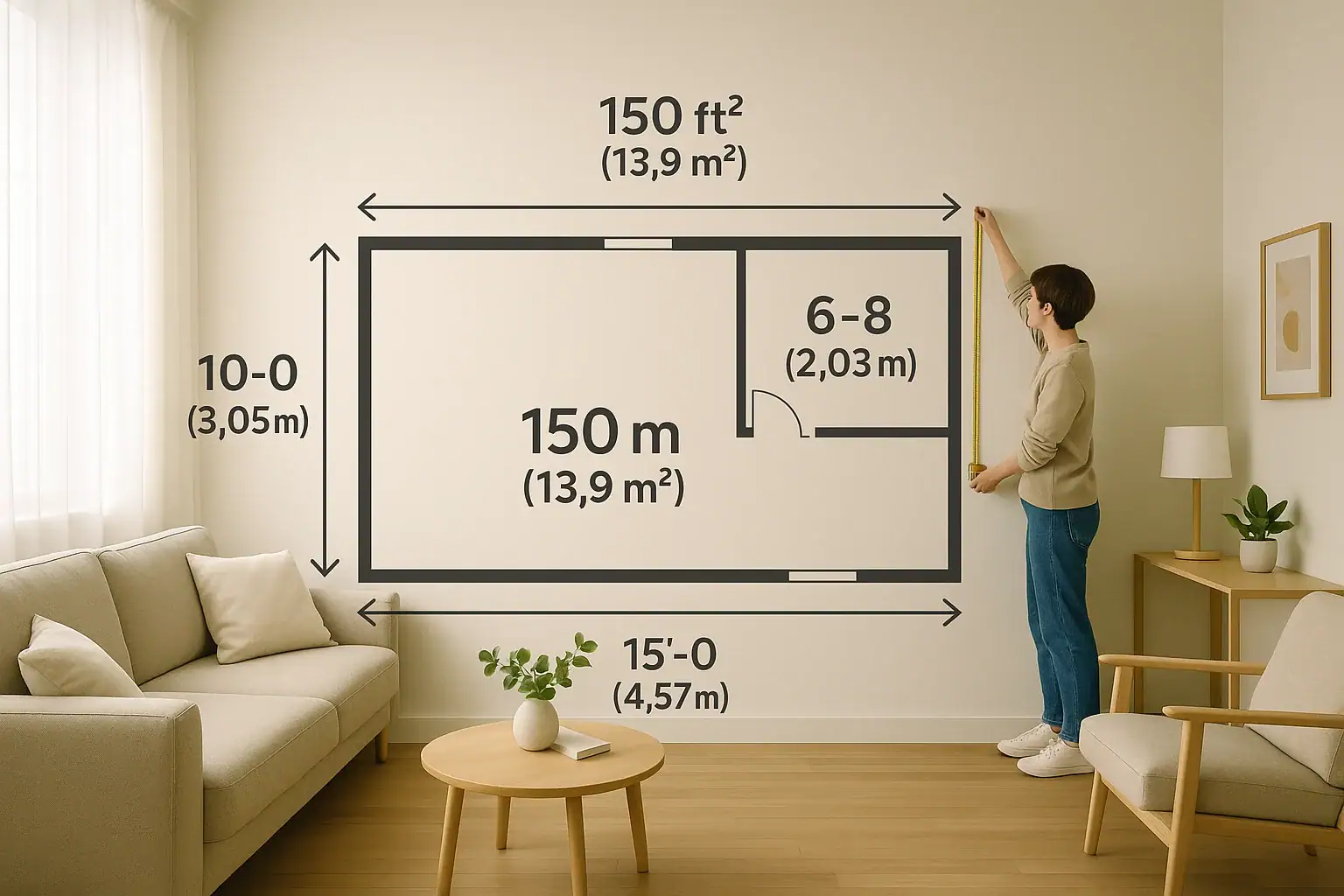
Choosing the right air devices for your home, such as air purifiers, dehumidifiers, humidifiers, fans, or portable cooling units, starts with one essential step: knowing your room size. If the device is too small, it will struggle to keep you comfortable. If it is too large, you may waste money on energy and equipment you do not actually need. Measuring your room correctly in both square feet and square meters gives you the numbers you need to compare product specifications with confidence.
This guide walks you through simple, tape-measure friendly methods to calculate room area, explains the difference between square feet (ft²) and square meters (m²), and shows you what to do with those measurements. You will also learn how to handle tricky spaces like L-shaped rooms, open floor plans, and rooms with high ceilings. By the end, you will be able to size air devices more accurately and create a more comfortable, efficient home.
Why Room Size Matters for Air Devices
Air devices are usually rated for a maximum coverage area. That rating is often listed in square feet for a US audience, and sometimes also in square meters. If your room is larger than the rating, performance drops. If it is smaller, you may be paying for capacity you do not need.
Common air devices affected by room size
- Air purifiers – rated by coverage area and clean air delivery rate.
- Dehumidifiers – rated by pints per day and recommended square footage.
- Humidifiers – often labeled for small, medium, or large rooms with a square foot range.
- Portable cooling units and fans – sized for room area and sometimes room volume.
Manufacturers assume you know your room size. When you do, you can match your space to the right device instead of guessing based on vague labels like “large room.”
Tools You Need to Measure Room Size
You do not need professional equipment to measure room size accurately. A few simple tools are enough.
- Measuring tape (at least 16 feet, preferably 25 feet)
- Notepad or notes app on your phone
- Pen or pencil
- Calculator or phone calculator
- Optional: laser distance measurer for long or tall rooms
Before you start, clear a path along the walls so you can stretch the tape measure without obstacles. Measuring along baseboards is usually easiest and most accurate.
Step-by-Step: How to Measure a Simple Rectangular Room
Most rooms are close to a rectangle. If your room is roughly rectangular, follow these steps first. You can handle irregular areas afterward.
1. Measure the length
- Choose the longest wall in the room.
- Place the end of the tape measure in one corner, tight against the wall.
- Extend the tape along the baseboard to the opposite corner.
- Write down the measurement in feet and inches (for example, 15 ft 4 in).
2. Measure the width
- Move to an adjacent wall that forms the width of the room.
- Measure from one corner to the opposite corner along the baseboard.
- Write down the width in feet and inches (for example, 12 ft 6 in).
3. Convert inches to decimal feet (optional but helpful)
To calculate area easily, it helps to convert inches to a decimal. Use this simple method:
- Divide the number of inches by 12.
- Add that to the feet.
Example:
- Room length: 15 ft 4 in → 4 ÷ 12 = 0.33 → 15.33 ft
- Room width: 12 ft 6 in → 6 ÷ 12 = 0.5 → 12.5 ft
4. Calculate area in square feet (ft²)
Use the basic formula for a rectangle:
Area (ft²) = length (ft) × width (ft)
Using the example above:
- Area = 15.33 ft × 12.5 ft ≈ 191.6 ft²
You can round to the nearest whole number for most air device sizing:
- Area ≈ 192 ft²
How to Convert Square Feet to Square Meters (ft² to m²)
Many product manuals list coverage in both square feet and square meters. Knowing both helps you compare options from different regions and understand technical charts.
Key conversion factors
- 1 square foot ≈ 0.0929 square meters
- 1 square meter ≈ 10.764 square feet
Convert ft² to m²
m² = ft² × 0.0929
Example using our 192 ft² room:
- m² = 192 × 0.0929 ≈ 17.84 m²
- Rounded: about 18 m²
Convert m² to ft²
If a device lists coverage in square meters only, convert it to square feet:
ft² = m² × 10.764
Example:
- Device rated for 20 m² → 20 × 10.764 ≈ 215.28 ft²
- Rounded: about 215 ft²
As a quick rule of thumb, you can think of 10 m² as roughly 108 ft², and 20 m² as roughly 215 ft².
Measuring Irregular Rooms: L-Shapes, Alcoves, and Open Areas
Many modern homes have open layouts, nooks, or rooms that are not perfect rectangles. The easiest way to handle these is to break the space into smaller rectangles, measure each one, and then add the areas together.
1. L-shaped rooms
- Sketch a quick outline of the room on paper.
- Divide the L-shape into two rectangles (A and B).
- Measure the length and width of each rectangle separately.
- Calculate the area of each rectangle in ft².
- Add the two areas together for the total room size.
Example:
- Rectangle A: 12 ft × 10 ft = 120 ft²
- Rectangle B: 8 ft × 6 ft = 48 ft²
- Total area = 120 + 48 = 168 ft²
2. Rooms with alcoves or bay areas
If the alcove is large enough for air to circulate freely, you should include it in the total area.
- Treat the main room as one rectangle and the alcove as another.
- Measure each area separately.
- Add the areas together.
3. Open floor plans
For open layouts where air moves freely between spaces, you may need to measure the combined area.
- If you plan to use one air device for the whole open area, measure the full connected space.
- If you will use separate devices for different zones, measure each zone individually.
In open spaces, it is often better to slightly oversize air devices or use more than one unit to avoid weak spots in coverage.
When You Should Measure Room Volume (ft³ and m³)
Most product labels focus on floor area, but some air devices also consider room volume, especially when air exchange rates matter. Volume is important for:
- Air purifiers with a specified air changes per hour (ACH)
- Dehumidifiers in very tall rooms or basements
- Spaces with unusually high or low ceilings
How to measure ceiling height
- Use a tape measure or laser measurer from floor to ceiling.
- Common ceiling heights are around 8 to 10 feet, but some rooms are taller.
- Write down the height in feet.
Calculate room volume in cubic feet (ft³)
For a simple rectangular room:
Volume (ft³) = length (ft) × width (ft) × height (ft)
Example using our 192 ft² room with a 9 ft ceiling:
- Volume = 15.33 ft × 12.5 ft × 9 ft ≈ 1,724 ft³
Convert cubic feet to cubic meters (m³)
- 1 cubic foot ≈ 0.0283 cubic meters
m³ = ft³ × 0.0283
Using the example:
- m³ ≈ 1,724 × 0.0283 ≈ 48.8 m³
- Rounded: about 49 m³
If a device lists recommended room volume in m³, this conversion helps you check compatibility with your space.
How to Use Your Measurements to Choose Air Devices
Once you know your room size in ft² and m², you can compare it directly to the coverage listed on product packaging or manuals.
1. Check coverage ratings
- Air purifiers: Look for maximum recommended room size in ft² or m² and any notes about air changes per hour.
- Dehumidifiers: Match your room area and humidity level (damp vs. very wet) to the recommended capacity chart.
- Humidifiers: Choose a model labeled for a room size equal to or slightly larger than your measured area.
- Portable cooling units and fans: Match the coverage area and consider ceiling height and sun exposure.
2. Decide whether to oversize or match exactly
In many real-world situations, it is better to choose a device rated for a slightly larger area than your measurement, especially if:
- The room gets strong direct sunlight.
- There are many people in the room regularly.
- You cook, exercise, or use electronics that generate heat or moisture nearby.
- The space is open to hallways or other rooms without doors.
A modest safety margin, such as choosing a device rated for 10 to 25 percent more area than your measurement, can improve comfort without a huge jump in energy use.
3. Consider multiple smaller units for large or divided spaces
For very large rooms or spaces with partial walls and corners, several smaller devices can sometimes perform better than one large unit. Multiple units help:
- Reduce dead zones where air does not circulate well.
- Allow you to adjust comfort levels in different parts of the space.
- Provide backup if one unit needs maintenance.
Common Measurement Mistakes to Avoid
Small errors in measuring can lead to noticeable differences in comfort. Watch out for these common mistakes.
1. Guessing instead of measuring
Eyeballing room size often leads to underestimating area, especially in open layouts. A quick measurement with a tape measure is much more reliable.
2. Forgetting attached spaces
If your air device will serve a room that opens directly into another space without a door, such as a living room connected to a dining area, you may need to include both areas in your calculation.
3. Ignoring ceiling height
Very high ceilings increase the volume of air that needs to be moved or treated. If your ceiling is taller than about 8 feet, consider this when choosing air devices, especially purifiers and dehumidifiers.
4. Not rounding up when in doubt
If your calculation lands right at the upper limit of a device’s rating, it is usually better to step up to the next size. This helps maintain performance when conditions are less than ideal, such as on very humid or hot days.
Quick Reference: Room Size and Conversion Cheat Sheet
Use these quick examples to double-check your own calculations.
Typical room sizes and conversions
- Small bedroom: 10 ft × 10 ft = 100 ft² ≈ 9.3 m²
- Medium bedroom: 12 ft × 14 ft = 168 ft² ≈ 15.6 m²
- Large living room: 16 ft × 20 ft = 320 ft² ≈ 29.7 m²
- Open living/dining area: 20 ft × 25 ft = 500 ft² ≈ 46.5 m²
Fast mental conversions
- To go from ft² to m²: divide by about 10.8 (or multiply by about 0.093).
- To go from m² to ft²: multiply by about 10.8.
These shortcuts are close enough for a quick check, but use a calculator for final sizing decisions.
Putting It All Together for Better Air Comfort
Measuring room size correctly is a simple habit that makes a big difference in home comfort. With just a tape measure and a calculator, you can:
- Find the true area of any room in square feet and square meters.
- Account for irregular shapes, alcoves, and open layouts.
- Include ceiling height when room volume matters.
- Match your space to the right air devices instead of guessing.
Once you have your measurements written down, keep them in a safe place or save them in your phone. You can reuse them whenever you shop for new air devices, rearrange rooms, or plan upgrades. Accurate room sizing is one of the easiest ways to improve air comfort while keeping energy use under control.
 Ceiling Fan Direction for Summer vs Winter: A Clear Homeowner’s Guide
 Radiator Reflector Panels: A Practical Home Guide
 Radiator Heat Balancing Tips for Older Homes: A Practical Guide