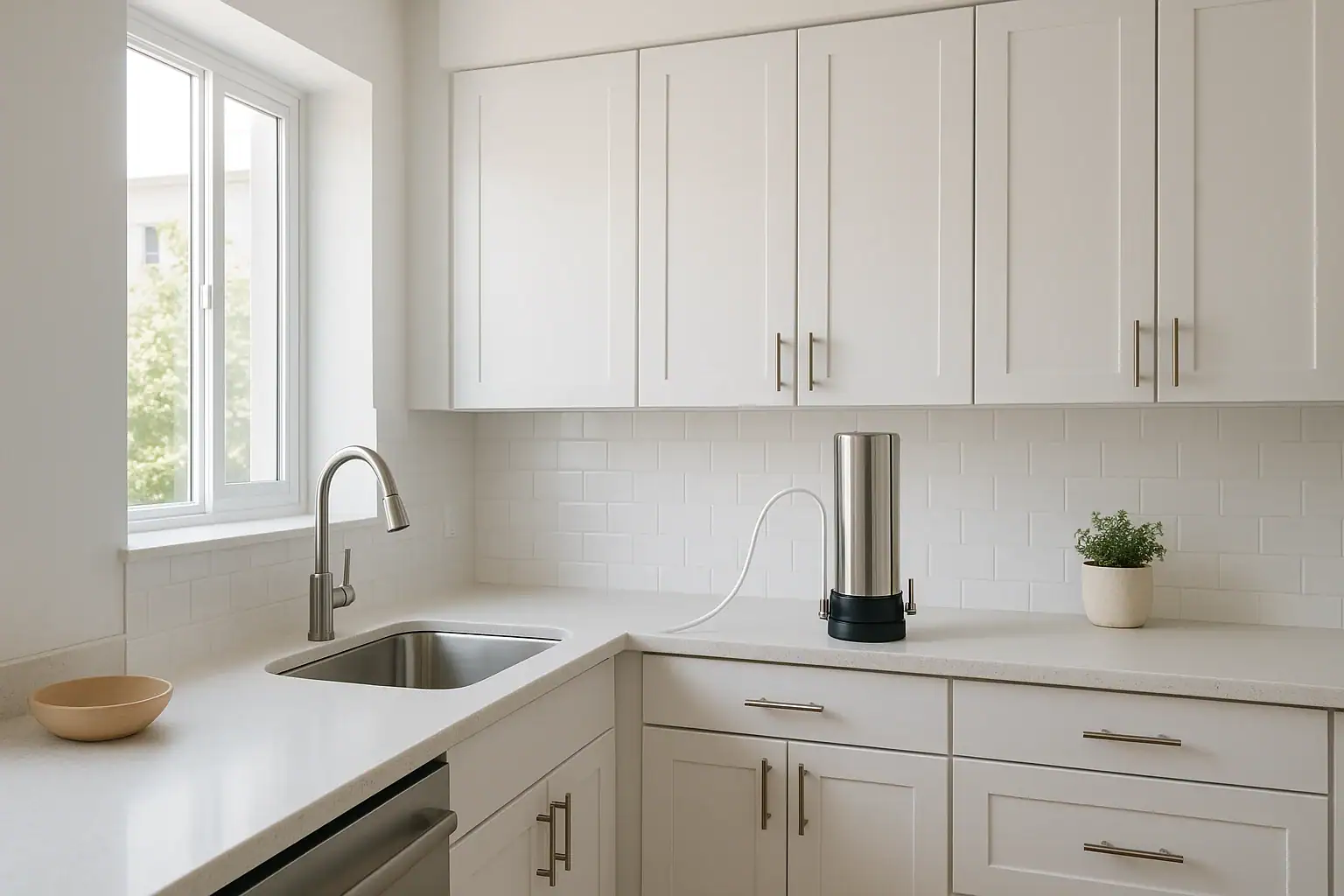
When you rent, you usually cannot drill into cabinets, cut pipes, or install permanent fixtures. Yet you still want cleaner, better-tasting water for drinking, cooking, coffee, and tea. Countertop water filters that require no plumbing changes are a practical solution. They sit on your counter, connect in seconds or work entirely on their own, and move with you when your lease is up.
On this page(click to collapse)
- Why Countertop Water Filters Are Ideal for Renters
- Types of Countertop Water Filters With No Plumbing Required
- Key Features to Look For in a Countertop Water Filter
- Best-For Guide: Matching a Countertop Filter to Your Situation
- How to Check Your Tap Water Before Choosing a Filter
- Installation Tips for Renters (No Tools, No Damage)
- Maintenance and Filter Replacement
- Countertop Filter vs Bottled Water in a Rental
- How to Choose the Best Countertop Water Filter for Your Rental
- Related guides
This guide focuses on the best types of countertop water filters for renters, especially options that need no tools, no permanent fittings, and no landlord approval. You will learn how these systems work, what contaminants they can reduce, which style fits your kitchen and lifestyle, and how to compare filter performance, cost, and convenience. By the end, you will be able to choose a filter that gives you better water without risking your security deposit.
Why Countertop Water Filters Are Ideal for Renters
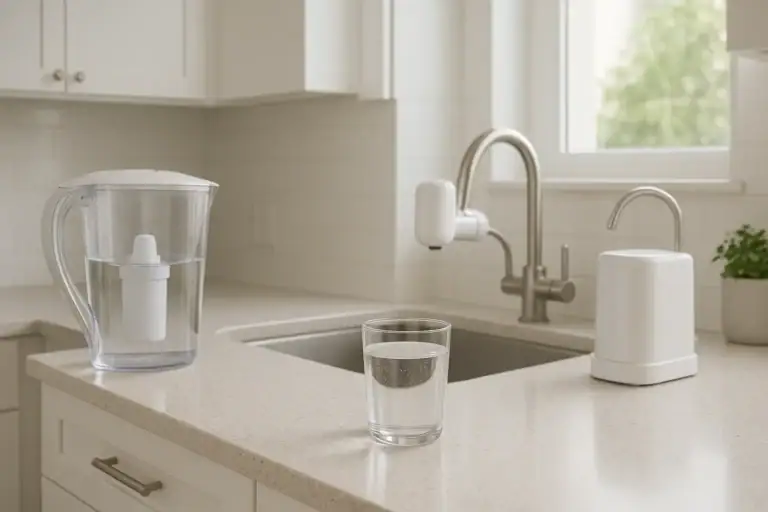
Countertop filters are designed to sit on your kitchen counter or beside the sink. Many are completely independent units, while others connect temporarily to the faucet. For renters, they solve some common problems.
Key benefits for renters
- No permanent changes: No drilling, no cutting pipes, and no special valves. You can install and remove them without leaving a trace.
- Portable: When you move, you simply pack the filter and take it to your next place.
- Fast setup: Most systems set up in minutes, often without tools.
- Better taste: Filters can reduce chlorine, sediment, and off-flavors that make tap water taste and smell unpleasant.
- Cost control: You avoid the ongoing cost and waste of bottled water, while keeping up-front costs lower than many under-sink systems.
Because they are not hard-plumbed, countertop filters are also easier to troubleshoot, clean, and replace. This flexibility is especially valuable if your building has older plumbing or if you are unsure about long-term water quality.
Types of Countertop Water Filters With No Plumbing Required
Not all countertop filters work the same way. Understanding the main types will help you choose the best fit for your kitchen layout and daily routine.
1. Gravity-fed countertop water filters
Gravity-fed systems use the force of gravity to pull water through filter media from an upper chamber into a lower chamber. You pour tap water into the top, and filtered water collects in the bottom.
Best for: Renters who want a standalone system with no faucet connection at all.
Pros:
- No hookup to the sink or plumbing
- Can be placed anywhere on the counter or even on a cart
- Works during short water pressure drops if you pre-fill the top chamber
- Often has large capacity for families or heavy water use
Cons:
- Takes up more vertical space on the counter
- Filtration can be slower than direct-flow systems
- You must manually refill the upper chamber
2. Faucet-connection countertop filters (quick-connect)
These filters sit on the counter and connect to your kitchen faucet using a small diverter valve. You pull a knob or switch on the diverter to send water through the filter instead of straight out of the faucet.
Best for: Renters who want on-demand filtered water directly from the faucet with minimal effort.
Pros:
- Very convenient for filling pots, bottles, and coffee makers
- Instant filtration when you turn on the tap and engage the diverter
- No permanent plumbing changes; diverter screws on and off
- Often faster flow than gravity systems
Cons:
- Not compatible with some pull-down or specialty faucets
- Diverter and hose may clutter the sink area
- Requires enough faucet thread length for the adapter
3. Countertop dispenser filters (pitcher-style or tank-style)
These systems work similarly to a large filtered pitcher. You fill a top reservoir, water passes through the filter, and you dispense it from a spigot or by pouring.
Best for: Small households, office nooks, or renters with very limited sink access.
Pros:
- Completely independent of the faucet
- Flexible placement on counters, side tables, or refrigerator shelves (for some models)
- Simple design and easy to understand
Cons:
- Smaller capacity than many gravity systems
- Requires frequent refilling in busy households
- Some designs filter more slowly as the filter ages
4. Electric countertop filtration systems
Some countertop units plug into an outlet and use an internal pump or powered filtration process. Certain designs may include advanced stages or compact reverse osmosis technology that drains into the sink without permanent plumbing.
Best for: Renters who want high-performance filtration and are comfortable using a powered appliance on the counter.
Pros:
- Can offer multi-stage filtration in a compact design
- Often includes digital indicators for filter life
- Some models provide filtered water on demand at the push of a button
Cons:
- Requires outlet space on the counter
- Generally higher up-front cost
- More parts to maintain compared with simple gravity systems
Key Features to Look For in a Countertop Water Filter
Once you know which style you prefer, compare specific features to find the best countertop water filter for your rental kitchen.
1. Filter performance and certifications
Not all filters target the same contaminants. Look for systems that clearly state what they are designed to reduce, and whether they have independent testing or certification.
- Chlorine and taste/odor: Almost all countertop filters should reduce chlorine and improve taste.
- Sediment and rust: Important if your building has older pipes or visible particles in the water.
- Lead and heavy metals: Critical for older buildings or areas with known issues.
- Volatile organic compounds (VOCs): May be present from industrial or agricultural sources.
- Microbial cysts: Some advanced filters target certain biological contaminants.
Check for clear performance data, such as independent lab testing or recognized standards. Look for detailed contaminant reduction claims rather than vague promises.
2. Filter media type
The internal filter media largely determines what the system can do.
- Activated carbon: Common and effective for chlorine, taste, and many chemicals.
- Carbon block: A more densely packed form that can offer finer filtration.
- Ion exchange resins: Used to target specific metals or minerals.
- Hollow fiber or microfiltration: Designed to physically block small particles and some microorganisms.
- Multi-stage combinations: Many countertop filters combine several media types for broader coverage.
3. Flow rate and capacity
Flow rate affects how quickly you can fill glasses and pots. Capacity refers to how much water a filter can treat before replacement.
- Flow rate: For faucet-connected units, look for a balance between speed and thorough filtration. Gravity systems naturally run slower.
- Daily use: Estimate how many gallons per day you need for drinking, cooking, and pets.
- Filter lifespan: Longer-lasting filters can reduce hassle and long-term cost.
4. Size and counter space
In many rentals, counter space is limited. Measure your available area and consider:
- Height: Will it fit under upper cabinets?
- Footprint: Does it leave room for food prep and small appliances?
- Weight when full: Larger gravity systems can be heavy when loaded with water.
5. Ease of installation and removal
For renters, installation must be simple and fully reversible.
- Tool-free setup: Most renter-friendly systems should not require wrenches or drilling.
- Quick-connect diverters: For faucet units, check that adapters are included for standard faucets.
- Clear instructions: Diagrams, labels, and online videos can make setup easier.
6. Ongoing filter costs
The initial price is only part of the total cost. Replacement filters are where you will spend most of your budget over time.
- Compare the gallons per filter and the price per replacement.
- Calculate an approximate cost per gallon for a realistic view.
- Check how easy it is to order filters and whether they are widely available.
Best-For Guide: Matching a Countertop Filter to Your Situation
The best countertop water filter for renters with no plumbing changes depends on your space, water quality, and habits. Use this section to match your needs with the right style.
Best for small apartments and studio kitchens
In very small kitchens, every inch of counter space matters.
- Choose a compact faucet-connected unit or a slim dispenser-style filter.
- Look for a small footprint and vertical design.
- Prioritize simple hose routing that does not block your sink.
Best for families and high water use
Larger households, home cooks, and those who drink a lot of water each day need more capacity.
- Consider a large gravity-fed countertop system with a generous storage tank.
- Look for high filter capacity to reduce how often you change cartridges.
- Choose a design with an easy-to-use spigot for kids and guests.
Best for renters with older plumbing
If your building has older pipes, you may be concerned about metals, rust, or other contaminants.
- Look for filters that specifically address lead, heavy metals, and sediment.
- Choose a system with multi-stage filtration, including sediment pre-filtration.
- Gravity-fed or standalone dispenser systems avoid stressing old faucet threads.
Best for coffee and tea lovers
Water quality has a noticeable impact on coffee and tea flavor.
- Choose a filter that targets chlorine, taste, and odor at a minimum.
- Consider a faucet-connected system for quick pot filling.
- Look for filters that maintain a balanced mineral profile rather than stripping everything out.
Best for frequent movers
If you move often for school, work, or military service, portability is crucial.
- Pick a lightweight, self-contained unit that packs easily.
- Choose a design with simple, universal connections or no faucet connection at all.
- Keep original packaging or a dedicated box for safe transport.
Best for renters concerned about a wide range of contaminants
Some renters want the broadest possible coverage for peace of mind.
- Look for multi-stage systems that combine several media types.
- Consider advanced countertop units that offer fine filtration while still avoiding permanent plumbing.
- Review independent test data and detailed contaminant lists before buying.
How to Check Your Tap Water Before Choosing a Filter
The best countertop water filter for your rental depends partly on what is in your local water. A little research can help you match the filter to your needs.
Steps to understand your water quality
- Review your local water report: Public utilities publish annual water quality reports that list common contaminants and treatment methods.
- Consider an at-home test kit: Basic kits can give you a snapshot of hardness, chlorine, and some metals.
- Observe taste, smell, and appearance: Cloudiness, metallic taste, or strong chlorine odor are useful clues.
- Ask neighbors or building management: They may know of past plumbing issues or upgrades.
Once you have a general idea of your water quality, choose a filter that clearly addresses the concerns that matter most to you, whether that is chlorine, metals, or other contaminants.
Installation Tips for Renters (No Tools, No Damage)
Most countertop water filters designed for renters are easy to install and remove. Still, a few practical steps can make the process smoother and protect your security deposit.
For faucet-connected countertop filters
- Check faucet compatibility: Before buying, confirm that your faucet has removable aerator threads and is not a pull-down sprayer.
- Use included adapters: Many systems come with several adapters for different faucet sizes. Test them gently before fully tightening.
- Avoid overtightening: Hand-tight is usually enough. Over-tightening can damage threads or make removal difficult later.
- Protect finishes: If you are concerned about scratches, place a soft cloth between metal parts and decorative finishes while you test-fit.
For gravity-fed and dispenser-style filters
- Choose a stable, level surface: A full tank of water can be heavy, so pick a sturdy counter or cart.
- Leave clearance for refilling: Make sure you can easily lift lids or remove containers for cleaning.
- Use a tray or mat: A small tray under the unit helps catch minor drips and protects the countertop.
Maintenance and Filter Replacement
Any water filter is only as good as its maintenance. Fortunately, countertop systems are usually straightforward to care for, which suits busy renters.
Routine cleaning
- Wash exterior surfaces with mild soap and water as needed.
- Clean reservoirs and tanks periodically to prevent buildup.
- Avoid harsh abrasives that can scratch plastic or metal finishes.
Replacing filters on time
- Follow the manufacturer’s recommended gallon or time limit, whichever comes first.
- Mark replacement dates on a calendar or set a reminder on your phone.
- Order replacement filters before the old one expires to avoid gaps in filtration.
Signs it is time for a new filter
- Noticeable drop in flow rate that does not improve after basic cleaning
- Return of chlorine taste or odor
- Discoloration or unusual taste in the water
Countertop Filter vs Bottled Water in a Rental
Many renters rely on bottled water because it seems simple, but countertop filters often offer clear advantages.
Cost comparison
- Bottled water: Costs add up quickly for individuals and families, especially if you prefer larger jugs or premium brands.
- Countertop filters: Higher initial cost, but lower cost per gallon over time, especially with long-life cartridges.
Convenience and storage
- Bottled water: Requires storage space for full bottles and recycling or disposal for empties.
- Countertop filters: Take some counter space but eliminate heavy lifting and frequent store trips.
Environmental impact
- Countertop filters reduce plastic waste and the environmental footprint of transporting bottled water.
How to Choose the Best Countertop Water Filter for Your Rental
To narrow down your options, walk through this simple decision process:
- Confirm your priorities: Is your main goal better taste, broad contaminant reduction, or cost savings?
- Measure your space: Decide whether a faucet-connected unit or a standalone gravity system fits better.
- Check faucet style: If you have a pull-down sprayer or unusual faucet, lean toward standalone systems.
- Review water quality: Use reports and basic tests to identify key contaminants of concern.
- Compare long-term costs: Look at both the initial price and replacement filter costs over one to three years.
- Plan for moving: If you expect to move soon, favor portable, easy-to-pack designs.
By following these steps, you can confidently select a countertop water filter that improves your everyday water while respecting rental limits and your budget.
Recommended next:
Related posts
Browse this topic →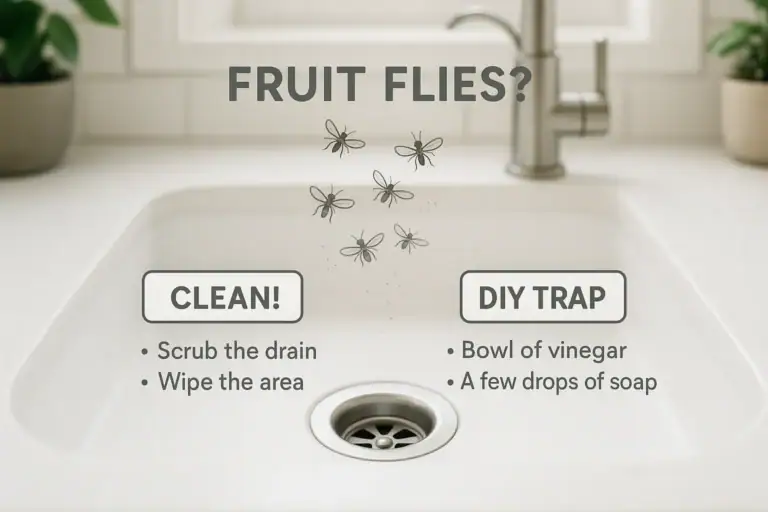
Fruit Flies in Sink Drain: Prevention, Traps, and Troubleshooting Tips
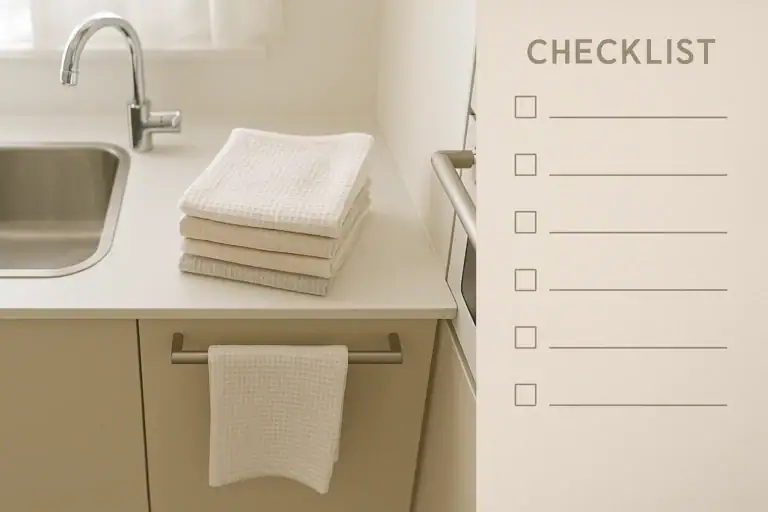
Kitchen Towel Hygiene: A Practical Checklist for Rotation and Washing Habits
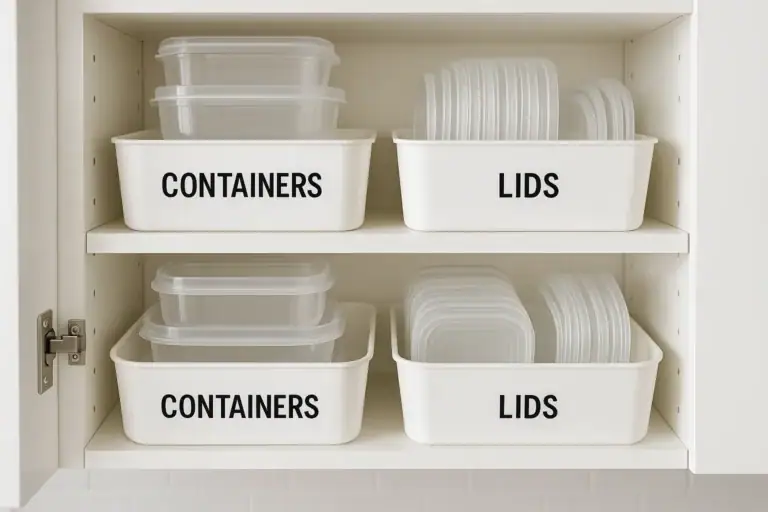
Food Storage Container Organization and Stain Removal Made Simple
How to Set Up a Pantry Inventory System with FIFO for Busy Kitchens
Condensation Inside Your Refrigerator: Causes, Fixes, and Prevention
Refrigerator Temperature Zones: A Food Safety Guide for Every Shelf
Keep reading
About this site
Signature Home Guide publishes practical, independent home guides. We aim to be clear, helpful, and transparent.
Affiliate disclosure
As an Amazon Associate, we earn from qualifying purchases. Some links on this site may be affiliate links. If you buy through these links, we may earn a small commission at no extra cost to you. This helps support our content. Learn more.