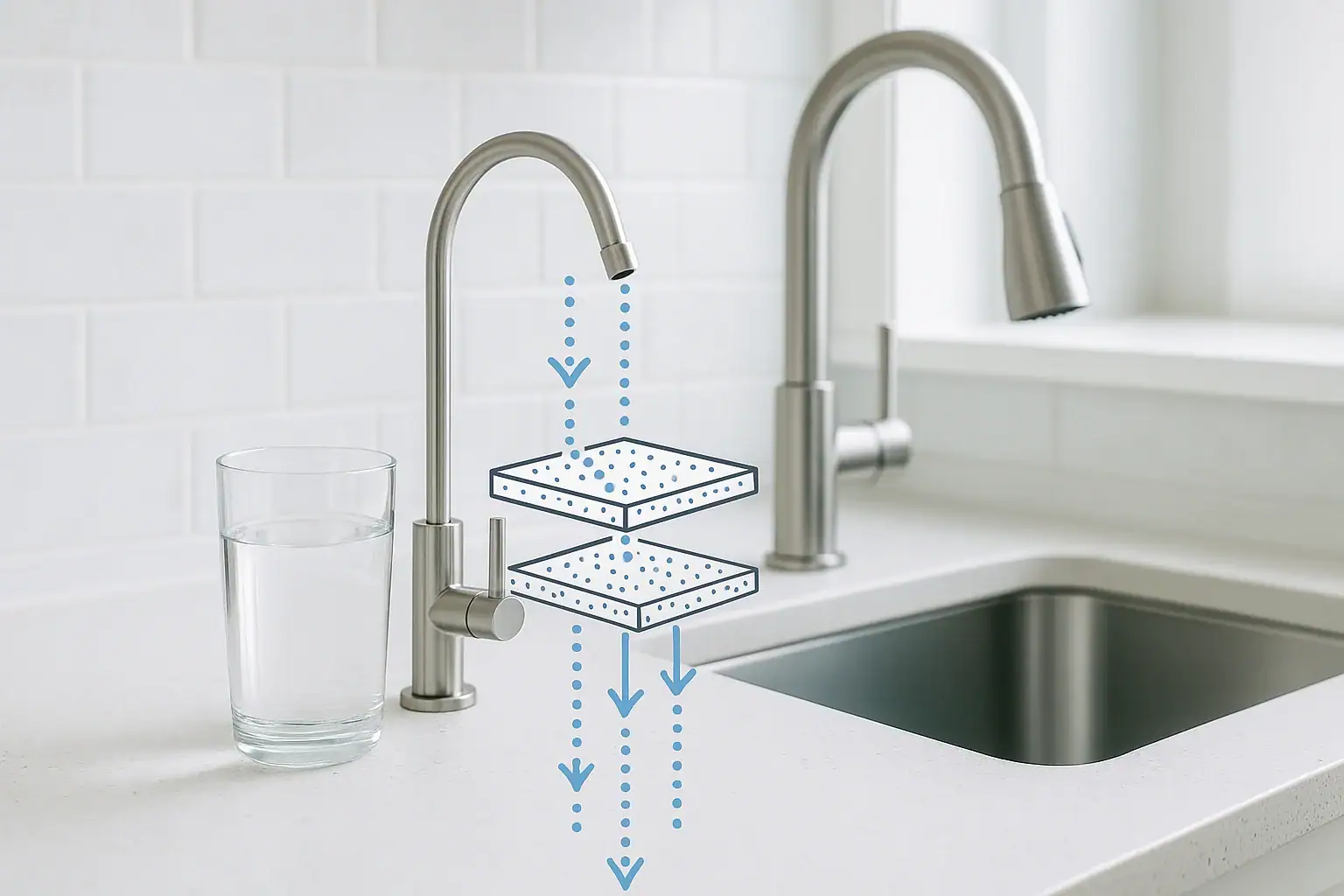
Reverse osmosis is one of the most common ways people in the United States filter their tap water at home. You see it mentioned in under-sink filters, countertop systems, and even some refrigerators. But many homeowners are not quite sure what reverse osmosis actually does, what it removes, and what it leaves behind. Understanding these basics can help you decide if it is the right option for your kitchen and your household.
This guide walks through how reverse osmosis works in plain language, which contaminants it is good at reducing, where its limits are, and how it compares with other types of filtration. You will also learn about minerals, pH, and taste, plus a few practical tips for choosing and caring for a system. By the end, you should feel more confident reading water filter labels and asking the right questions before you install anything under your sink.
What Is Reverse Osmosis?
Reverse osmosis, often shortened to RO, is a type of water treatment that uses a very fine membrane to separate water from many dissolved substances. The membrane has tiny pores that allow water molecules to pass through while blocking larger particles and many contaminants.
In nature, water tends to move from areas with low dissolved solids to areas with higher dissolved solids through a process called osmosis. Reverse osmosis does the opposite by using pressure to push water through the membrane, leaving much of the dissolved material behind and sending the filtered water to a storage tank or faucet.
At the household level, reverse osmosis is most often used for drinking and cooking water, not for treating all the water in the home. It is commonly installed under the kitchen sink with a small dedicated faucet on the countertop.
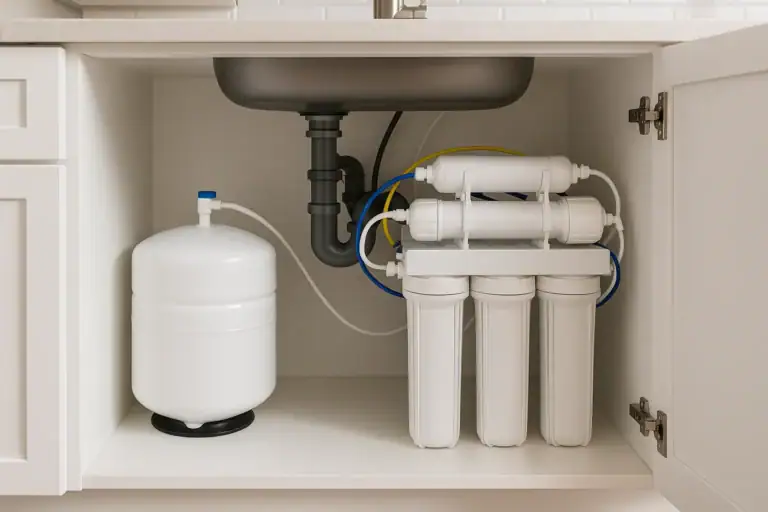
Basic parts of a typical RO system
- Pre-filters: Usually one or more sediment and carbon filters that remove sand, rust, chlorine, and some chemicals before the water reaches the membrane.
- RO membrane: The core component that blocks many dissolved solids, metals, and other contaminants.
- Storage tank: Holds filtered water so it is available on demand.
- Post-filter: Often a carbon filter that polishes the taste before the water reaches your glass.
- Dedicated faucet: A small faucet at the sink that dispenses the filtered water.
How Reverse Osmosis Works Step by Step
While the internal construction can vary, most home reverse osmosis systems follow a similar flow. Understanding the steps makes it easier to know what is being removed at each stage.
1. Pre-filtration
Incoming tap water first passes through one or more pre-filters. These are usually:
- Sediment filters to catch sand, silt, rust, and larger particles.
- Carbon filters to reduce chlorine, chloramine, and some organic chemicals that can damage the membrane or affect taste and odor.
Pre-filtration protects the delicate membrane and helps it last longer.
2. The reverse osmosis membrane
After pre-filtration, water is pushed under pressure through the semi-permeable membrane. The membrane allows water molecules to pass but rejects many dissolved salts, metals, and other contaminants.
The water that passes through the membrane is called permeate (the filtered water). The water that carries away the rejected contaminants is called concentrate or reject water and is typically sent down the drain.
3. Storage and post-filtration
The filtered water is stored in a small pressurized tank until you open the faucet. Before it reaches your glass, it usually passes through a final carbon filter that improves taste and removes any residual odors.
4. Delivery to the faucet
When you open the dedicated faucet, pressure in the storage tank pushes the water out. Some systems also include optional stages such as remineralization cartridges or ultraviolet lights, but these are add-ons rather than core parts of reverse osmosis itself.
What Reverse Osmosis Commonly Removes
Reverse osmosis is known for its ability to reduce a wide range of contaminants. The exact performance depends on the specific system, water pressure, membrane condition, and pre-filters, but in general RO is effective at lowering:
Dissolved salts and total dissolved solids (TDS)
RO membranes are designed to reduce total dissolved solids, which include minerals and salts. If you measure your tap water with a TDS meter, you will usually see a much lower reading after reverse osmosis. This is one reason RO water often tastes smoother or “lighter” than regular tap water.
Many heavy metals
Reverse osmosis can significantly reduce many dissolved metals, such as:
- Lead
- Arsenic
- Chromium
- Copper
- Cadmium
- Mercury
Because these substances can be harmful even at low levels, many homeowners choose RO specifically for this type of protection, especially in older homes or areas with known water quality concerns.
Some fluoride
Many municipalities add fluoride to drinking water. Reverse osmosis membranes can reduce fluoride levels. The amount removed depends on the membrane and system design, but RO is one of the more effective household options for lowering fluoride if that is a priority for your family.
Nitrate and nitrite
In agricultural areas, nitrate and nitrite can enter groundwater from fertilizers and animal waste. Reverse osmosis is often used to reduce these contaminants, which are a particular concern for infants and certain health conditions.
Some organic chemicals
With the help of carbon pre-filters and the membrane, RO systems can reduce many organic chemicals such as certain pesticides, herbicides, and industrial solvents. Performance varies widely depending on the specific compound, so it is important to check system certifications if a particular contaminant is a concern.
Microorganisms (with limitations)
RO membranes can physically block many bacteria and some larger microorganisms due to their small pore size. However, household RO systems are usually not certified as stand-alone disinfection systems. If your water supply is microbiologically unsafe, you may need additional treatment such as disinfection or ultraviolet light.
What Reverse Osmosis Does Not Fully Remove
Despite its strengths, reverse osmosis is not a complete solution for every water quality issue. Some substances are only partially reduced, and others may pass through more easily. Understanding these limits helps you decide if you need extra treatment steps.
Very small or volatile chemicals
Certain small organic molecules and volatile chemicals can be difficult for RO membranes to remove on their own. This is why most systems rely on carbon pre-filters to handle many chemicals that affect taste and odor. If the carbon filters are not replaced on schedule, performance can decline.
All microorganisms
While the membrane can block many bacteria, it is not guaranteed to remove all microorganisms, especially if the system is not properly maintained. If you are dealing with a private well or a known microbiological issue, a separate disinfection step is usually recommended.
Certain dissolved gases
Some dissolved gases, such as a portion of carbon dioxide, can pass through the membrane. These gases can influence the pH of the treated water and may contribute to a slightly more acidic reading compared to the original tap water.
What Reverse Osmosis Leaves Behind
Because reverse osmosis is so effective at reducing total dissolved solids, a common question is, “Does it remove everything?” The answer is no. Some substances remain in the water, and that is not always a bad thing.
Low levels of minerals
RO water usually has much lower mineral content than tap water, but it is rarely completely free of minerals. Small amounts of calcium, magnesium, and other ions can still be present. The amount left behind depends on the original water quality and the efficiency of the membrane.
For most healthy adults who eat a varied diet, the minerals removed by reverse osmosis are a small fraction of total daily intake. However, if you prefer the taste of mineral-rich water, you may notice that RO water tastes flatter or less crisp.
Some harmless dissolved solids
Even after treatment, you may see a small TDS reading if you use a meter. This usually represents low levels of minerals and other dissolved solids that passed through or were picked up from storage tanks and plumbing. A modest TDS reading after RO is normal and does not automatically mean the system is failing.
Trace amounts of certain contaminants
No household system removes 100 percent of every contaminant. Reverse osmosis can greatly reduce many substances, but trace amounts may remain. This is why independent testing and certification are important when you are choosing a system for specific water quality concerns.
RO Water, Minerals, and Health
One of the most debated topics around reverse osmosis is whether removing minerals from water is good or bad for health. It helps to separate taste preferences from nutritional needs.
How much do drinking water minerals matter?
Tap water can contribute some calcium, magnesium, and other minerals, especially in areas with hard water. However, for most people, food is the primary source of these nutrients. The minerals removed by RO usually represent a relatively small portion of daily intake.
That said, if you enjoy the taste of mineral-rich water or follow a diet that is already low in certain nutrients, you may prefer to add minerals back to your water.
Remineralization options
If you want some mineral content in your drinking water, there are several options:
- Remineralization cartridges: Some RO systems include a final stage that adds small amounts of calcium or magnesium for taste and to raise pH slightly.
- Mineral drops or powders: You can add these directly to your water pitcher or glass.
- Mixing with untreated water: Some people blend a portion of filtered water with regular tap water to adjust taste and mineral levels, though this can also reintroduce contaminants.
RO Water Taste, pH, and Cooking
Beyond health questions, many homeowners are simply curious how reverse osmosis will change the way their water tastes and behaves in the kitchen.
Taste and odor
Because RO removes many minerals and chemicals, the water often tastes smoother and less “heavy” than hard tap water. It may also lack the chlorine or musty odors that some people notice from municipal supplies.
However, some find RO water a bit flat. This is often due to the low mineral content. A remineralization stage or a squeeze of lemon can brighten the flavor.
pH and acidity
RO water often tests slightly more acidic than the original tap water, partly because of dissolved carbon dioxide. In most cases, this mild shift in pH is not a concern for healthy individuals. If you prefer a more neutral or slightly alkaline taste, remineralization cartridges can help.
Using RO water for cooking
Many people enjoy using reverse osmosis water for:
- Coffee and tea: Cleaner water can bring out more of the natural flavors.
- Soups and sauces: Reduced off-flavors from chlorine or metals.
- Ice cubes: Clearer ice with fewer cloudy minerals.
- Bread and baking: More consistent results when local tap water quality varies.
Pros and Cons of Reverse Osmosis in the Kitchen
Before installing a system, it helps to weigh the advantages and trade-offs compared with other water treatment options.
Advantages
- Broad contaminant reduction: Effective at lowering many dissolved solids, metals, and certain chemicals.
- Consistent taste: Often improves flavor and odor of drinking and cooking water.
- Convenience: On-demand filtered water at a dedicated faucet.
- Helps with hard water effects: Reduces scale-forming minerals in the water you drink and use in small appliances.
Drawbacks
- Wastewater: Traditional RO systems send some water down the drain as they operate. Newer designs may be more efficient, but there is still some waste.
- Slower flow: Water is produced gradually and stored in a tank, so flow from the faucet is usually slower than regular tap water.
- Maintenance: Filters and membranes must be replaced on schedule to maintain performance.
- Under-sink space: The tank and filters take up cabinet room.
- Lower mineral content: Some people dislike the flatter taste of low-mineral water.
Is Reverse Osmosis Right for Your Home?
Whether reverse osmosis is a good fit depends on your water source, your goals, and your kitchen setup. Asking a few key questions can help you decide.
Questions to consider
- What is in your water now? Have you reviewed your local water quality report or had your well tested?
- Are you mainly concerned about taste, or are there specific contaminants you want to reduce?
- Do you have enough space under the sink for a tank and filters?
- Are you comfortable replacing filters on a schedule or hiring someone to do it?
- How important is mineral content in your drinking water to you?
When RO often makes sense
Reverse osmosis is often a strong option when:
- You want broad reduction of dissolved solids, including many metals.
- You dislike the taste or smell of your tap water.
- You use well water with elevated nitrate, arsenic, or similar concerns.
- You are willing to maintain filters and accept some wastewater in exchange for higher-quality drinking water.
When you might consider alternatives or add-ons
You may want to look at other options, or pair RO with additional treatment, if:
- Your main concern is sediment or basic taste issues that a simple carbon filter can handle.
- You have microbiological contamination that requires dedicated disinfection.
- You strongly prefer mineral-rich water and do not want to use remineralization.
Practical Tips for Choosing and Maintaining an RO System
If you decide that reverse osmosis fits your needs, a few practical steps can help you get better performance and value over time.
Look for clear performance information
When comparing systems, pay attention to:
- Contaminant reduction claims: Check which substances are specifically listed.
- Independent testing or certifications: These can give you more confidence in performance claims.
- Filter and membrane life: Short replacement intervals may increase long-term costs.
- Wastewater ratio: Some systems use less water than others to produce the same amount of filtered water.
Follow a maintenance schedule
Even the best system will not perform well if filters are overdue for replacement. General guidelines often include:
- Replacing sediment and carbon pre-filters every 6 to 12 months, depending on use and water quality.
- Replacing the RO membrane every 2 to 5 years, or as recommended by the manufacturer.
- Sanitizing the storage tank and lines periodically to help control microbial growth.
Always follow the instructions that come with your specific system, since designs vary.
Monitor performance
A simple way to keep an eye on your system is to:
- Notice changes in taste, odor, or flow rate.
- Use a basic TDS meter to compare tap water and RO water readings over time.
- Check for leaks or unusual sounds from the under-sink area.
If something seems off, it may be time to replace filters or have the system inspected.
Bringing It All Together
Reverse osmosis is a powerful tool for improving drinking and cooking water in the kitchen. It works by pushing water through a fine membrane that reduces many dissolved solids, metals, and other contaminants. Along the way, pre-filters and post-filters help protect the membrane and improve taste.
RO is especially strong at lowering total dissolved solids, many heavy metals, and certain chemicals, while leaving behind low levels of minerals and other harmless dissolved solids. It does not remove everything, and it is not a stand-alone solution for every water problem, but it can be an effective part of a broader water quality strategy.
By understanding what reverse osmosis removes, what it leaves behind, and how it fits into your overall kitchen setup, you can make a more informed choice for your home. If you would like to explore how RO compares with other water and kitchen upgrades, you can continue learning through broader home water and kitchen resources such as this water and kitchen hub.
 Reverse Osmosis Tank Not Filling: Step‑By‑Step Fix
 Cloudy Glasses From the Dishwasher: Causes and Simple Fixes
 How to Safely Remove a Stuck Refrigerator Water Filter